
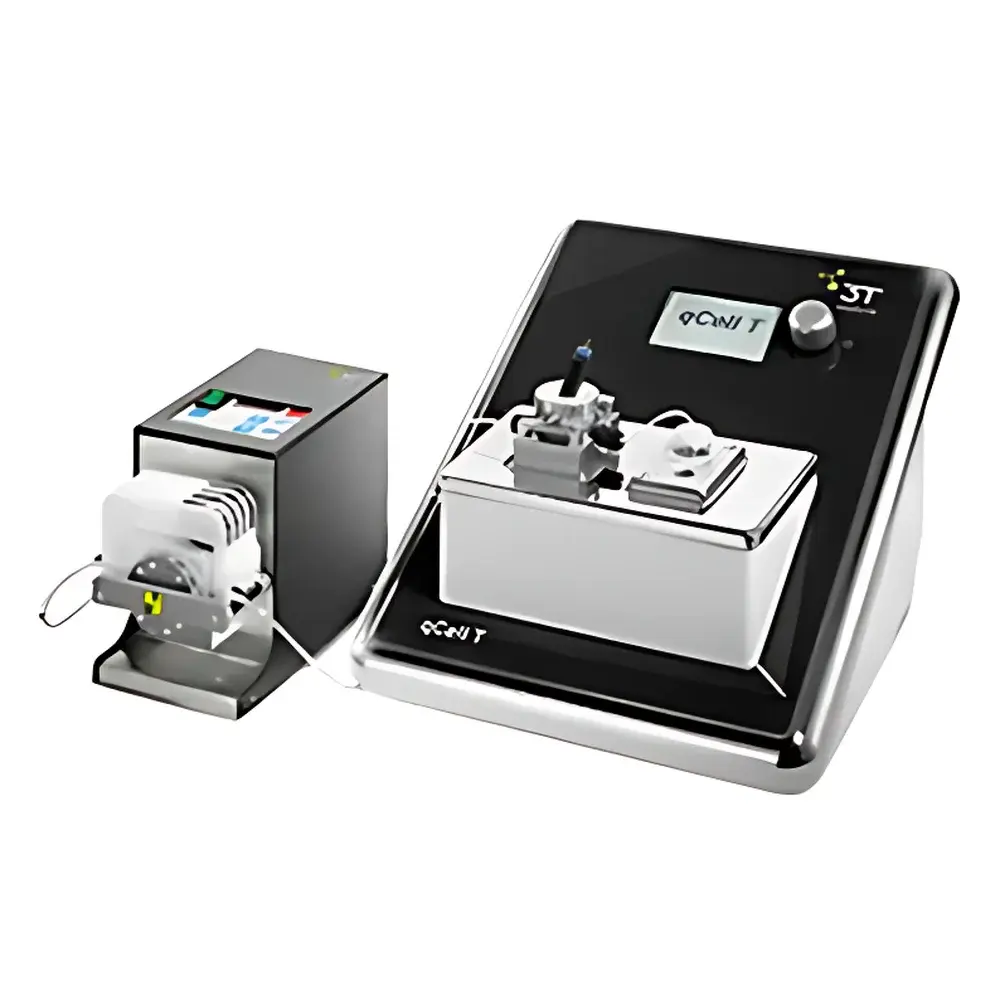
3T analytik qCell T eChem Electrochemical Quartz Crystal Microbalance (QCM-D) System
| Brand | 3T analytik |
|---|---|
| Origin | Germany |
| Model | qCell T eChem |
| Channel Configuration | Single-channel |
| Measurement Modes | Frequency (Δf) and Dissipation (ΔD) |
| Temperature Control | Peltier-driven, ±0.1 °C stability |
| Fluid Handling | Integrated programmable peristaltic pump |
| Software | qGraph qCell T (data acquisition, temperature & flow control), compatible with Metrohm Autolab Nova™ for electrochemical control |
| Compliance | Designed for GLP-compliant environments |
Overview
The 3T analytik qCell T eChem is a purpose-built electrochemical quartz crystal microbalance (EC-QCM-D) system engineered for real-time, label-free monitoring of interfacial mass changes and viscoelastic properties under controlled electrochemical potential or current conditions. Based on the fundamental principle of piezoelectric resonance, the instrument tracks shifts in the resonant frequency (Δf, in Hz) and energy dissipation (ΔD, dimensionless) of an AT-cut quartz sensor crystal (typically 5 MHz) upon mass loading or structural rearrangement at its surface. Unlike conventional QCM systems, the qCell T eChem integrates synchronized electrochemical control—enabling simultaneous application of potentiostatic/galvanostatic stimuli while resolving nanogram-level mass changes (< 0.1 ng/cm² resolution) and quantifying mechanical rigidity of adsorbed layers (e.g., polymer films, biomolecular assemblies, or bacterial biofilms). Its architecture supports rigorous experimental reproducibility across variable ionic strength, pH, and temperature regimes—critical for studies requiring compliance with ISO 17025, ASTM E2916, or USP <1058> analytical instrument qualification guidelines.
Key Features
- Single-channel EC-QCM-D platform optimized for integration with third-party potentiostats (e.g., Metrohm Autolab PGSTAT series) via analog I/O and digital trigger synchronization
- Dual-parameter sensing: Real-time acquisition of frequency shift (Δf) and dissipation factor (ΔD) at up to 100 Hz sampling rate, enabling quantitative modeling of adsorbed layer thickness, shear modulus, and hydration state
- Peltier-based temperature control (range: 4–45 °C) with ±0.1 °C stability and active thermal shielding to minimize convective artifacts during long-term electrochemical experiments
- Integrated peristaltic fluid handling system with programmable flow rates (0.01–1.0 mL/min), bubble detection, and automated rinse/prime sequences—reducing manual intervention and cross-contamination risk
- Patented quartz sensor holder (US8230724B2) ensuring optimal acoustic coupling, minimal stress-induced frequency drift, and rapid chip exchange without recalibration
- Modular hardware design compliant with CE, RoHS, and IEC 61326-1 electromagnetic compatibility standards
Sample Compatibility & Compliance
The qCell T eChem accommodates standard 14 mm diameter QCM sensors (gold-coated, chromium adhesion layer) and supports custom electrode configurations (e.g., three-electrode cells with working, counter, and reference electrodes integrated into the flow cell). It is validated for use with aqueous electrolytes (KCl, PBS, H₂SO₄), organic solvents (acetonitrile, DMF), and complex biological media (serum-supplemented cell culture medium, saliva, wastewater effluents). All firmware and qGraph software versions comply with data integrity requirements outlined in FDA 21 CFR Part 11 when deployed with electronic signature and audit trail modules. Instrument qualification documentation—including Installation Qualification (IQ), Operational Qualification (OQ), and Performance Qualification (PQ) templates—is provided to support GMP/GLP-regulated laboratories.
Software & Data Management
qGraph qCell T serves as the native control and analysis suite, offering intuitive experiment setup, real-time dual-parameter visualization, and automated parameter logging (temperature, flow rate, sensor status). Raw Δf/ΔD time-series data are exported in ASCII or HDF5 format for downstream analysis using Sauerbrey, Voigt, or Maxwell models. When interfaced with Metrohm Nova™ software, electrochemical protocols (cyclic voltammetry, chronoamperometry, impedance spectroscopy) execute in parallel with QCM-D acquisition—time-aligned datasets are merged automatically with microsecond-level timestamp precision. The software architecture supports multi-user role-based access control, encrypted database storage, and version-controlled method files—essential for regulated quality control environments.
Applications
- Electrochemically triggered polymer swelling/deswelling and redox-switchable monolayer assembly
- In situ monitoring of enzyme-catalyzed reactions (e.g., glucose oxidase kinetics) under applied potential
- Real-time assessment of anti-fouling coating performance on biomedical implants under physiological polarization
- Quantitative analysis of electrophoretic deposition dynamics for battery electrode fabrication
- Label-free detection of DNA hybridization or aptamer-target binding with electrochemical signal amplification
- Viscoelastic characterization of electroactive hydrogels during redox cycling
- Corrosion inhibitor film formation kinetics on metal surfaces in chloride-containing electrolytes
- Study of electron-transfer coupled protonation in proton-exchange membrane catalyst layers
FAQ
Can the qCell T eChem operate independently of an external potentiostat?
Yes—the system includes built-in analog voltage/current output channels for basic galvanostatic/potentiostatic control, though full electrochemical method flexibility requires integration with a dedicated potentiostat such as Autolab or Biologic SP-300.
What sensor frequencies are supported?
Standard operation uses 5 MHz AT-cut quartz crystals; custom 10 MHz or 25 MHz sensors can be accommodated with appropriate calibration and driver tuning.
Is temperature calibration traceable to NIST standards?
The integrated Pt1000 sensor is factory-calibrated against NIST-traceable references; optional on-site calibration verification kits are available.
How is data security ensured during long-duration experiments?
qGraph implements automatic incremental backup, write-protected raw data directories, and SHA-256 hash validation for all exported datasets—meeting ALCOA+ principles for data reliability.
Does the system support multi-frequency QCM-D measurements?
No—the qCell T eChem is a single-frequency platform; multi-harmonic analysis requires the higher-tier qCell X series.
Related Products






