
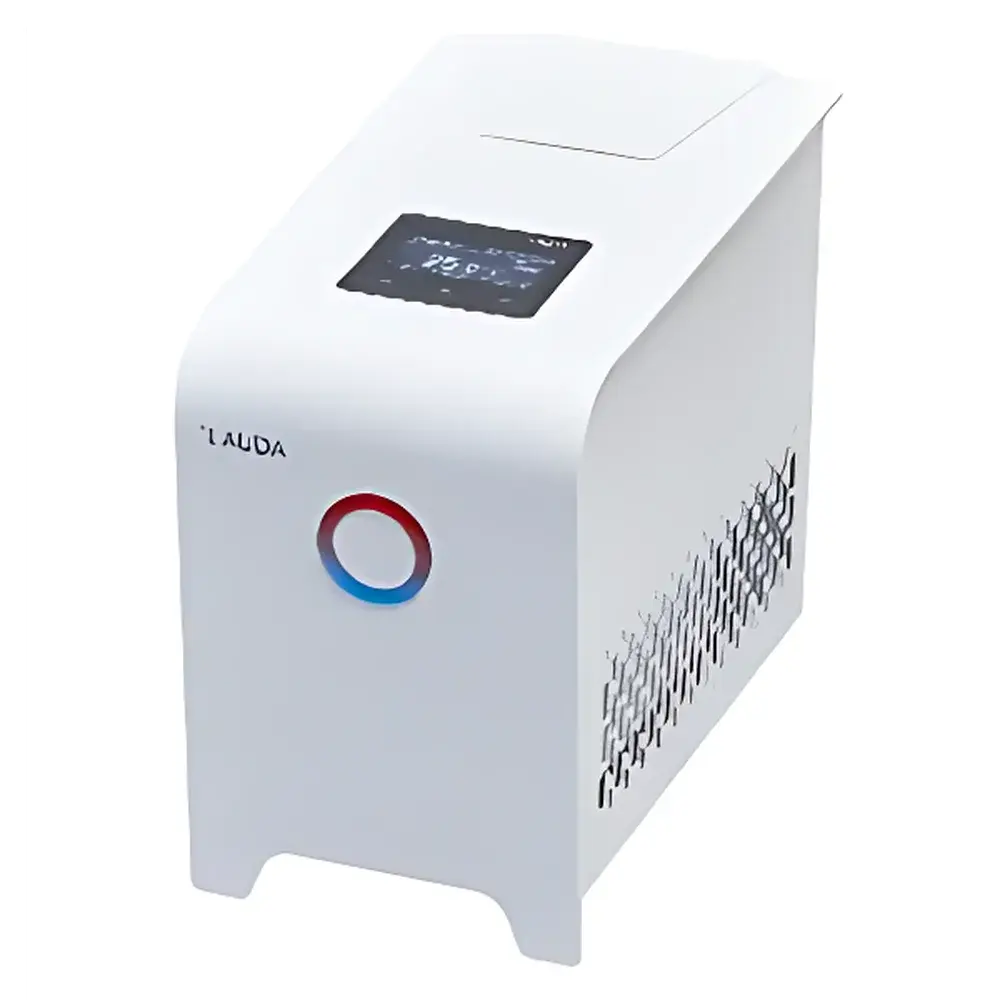
Lauda LOOP Compact Circulating Thermostat
| Brand | LAUDA |
|---|---|
| Origin | Germany |
| Model | LOOP |
| Temperature Range | 4–80 °C |
| Cooling Power | 120 W (L 100), 250 W (L 250) |
| Input Voltage | 100–240 V AC, 50/60 Hz |
| Cooling Method | Refrigerant-free air-cooled system |
| Fluid Compatibility | Non-flammable liquids (e.g., water, water/ethylene glycol mixtures) |
| Display | High-contrast graphical OLED |
| Interface | RS232 |
| User Interface | 3-key soft-touch control |
| Pump Connection | Quick-release fittings |
| Noise Level | Low (typ. <45 dB(A) at partial load) |
| Compliance | CE, RoHS, IEC 61010-1 |
Overview
The Lauda LOOP Compact Circulating Thermostat is an engineered solution for precise, stable temperature control in external applications requiring thermal regulation between 4 °C and 80 °C. Designed and manufactured in Germany, the LOOP series employs a refrigerant-free, air-cooled thermoelectric or fan-assisted cooling architecture—eliminating compressors, refrigerants, and associated maintenance overhead. This architecture delivers high thermal stability (< ±0.05 °C typical at setpoint), low mechanical vibration, and quiet operation (<45 dB(A) under partial-load conditions), making it suitable for integration into sensitive analytical platforms such as spectrophotometers, calorimeters, chromatography modules, and material testing rigs where ambient noise and micro-vibrations must be minimized. Its compact footprint and lightweight construction (L 100: ~12 kg; L 250: ~15 kg) facilitate benchtop deployment in space-constrained laboratories, cleanrooms, or mobile test environments.
Key Features
- Refrigerant-free air-cooling system ensures zero ozone-depleting substances (ODP = 0), no refrigerant leaks, and simplified regulatory compliance for lab safety and environmental audits.
- Wide universal input voltage range (100–240 V AC, 50/60 Hz) enables seamless operation across global laboratory infrastructures without external transformers or voltage converters.
- Graphical OLED display with high contrast and wide viewing angle supports intuitive five-language menu navigation (English, German, French, Spanish, Chinese), reducing operator training time and minimizing misconfiguration risk.
- Three-key soft-touch interface provides tactile feedback and logical hierarchical access to setpoint adjustment, pump speed control, alarm status, and system diagnostics—designed for gloved-hand usability in controlled environments.
- Quick-release pump fittings (DIN 477 or ISO 228/1 compatible) allow rapid reconfiguration between applications—ideal for labs managing multiple instruments or rotating test setups.
- Energy-optimized control logic dynamically adjusts fan speed and thermal output based on real-time load demand, achieving up to 40% lower power consumption during partial-load operation compared to conventional compressor-based thermostats.
Sample Compatibility & Compliance
The LOOP series is validated for use with non-flammable heat-transfer fluids only—including deionized water, aqueous glycol solutions (up to 50% v/v ethylene glycol), and other miscible, low-viscosity, non-corrosive media compliant with DIN 51587 and ASTM D1384 standards. It is not rated for organic solvents, oils, or flammable mixtures. All units comply with IEC 61010-1 (Safety Requirements for Electrical Equipment for Measurement, Control, and Laboratory Use), CE marking directives (EMC 2014/30/EU, LVD 2014/35/EU), and RoHS 2011/65/EU. The absence of refrigerants aligns with F-Gas Regulation (EU) No. 517/2014 reporting requirements and supports institutional sustainability reporting frameworks.
Software & Data Management
Equipped with an RS232 serial interface (3-wire TTL-level), the LOOP thermostat supports bidirectional communication with host systems including LabVIEW, MATLAB, Python-based automation suites, and LIMS-integrated controllers. ASCII protocol documentation is provided for custom script development. While the device does not include onboard data logging memory, its real-time temperature and status outputs (including pump RPM, outlet temperature, and fault codes) can be streamed continuously for time-stamped recording, trend analysis, or integration into GLP/GMP-compliant electronic lab notebooks (ELNs). Optional USB-to-RS232 adapters enable direct PC connectivity for remote monitoring and scheduled setpoint changes—supporting 21 CFR Part 11 audit trail requirements when deployed with validated third-party software.
Applications
- Temperature stabilization of UV-Vis and FTIR spectrometer sample compartments and detector housings
- Cooling/heating of HPLC column ovens and detector flow cells to maintain retention time reproducibility
- Thermal conditioning of rheometer measuring geometries and sample holders
- Controlled-temperature feed loops for electrochemical cells and battery cycling test stations
- Environmental simulation for accelerated aging tests of polymers and adhesives per ISO 4892-2
- Calibration bath support for thermometer and RTD verification in metrology labs (traceable to national standards via external reference sensors)
FAQ
What fluids are approved for use with the Lauda LOOP series?
Only non-flammable, water-miscible heat-transfer fluids are permitted—specifically deionized water, aqueous ethylene glycol solutions (≤50% v/v), and other low-conductivity, low-viscosity fluids meeting DIN 51587 Class A specifications.
Does the LOOP require refrigerant servicing or periodic compressor maintenance?
No. The LOOP uses a solid-state, refrigerant-free air-cooling system with no moving parts beyond low-noise fans and a centrifugal circulation pump—eliminating scheduled refrigerant checks, oil changes, or compressor overhauls.
Can the LOOP be integrated into automated workflows under 21 CFR Part 11?
Yes—when paired with validated third-party software that implements electronic signatures, audit trails, and role-based access control, the RS232 interface enables compliant remote operation and data capture.
Is external calibration required for traceability?
The built-in Pt100 sensor is factory-calibrated; however, users performing ISO/IEC 17025-accredited measurements should perform periodic in-situ verification using an NIST-traceable reference thermometer per ISO/IEC 17025 clause 6.5.
What is the maximum recommended head pressure for the integrated pump?
The pump is rated for continuous operation up to 2.5 bar (36 psi) static pressure; system backpressure must remain below this threshold to ensure flow stability and avoid premature wear.



