
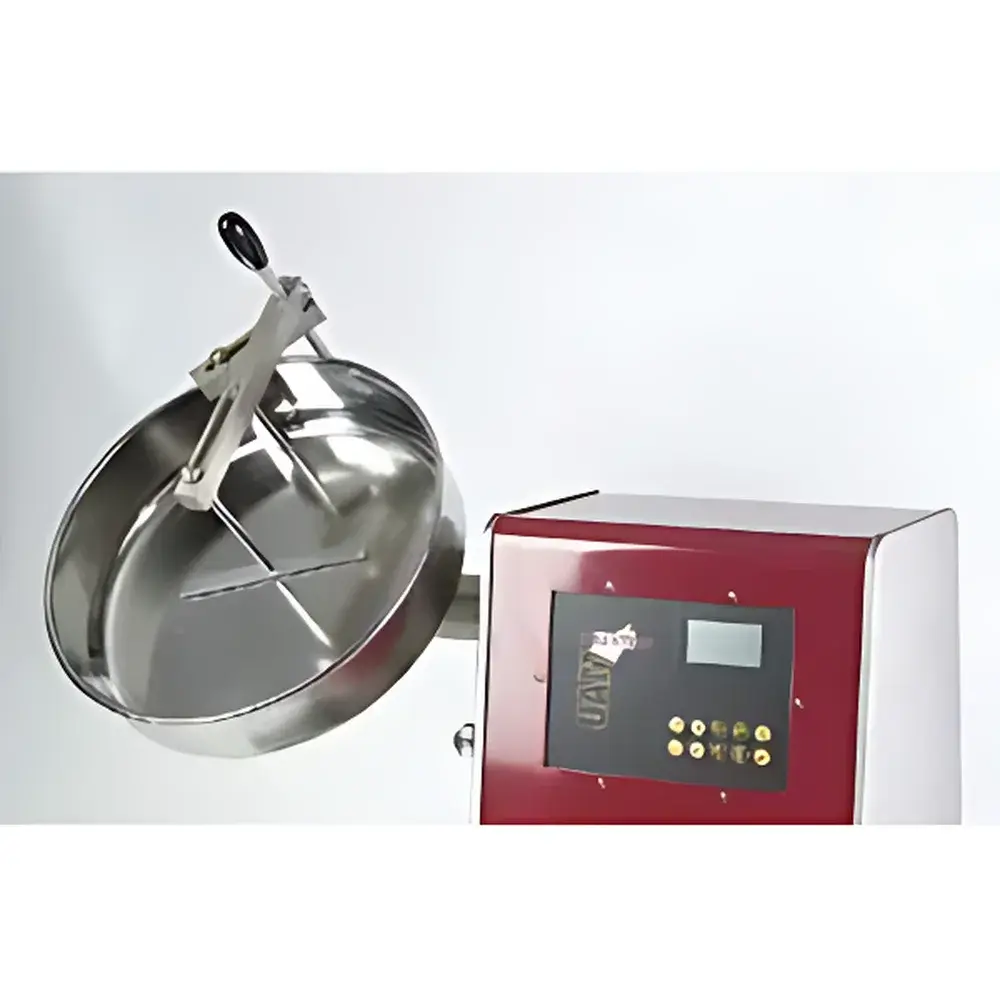
Pharmag Pill Machine P-Series
| Brand | Pharmag |
|---|---|
| Origin | Germany |
| Manufacturer Type | Authorized Distributor |
| Origin Category | Imported |
| Model | P-Series |
| Speed Range | 5–50 rpm |
| Pan Diameter | 400 mm |
| Tilt Angle Adjustment | 0–90° |
| Construction Material | Stainless Steel (AISI 316L) |
| Drive System | Gear-driven, clockwise rotation with UGD precision gearbox |
| Control | Manual mechanical adjustment of speed and tilt angle |
Overview
The Pharmag P-Series Pill Machine is an engineered pharmaceutical granulation and pelletization system designed for the reproducible production of spherical micro-pellets (microspheres), traditional water-based pills (shuǐ wán), and coated multiparticulates in R&D, pilot-scale, and small-batch GMP-compliant manufacturing environments. Based on the principle of centrifugal agglomeration within a rotating, tiltable pan—commonly referred to as a “sugar-coating pan” or “pelletizing drum”—the machine leverages controlled rotational dynamics and gravitational shear to induce nucleation, layering, and densification of powder beds. Its core architecture adheres to European pharmaceutical equipment design conventions, emphasizing cleanability, material compatibility, and mechanical stability under continuous operation. Unlike high-shear wet granulators or fluid-bed processors, the P-Series operates without integrated spray nozzles or hot-air systems; instead, it serves as a dedicated mechanical platform for dry rolling, wet massing, and layering processes when paired with external liquid addition devices (e.g., peristaltic pumps or manual droppers).
Key Features
- Stainless steel pan (AISI 316L) with polished internal surface (Ra ≤ 0.8 µm) for corrosion resistance and ease of cleaning—compliant with EU GMP Annex 15 and ASME BPE surface finish requirements.
- Precision UGD (Universal Gear Drive) transmission system enabling independent, stepless mechanical adjustment of both rotational speed (5–50 rpm) and pan tilt angle (0–90°), ensuring process repeatability across batch sizes from 100 g to 3 kg.
- Robust cast-iron base frame with vibration-damping mounts, minimizing operational resonance and enhancing long-term mechanical alignment integrity.
- Manually operated, non-electronic control interface—eliminating software validation requirements while supporting IQ/OQ protocols under FDA 21 CFR Part 11–exempt workflows.
- Modular mounting configuration compatible with standard laboratory fume hoods and ISO Class 7/8 cleanroom carts via optional stainless steel skid base.
Sample Compatibility & Compliance
The P-Series accommodates a broad spectrum of pharmaceutical excipients and actives, including but not limited to microcrystalline cellulose (MCC), lactose monohydrate, mannitol, hydroxypropyl methylcellulose (HPMC), and herbal powder blends. It supports both aqueous and organic solvent-based agglomeration, provided vapor handling is managed externally. The equipment conforms to EN 61000-6-2 (EMC immunity) and EN 61000-6-4 (EMC emission) standards. While not certified as a Class I medical device, its construction and documentation package—including material traceability certificates (EN 10204 3.1), weld maps, and surface roughness reports—facilitates integration into pharmaceutical quality systems compliant with ICH Q5A, Q5D, and ISO 9001:2015. Full FAT/SAT documentation support is available upon request.
Software & Data Management
The P-Series operates without embedded firmware or digital control units. All operational parameters—speed, tilt angle, run time, and batch identification—are recorded manually in paper-based or electronic batch records (EBR) using validated LIMS or MES platforms. This analog architecture simplifies qualification (IQ/OQ) and eliminates the need for computer system validation (CSV) per FDA Guidance for Industry: General Principles of Software Validation (2002). For users requiring audit trails, optional third-party digital tachometers and inclinometers with 4–20 mA output can be integrated and logged via PLC-connected SCADA systems compliant with 21 CFR Part 11 Annex 11 requirements.
Applications
- Development of immediate-release and sustained-release multiparticulate dosage forms per USP <1151> and Ph. Eur. 2.9.41.
- Scale-down modeling of industrial pan-coating processes for formulation optimization and regulatory filing (e.g., ANDA, MAA).
- Preparation of placebo pellets for dissolution method development and bioequivalence studies.
- Traditional Chinese medicine (TCM) pill manufacturing under GMP-aligned workshop conditions, supporting pharmacopoeial compliance with ChP 2020 General Chapter 0108.
- Academic research in particle engineering, including studies on granule growth mechanisms, binder distribution kinetics, and attrition behavior under variable shear regimes.
FAQ
Is the P-Series suitable for sterile manufacturing?
No—it is intended for non-sterile solid dosage form development and does not include HEPA filtration, steam-in-place (SIP), or autoclave compatibility.
Can the pan be removed for cleaning or replacement?
Yes—the pan is secured via a quick-release flange system and can be detached without tools; spare pans with alternate diameters (300 mm, 500 mm) are available as accessories.
Does Pharmag provide validation documentation?
Yes—Factory Acceptance Test (FAT) reports, dimensional drawings, material certifications, and user requirement specification (URS) response packages are supplied standard with each unit.
What maintenance is required?
Biannual inspection of gear backlash, lubrication of UGD gearbox with ISO VG 68 synthetic oil, and verification of pan concentricity using dial indicator (tolerance ±0.15 mm).
Is technical support available outside Germany?
Yes—authorized distributors provide local installation assistance, operator training, and preventive maintenance contracts aligned with ISO 55001 asset management principles.





