
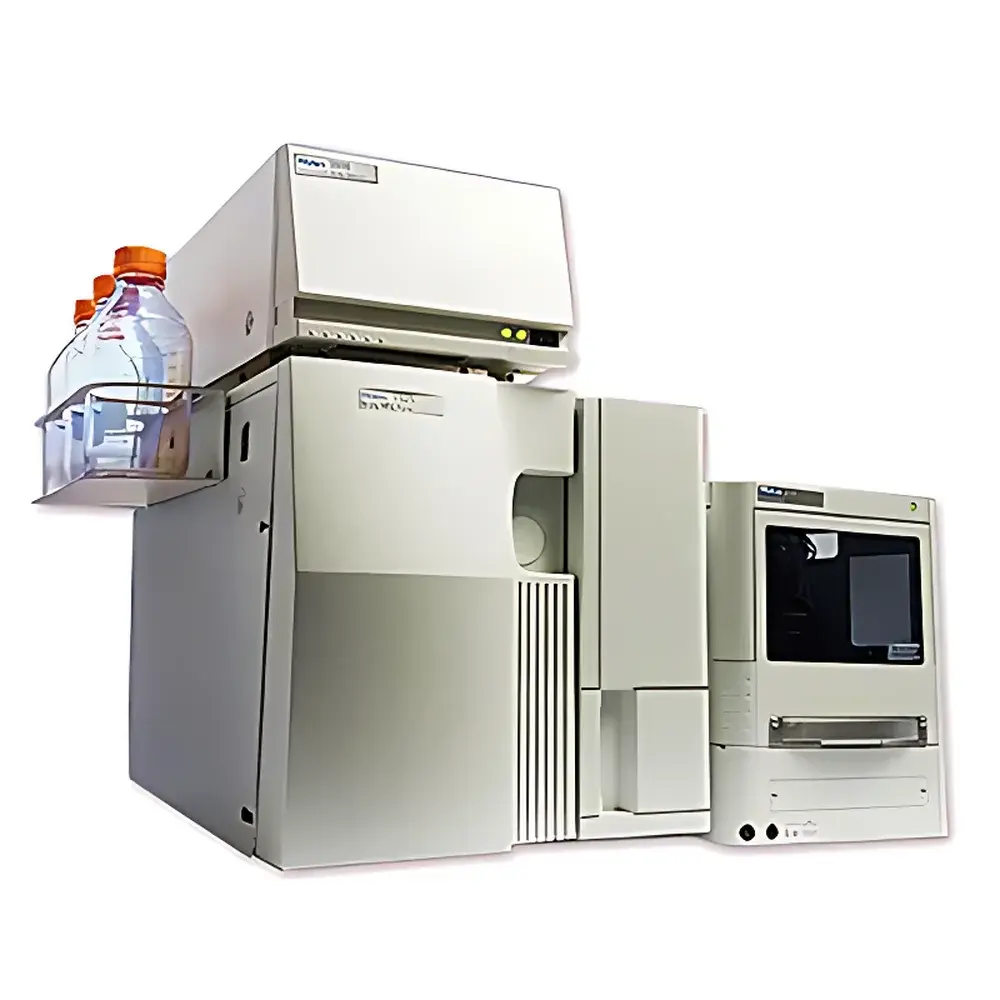
Waters Breeze2 GPC System
| Brand | Waters |
|---|---|
| Model | Breeze2 GPC |
| Origin | USA |
| Instrument Type | Ambient-Temperature SEC System |
| UV Detector Noise | 1.5 × 10⁻⁹ RIU |
| Column Oven Temperature Range | 5 °C above ambient to 60 °C |
| Detection Modes | UV/Vis (2489), Refractive Index (2414) |
| Pump | 1500 Solvent Delivery Module |
| Autosampler | 2707 |
Overview
The Waters Breeze2 GPC System is a dedicated, modular size exclusion chromatography (SEC) platform engineered for precise and reproducible molecular weight distribution (MWD) analysis of synthetic polymers and macromolecules in organic solvents. As a validated ambient-temperature SEC configuration, it implements the fundamental principle of hydrodynamic volume-based separation—where analytes are resolved solely by their effective hydrodynamic radius in solution, independent of chemical interaction with the stationary phase. This non-adsorptive, calibration-dependent technique enables quantitative determination of number-average (Mn), weight-average (Mw), z-average (Mz), and viscosity-average (Mv) molecular weights, as well as dispersity (Đ = Mw/Mn). The system is optimized for routine quality control and R&D applications requiring compliance with ASTM D5296, ISO 16014, and USP guidelines for polymer characterization.
Key Features
- Modular architecture integrating Waters 1500 isocratic pump with low-pressure pulsation (< ±0.1% RSD) and flow accuracy of ±0.2% over 0.01–10.0 mL/min range
- Dual-detection capability: Waters 2489 UV/Vis detector (190–700 nm, variable bandwidth) and 2414 refractive index detector (RIU sensitivity ≤1.5 × 10⁻⁹ RIU, drift <100 µRIU/h)
- Column oven (2410-compatible) maintaining thermal stability from 5 °C above ambient to 60 °C with ±0.1 °C setpoint accuracy and uniformity across dual-column positions
- 2707 autosampler supporting 1–120 sample positions, 1–100 µL injection volumes, and programmable needle wash cycles to minimize carryover
- Robust solvent compatibility with chlorinated (e.g., chloroform, THF), aromatic (e.g., toluene), and polar aprotic (e.g., DMF, NMP) mobile phases—validated per ASTM D5296 protocols
- Pre-configured Breeze2 software with SEC-specific data acquisition, calibration curve generation (linear or cubic spline), and multi-detector overlay analysis
Sample Compatibility & Compliance
The Breeze2 GPC System accommodates a broad spectrum of synthetic and semi-synthetic macromolecules, including polystyrene, poly(methyl methacrylate), polyethylene oxide, polybutadiene, and acrylic copolymers. It supports both narrow- and broad-standard calibration approaches using certified polystyrene or polyethylene glycol reference materials traceable to NIST SRMs. The system meets essential regulatory requirements for laboratory documentation integrity: raw data files include embedded audit trails, user-defined metadata fields, and time-stamped acquisition logs compliant with FDA 21 CFR Part 11 principles when deployed with appropriate network authentication and electronic signature controls. All hardware modules conform to IEC 61010-1 safety standards and electromagnetic compatibility (EMC) directives.
Software & Data Management
Breeze2 Empower Software provides an intuitive, workflow-driven interface tailored for SEC analysts. It enables automated sequence execution, real-time peak tracking, and simultaneous dual-detector chromatogram alignment. Calibration curves are generated using third-order polynomial or linear regression with residual error reporting. Molecular weight distributions are calculated via moment analysis and visualized as differential (dW/dlog M) and cumulative (W(log M)) plots. Data export supports CSV, ASCII, and Waters .arw formats; integration with LIMS is achieved through standard ODBC drivers. All processing parameters—including baseline correction method, noise threshold, and integration event definitions—are saved with each result set to ensure full traceability and method reproducibility across instruments and operators.
Applications
- Quality assurance of polymer feedstocks and finished resins in petrochemical and plastics manufacturing
- Monitoring chain scission or crosslinking during polymer aging, irradiation, or thermal degradation studies
- Characterizing controlled-radical polymerization (CRP) products such as ATRP and RAFT syntheses
- Supporting formulation development for coatings, adhesives, and biomedical hydrogels where rheological behavior correlates directly with MWD
- Validating batch-to-batch consistency in pharmaceutical excipients (e.g., PEGylated proteins, polysorbates) under ICH Q5E guidance
- Academic research in macromolecular engineering, supramolecular chemistry, and stimuli-responsive polymer design
FAQ
What types of solvents are compatible with the Breeze2 GPC system?
THF, chloroform, toluene, o-dichlorobenzene, DMF, and NMP are routinely used; solvent selection must align with column chemistry and detector compatibility.
Can the system be upgraded to include light scattering detection?
Yes—the modular design supports integration of multi-angle light scattering (MALS) or viscometry detectors via auxiliary flow cells and external signal synchronization.
Is method transfer possible from legacy Waters Alliance or ACQUITY systems?
Method parameters (flow rate, temperature, injection volume) are directly translatable; column dimensions and calibration standards require validation per ISO 16014-2 Annex C.
Does the system support GPC analysis in aqueous phase?
While optimized for organic-phase SEC, aqueous operation is feasible using compatible columns and RI/UV detectors—but requires separate column oven and pump seals rated for water-based mobile phases.
How is data integrity maintained during long-duration runs?
The system logs all acquisition events, detector voltage fluctuations, and temperature deviations in real time; raw data files are immutable and digitally signed upon completion.
Related Products




