
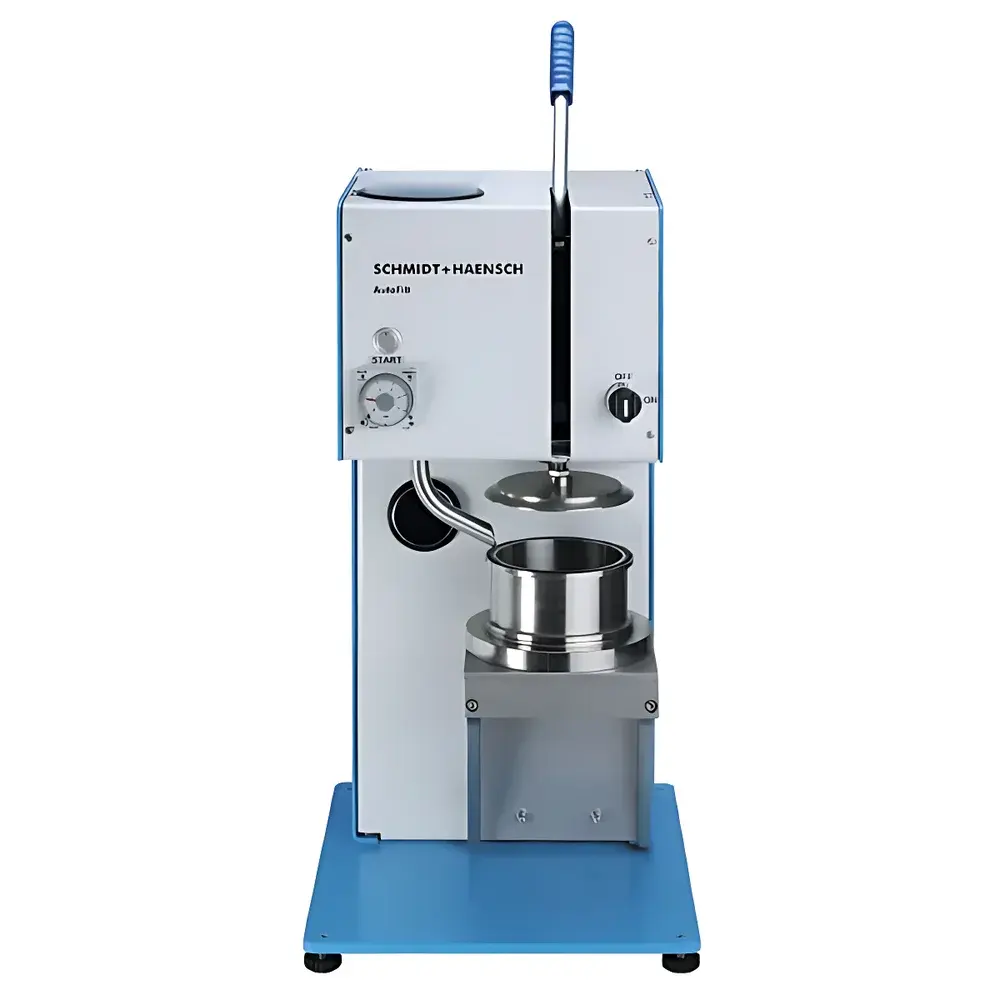
Schmidt + Haensch AutoFilt Automated Filtration System
| Brand | Schmidt + Haensch (S+H) |
|---|---|
| Origin | Germany |
| Manufacturer Type | Authorized Distributor |
| Origin Category | Imported |
| Model | AutoFilt |
| Pricing | Available Upon Request |
Overview
The Schmidt + Haensch AutoFilt Automated Filtration System is a precision-engineered, benchtop pressure-driven filtration instrument designed specifically for demanding analytical workflows in sugar analysis laboratories. It operates on the principle of controlled positive-pressure filtration—using regulated compressed air to drive sample suspension through a standardized filter medium under reproducible conditions. As a dedicated companion system to Schmidt + Haensch’s NIR-based polarimeters and saccharimeters, the AutoFilt addresses a critical bottleneck in sample preparation: the clarification of highly pigmented, suspended-solids-rich raw juices (e.g., beet diffusion juice, cane mill juice) without resorting to toxic clarifying agents such as lead acetate. By replacing chemical clarification with physical filtration under defined pressure and volume parameters, the AutoFilt supports GLP-compliant, environmentally sustainable, and operator-safe laboratory practices aligned with modern food safety and regulatory expectations (including ISO 21508:2020 for sugar analysis and EU Directive 2009/32/EC on food contact substances).
Key Features
- Stainless-steel filtration chamber with integrated pressure-regulated inlet valve, engineered for corrosion resistance and long-term stability in aggressive juice matrices
- Adjustable filtration pressure range: 0.5–5 bar (50–500 kPa), enabling method optimization for varying suspension viscosities and particle loadings
- Precise volumetric control: maximum filtration volume up to 250 mL; calibrated measurement volume of 50 mL for direct optical path compatibility with downstream polarimetric analysis
- Sealed lower outlet design ensuring complete sample containment and preventing cross-contamination or evaporation loss during filtration
- Standardized filter support accommodating 100-mesh (150 µm nominal pore size) filter paper—compatible with widely used qualitative and quantitative cellulose grades (e.g., Whatman Grade 1, Schleicher & Schuell 589/1)
- Integrated environmental monitoring: built-in temperature sensor with operating range +10 °C to +40 °C, ensuring thermal stability during extended batch processing
- Low-power operation: 40 W nominal consumption, compatible with universal AC input (100–240 VAC, 47–63 Hz)
Sample Compatibility & Compliance
The AutoFilt is validated for use with raw, unclarified plant-derived sugar solutions containing high concentrations of non-sugar solids (e.g., pectins, proteins, colloidal particles, and melanoidins). It meets mechanical and material requirements specified in ISO 21508 for polarization-based sucrose determination and supports compliance with EU Regulation (EC) No 1234/2007 Annex IV for sugar quality testing. The system requires oil-free compressed air supply (max. 10 bar, Ø6 mm outer diameter tubing) and utilizes a 16 mm inner diameter waste line for efficient effluent disposal. All wetted parts are constructed from electropolished AISI 316 stainless steel and FDA-compliant elastomers, satisfying USP and EU Pharmacopoeia Chapter 3.1. materials criteria.
Software & Data Management
While the AutoFilt operates as a stand-alone hardware module without embedded microprocessor control, its mechanical repeatability and pressure/volume traceability enable full integration into LIMS- and ELN-managed workflows. Pressure settings, filtration time, ambient temperature, and operator ID can be recorded manually or via optional analog signal output (0–10 V) for connection to external data acquisition systems. The device supports audit-trail-ready documentation per FDA 21 CFR Part 11 when paired with compliant electronic lab notebooks, fulfilling GMP-aligned record retention requirements for QC laboratories in food and beverage manufacturing.
Applications
- Routine clarification of raw beet diffusion juice prior to polarimetric sucrose quantification (ICUMSA Method GS2/3-15)
- Preparation of clarified cane juice samples for Brix and polarization index determination in sugar refineries
- Standardized filtration of molasses and syrup fractions for purity assessment
- Method development for solid-liquid separation in plant extract analysis (e.g., stevia, monk fruit)
- Validation studies supporting replacement of lead-based clarification protocols in accredited food testing labs
FAQ
Is the AutoFilt compatible with automated polarimeters from other manufacturers?
Yes—the 50 mL calibrated filtrate volume and standardized outlet geometry ensure interoperability with any polarimeter requiring a fixed-path, bubble-free sample cell.
Can the filtration pressure be logged in real time?
The base unit does not include digital pressure logging; however, an external pressure transducer (e.g., WIKA S-10) can be installed inline with analog output integration.
What maintenance is required for long-term reliability?
Routine cleaning of the stainless-steel chamber and O-rings with ethanol or dilute nitric acid; annual verification of pressure regulator calibration is recommended.
Does the system comply with RoHS and REACH directives?
Yes—all materials and components conform to EU RoHS Directive 2011/65/EU and REACH Regulation (EC) No 1907/2006, with full declaration of SVHCs available upon request.




