
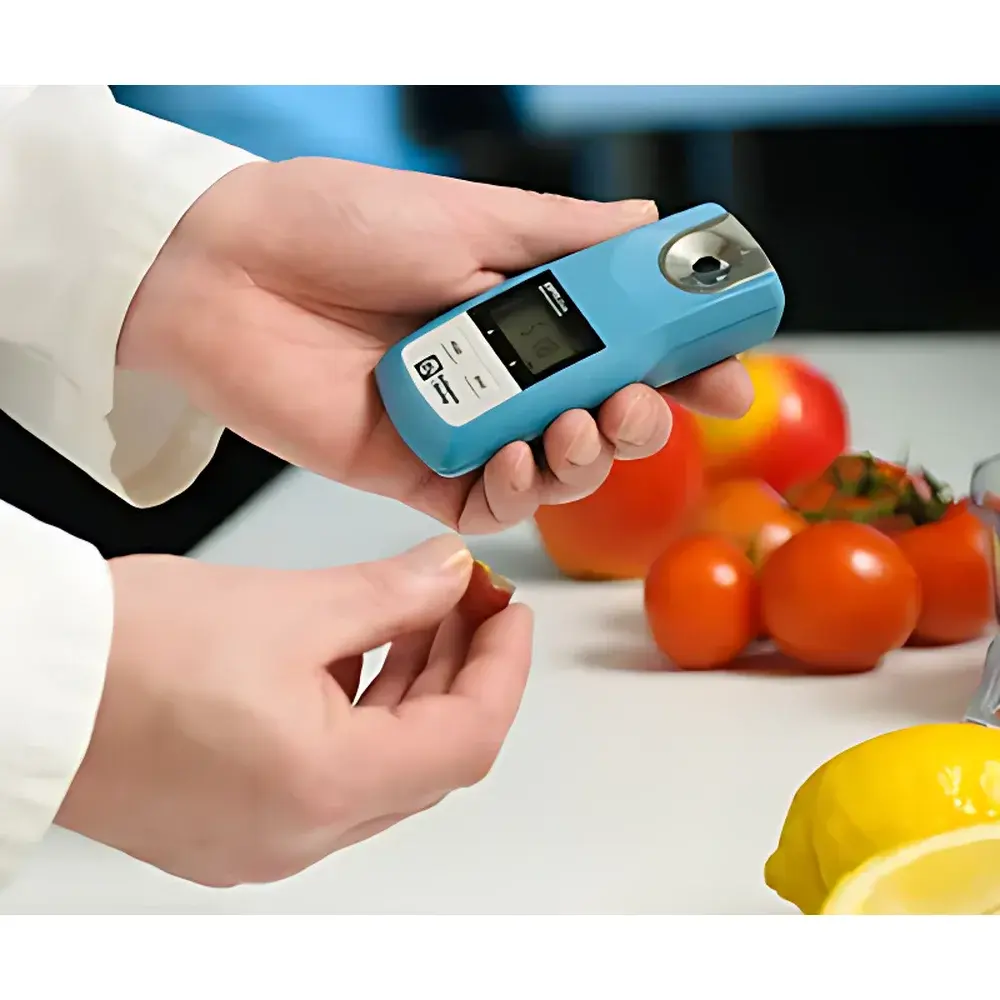
Bellingham + Stanley OPTi Handheld Wine & Brew Refractometer
| Brand | Bellingham + Stanley |
|---|---|
| Origin | United Kingdom |
| Model | OPTi |
| Application | Wine & Beer Quality Control |
| Calibration | Pure Water Zero Point |
| ATC | Yes (Automatic Temperature Compensation) |
| IP Rating | IP65 |
| Prism Design | Shallow, Cleanable, No-Dead-Zone |
| Scale Options | Dual-Scale (A+B) |
| Compliance | BS EN ISO 9001:2000, UKAS, CE |
| Accuracy | ±0.2–±0.5 (varies by scale) |
| Resolution | 0.1–1 unit (scale-dependent) |
Overview
The Bellingham + Stanley OPTi Handheld Wine & Brew Refractometer is a precision optical instrument engineered for rapid, field-deployable measurement of soluble solids and alcohol-related parameters in winemaking and brewing processes. Based on the principle of critical angle refractometry—where the refractive index of a liquid sample is determined by measuring the angle at which light undergoes total internal reflection at the prism-sample interface—the OPTi delivers traceable, repeatable results without requiring laboratory infrastructure. Its optical architecture is optimized for aqueous ethanol solutions, with calibrated scales aligned to internationally recognized enological and brewing standards including Oechsle (Germany/Switzerland), KMW (Babo), °Baumé, ABV (°Zeiss), and Alcohol Probable (AP). Designed for use in high-moisture environments—including fermentation cellars, vineyard sampling points, and brewhouse floors—the OPTi operates reliably under ambient temperature fluctuations thanks to integrated Automatic Temperature Compensation (ATC), eliminating manual correction and reducing operator dependency.
Key Features
- Manufactured in the United Kingdom to Bellingham + Stanley’s century-old optical engineering standards
- Ergonomic, one-handed operation with non-slip grip and balanced weight distribution for extended field use
- Shallow-depth prism chamber minimizes residual sample retention and enables rapid, residue-free cleaning—even with viscous must or wort
- Dual-scale viewing system (A + B) allows simultaneous reading of two correlated parameters (e.g., °Baumé and AP) without recalibration or scale switching
- IP65-rated polycarbonate housing resists corrosion from acidic grape juice, sulfite solutions, and caustic brewery cleaners
- Factory-calibrated against NIST-traceable reference standards; zero-point verification using deionized water only
- No batteries or electronics required—fully mechanical optical design ensures long-term stability and zero drift
Sample Compatibility & Compliance
The OPTi is validated for direct measurement of unfiltered grape must, fermented wine, beer wort, and finished beer—without dilution or thermal equilibration. It accommodates samples with suspended solids up to 5% v/v and ethanol concentrations up to 22% v/v (AP scale) or 135° Zeiss (ABV scale). All OPTi models comply with BS EN ISO 9001:2000 quality management requirements and bear CE marking per EU Directive 2014/30/EU (EMC) and 2014/35/EU (LVD). While not an electronic data-generating device, its measurement methodology supports alignment with GLP and GMP documentation workflows when paired with controlled calibration logs and operator training records. The instrument meets the physical robustness criteria referenced in ASTM D1218–22 (Standard Test Method for Refractive Index of Hydrocarbon Liquids) for field-deployable refractometers used in process monitoring.
Software & Data Management
As a fully analog optical instrument, the OPTi does not incorporate embedded firmware, Bluetooth, or digital output interfaces. This design choice prioritizes metrological integrity, eliminates firmware validation burdens under FDA 21 CFR Part 11, and ensures compliance with environments where electromagnetic interference (EMI) may affect electronic instrumentation. Users record readings manually into paper-based or LIMS-integrated logbooks. For audit readiness, Bellingham + Stanley provides a UKAS-accredited calibration certificate (optional) with documented uncertainty budgets traceable to the National Physical Laboratory (NPL), supporting ISO/IEC 17025–compliant quality systems. Traceability is maintained through unique serial-numbered instruments and factory calibration records retained for 10 years.
Applications
- Real-time monitoring of grape maturity via Oechsle, KMW, or °Baumé during harvest decision-making
- Tracking sugar depletion and alcohol accumulation throughout alcoholic fermentation in red/white wine production
- Verifying target extract levels (°Plato) and estimating final ABV in craft and industrial brewing operations
- Quality gate checks at receiving (grape intake), pressing, blending, and bottling stages
- Field verification of must dilution or chaptalization accuracy prior to fermentation initiation
- Supporting HACCP critical control point (CCP) documentation for sugar content and alcohol potential
FAQ
Is the OPTi suitable for measuring fortified wines with high alcohol content?
Yes—models with the ABV (°Zeiss) scale (e.g.,货号 38-47) are calibrated up to 135° Zeiss, covering fortified wines up to ~22% ABV. Accuracy remains within ±0.5° Zeiss across the full range.
Does the OPTi require periodic recalibration by an external lab?
No. Daily zero-point verification with deionized water is sufficient for routine use. Optional UKAS calibration (every 12 months) is recommended for regulated QC labs operating under ISO 17025 or GMP frameworks.
Can the OPTi be used with turbid or particulate-laden samples?
It is designed for direct use with unfiltered must and wort. However, excessive pulp or hop debris may obscure the shadow line; brief centrifugation or filtration through a 0.45 µm membrane is advised for highly suspended samples.
What maintenance is required beyond cleaning?
No lubrication or alignment adjustment is needed. Prism surfaces should be wiped with lens tissue and isopropyl alcohol after each use. Avoid abrasive cloths or acetone, which may damage anti-reflective coatings.
Is there a version certified for hazardous area use (e.g., ATEX)?
No—its mechanical design excludes ignition sources, but it is not formally ATEX-certified. For Zone 2 environments, consult local safety authority guidance on non-electrical equipment classification.




