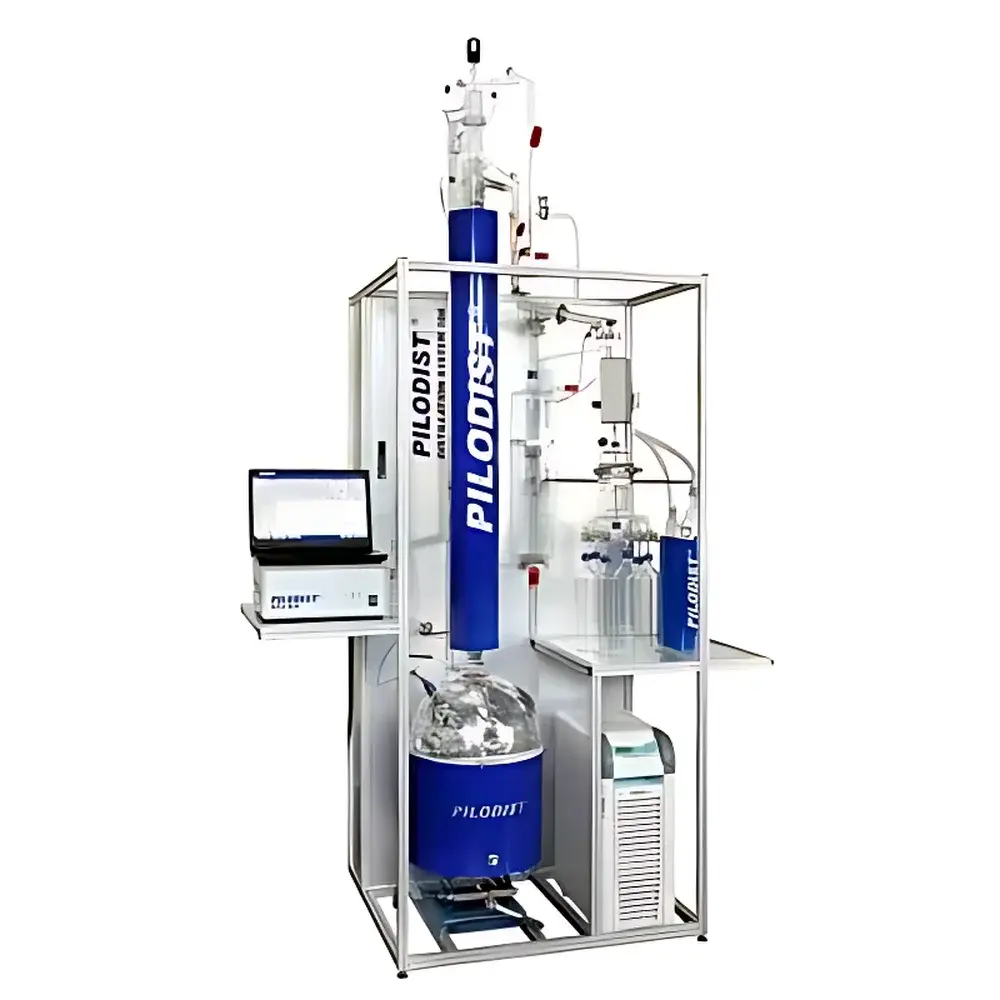
Pilodist PD 104 / PD 107 Precision Batch Distillation & Solvent Recovery System
| Brand | Pilodist |
|---|---|
| Origin | Germany |
| Model | PD 104 / PD 107 |
| Construction | Full Borosilicate Glass (Duran®-grade) |
| Distillation Mode | Batch, Vacuum-to-Atmospheric |
| Theoretical Plates | Up to 90 |
| Minimum Sample Volume | 1 mL |
| Column Type | Concentric-Tube Precision Fractionating Column |
| Vessel Options | 0.05–20 L (Glass or SS) |
| Heating Options | Oil Bath or Electric Heating Mantle |
| Compliance | ASTM D2892, D5236, ISO 9198, IP 123 |
Overview
The Pilodist PD 104 and PD 107 are laboratory-scale, batch-mode precision distillation and solvent recovery systems engineered for high-fidelity separation of thermally sensitive, low-to-medium volatility organic compounds. Designed and manufactured in Germany, these systems operate on the principles of equilibrium-stage vapor–liquid separation under precisely controlled temperature and pressure conditions—enabling reproducible fractional distillation across a wide operational range from atmospheric pressure down to <1 mbar absolute. Unlike conventional packed or plate columns, the core separation element is Pilodist’s proprietary concentric-tube fractionating column—a fused dual-glass cylindrical assembly where ascending vapor flows centrally while descending liquid forms an ultra-thin, uniform film within the annular gap. This geometry ensures minimal pressure drop (<0.5 mbar per theoretical plate), negligible hold-up volume (<0.3 mL), and exceptional mass transfer efficiency—critical for preserving molecular integrity in heat-labile substances such as fatty alcohols (C8–C22), unsaturated fatty acids, rosin esters, essential oils, and bio-based intermediates.
Key Features
- Concentric-tube fractionating column with up to 90 theoretical plates—optimized for high-resolution separation of compounds with boiling point differences as low as 2–5 °C
- Full borosilicate glass (Duran® 3.3) construction—including vessels, condensers, columns, and receivers—eliminates metal contamination and ensures compatibility with aggressive solvents (e.g., DMF, THF, acetonitrile, chloromethane) and corrosive feedstocks
- Vacuum-integrated ground-glass and PTFE-sealed joints—no vacuum grease required; validated for sustained operation at ≤0.1 mbar without leakage or interface degradation
- Modular thermal management: interchangeable heating options include silicone oil bath (up to 250 °C) or programmable electric mantle (with PID-controlled surface temperature and vessel immersion sensing)
- Scalable vessel configuration: 50 mL to 20 L capacity options—glass or stainless-steel釜—with optional magnetic or mechanical stirring, temperature probe ports, and inert gas purging interfaces
- Integrated pressure control system with digital vacuum regulator, capacitance manometer, and automated vent/bleed sequencing for repeatable ramp-and-hold profiles
Sample Compatibility & Compliance
The PD 104/PD 107 system is routinely deployed for ASTM D2892 (true boiling point analysis of petroleum fractions), ASTM D5236 (high-vacuum distillation of heavy hydrocarbons), ISO 9198 (distillation characteristics of lubricants), and IP 123 (solvent recovery efficiency testing). Its all-glass architecture meets GLP requirements for traceability and residue-free operation—particularly critical when processing pharmaceutical intermediates, natural product extracts, or catalyst-sensitive organometallics. The system supports full audit trails when paired with optional data acquisition modules compliant with FDA 21 CFR Part 11 (electronic records/signatures), including timestamped temperature, pressure, reflux ratio, and collected fraction volume logs.
Software & Data Management
While the base PD 104/PD 107 operates via analog instrumentation and manual fraction collection, optional digital integration includes a DIN-rail-mounted PLC controller with HMI touchscreen interface. This module enables programmable distillation sequences (e.g., variable reflux ratio ramping, pressure-step elution, endpoint-triggered fraction switching), real-time graphing of head temperature vs. time/volume, and CSV-exportable datasets aligned to LIMS-compatible metadata schemas. All firmware adheres to IEC 61508 functional safety standards for laboratory process control equipment.
Applications
- Purification of high-value fragrance and flavor compounds (e.g., citral, geraniol, vanillin derivatives) without thermal decomposition
- Recovery and reuse of polar aprotic solvents (DMF, NMP, DMSO) from reaction workups in API synthesis
- Isolation of mono- and di-glycerides from transesterified vegetable oils under mild vacuum
- Removal of residual monomers (e.g., methyl methacrylate, styrene) from polymerization feeds
- Preparative-scale isolation of isomeric fatty acid methyl esters (FAMEs) for biodiesel standard certification
- Distillative cleanup of metal-catalyzed cross-coupling reaction mixtures where stainless-steel contact must be avoided
FAQ
What is the minimum recommended sample volume for reliable separation on the PD 104?
For optimal performance with the concentric-tube column, a minimum of 1 mL is technically feasible—but for method development and reproducibility, ≥5 mL is recommended.
Can the system handle corrosive halogenated solvents such as chloroform or carbon tetrachloride?
Yes—provided appropriate cold trap and exhaust scrubbing are employed; all wetted parts are borosilicate glass or PTFE, with no elastomers or metal seals in the vapor path.
Is validation documentation (IQ/OQ/PQ protocols) available for GMP-regulated environments?
Pilodist provides standardized IQ/OQ templates aligned with ISO/IEC 17025 and ASTM E2500; PQ execution requires site-specific reference standards and certified thermometry.
How is column efficiency verified post-installation?
Efficiency is confirmed using a binary standard mixture (e.g., ethylbenzene/m-xylene) under defined reflux ratio and pressure; plate count is calculated per ASTM D1078 using measured cut-point temperatures and volume yields.
Are spare parts—especially custom-fused glass components—readily available outside Germany?
Yes—Duran®-grade replacement columns, adapters, and receivers are stocked by authorized distributors in North America, UK, and APAC regions with lead times ≤4 weeks; custom geometries require engineering review.