
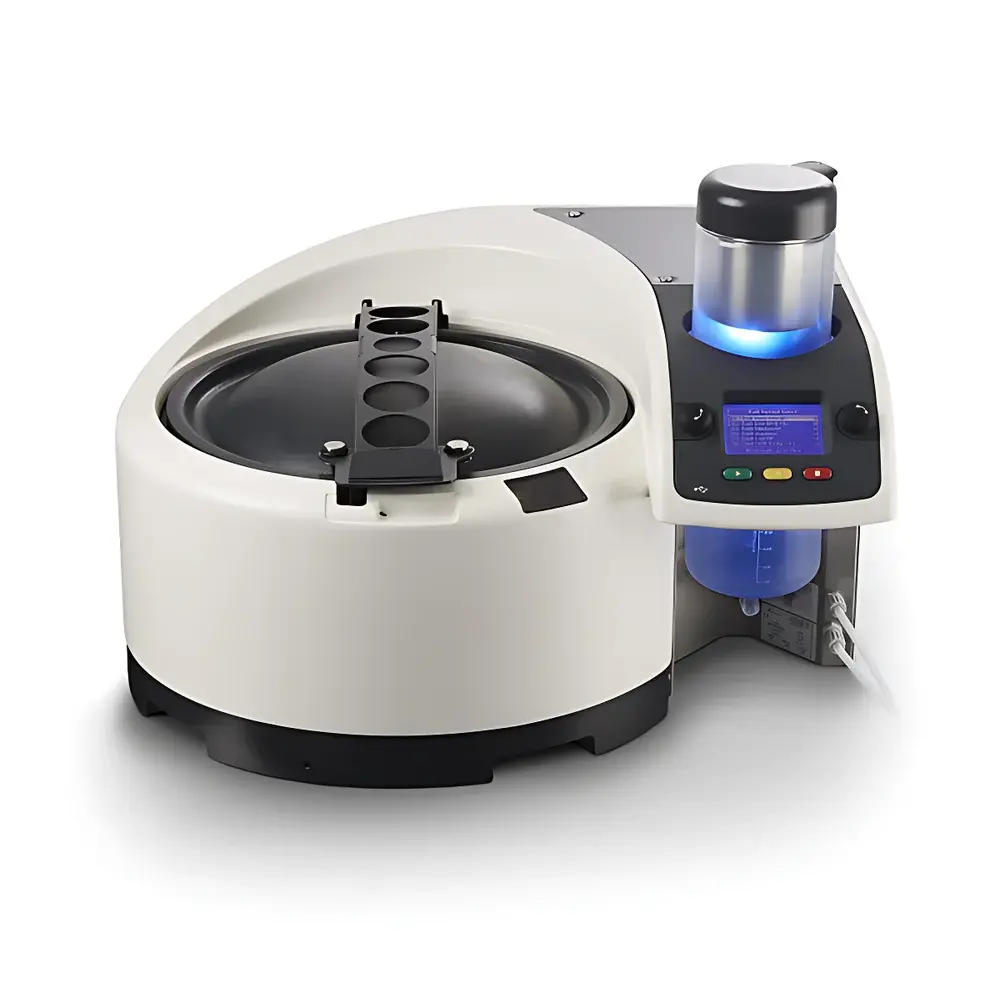
GeneVac Rocket Synergy2 Vacuum Centrifugal Evaporator
| Brand | GeneVac |
|---|---|
| Origin | United Kingdom |
| Model | Rocket Synergy2 |
| Instrument Type | Vacuum Centrifugal Concentrator |
| Temperature Range | +5 °C to 60 °C (±1 °C accuracy) |
| Temperature Control Precision | ±1 °C across 30–80 °C operating band |
| Rotational Speed | 1800 rpm |
| Relative Centrifugal Force (RCF) | 700 × g |
| Maximum Sample Volume per Vessel | 450 mL |
| Standard Capacity | 6 positions (450 mL each) |
| Expandable Capacity | 18 positions with Puck accessory |
| Sample Vessel Options | 60 mL, 250 mL, 400 mL, 450 mL |
| Automated Solvent Addition | Up to 100 L total (via integrated peristaltic dosing module) |
| Ultimate Vacuum | 3 mbar (oil-free PTFE diaphragm pump) |
| Cold Trap | Dual-stage, frost-free, auto-drain capable |
| Real-time Monitoring | Stroboscopic viewing window |
| Programmability | 15 user-storable methods |
| Data Interface | USB for method upload/download and audit log export |
| SampleGenie™ Compatibility | Yes (direct-to-vial concentration & quantitative endpoint control) |
| Dri-Pure® Anti-Bumping Technology | Integrated |
Overview
The GeneVac Rocket Synergy2 is a high-throughput, vacuum-assisted centrifugal evaporator engineered for reproducible, scalable solvent removal from liquid samples in pharmaceutical, analytical, and synthetic chemistry laboratories. Unlike conventional rotary evaporation or nitrogen blow-down systems, the Rocket Synergy2 combines controlled centrifugal force, precise low-temperature steam heating (down to 40 °C), and deep vacuum (3 mbar) to accelerate evaporation kinetics—reducing processing time by up to 5× for medium- to high-boiling-point organic solvents (e.g., DMSO, DMF, ethyl acetate, chloroform, acetonitrile). Its core architecture implements Couette-flow thermal transfer: pressurized water vapor circulates within a sealed heating jacket surrounding rotating sample vessels, enabling uniform radial heat distribution without direct contact or hot surfaces. This principle ensures minimal thermal stress on thermolabile analytes while maintaining consistent solvent removal rates across all positions.
Key Features
- Parallel processing of up to six 450 mL samples simultaneously—with optional Puck accessory expanding capacity to 18 positions for high-volume screening workflows.
- Integrated SampleGenie™ technology enables direct concentration or lyophilization into GC vials, HPLC vials, or custom containers—eliminating manual transfer, reducing contamination risk, and supporting quantitative endpoint determination via real-time mass loss monitoring.
- Dri-Pure® anti-bumping system dynamically modulates vacuum pressure and rotational acceleration to suppress nucleation-driven frothing, ensuring stable evaporation even with viscous or surfactant-laden matrices.
- Oil-free PTFE diaphragm vacuum pump delivers robust, maintenance-light operation with chemical resistance to aggressive solvents; ultimate vacuum performance stabilized at ≤3 mbar.
- Dual-stage cold trap design captures volatile condensates upstream of the pump, while the secondary stage recaptures residual vapors post-pump—minimizing solvent emissions and extending pump service life.
- Frost-free cold trap with automatic condensate drainage eliminates manual defrost cycles and supports unattended overnight operation.
- Stroboscopic viewing window allows non-invasive, real-time visual assessment of sample volume reduction and endpoint detection without interrupting vacuum or rotation.
- 15 programmable methods stored onboard; USB interface supports secure export of method parameters, run logs, and audit trails compliant with GLP/GMP data integrity requirements (21 CFR Part 11-ready when paired with validated LIMS integration).
Sample Compatibility & Compliance
The Rocket Synergy2 accommodates a broad range of vessel formats—including glass tubes (60–450 mL), round-bottom flasks, and specialized SampleGenie-compatible vials—enabling seamless integration into existing sample preparation pipelines. It is routinely deployed for post-extraction cleanup in pesticide residue analysis (AOAC 2007.01), residual solvent testing per ICH Q3C guidelines, and preparative-scale reaction workup under cGMP conditions. The system meets CE marking requirements for laboratory equipment (2014/30/EU EMC Directive and 2014/35/EU Low Voltage Directive) and conforms to ISO 13485-aligned design controls for medical device-related R&D environments. Its closed-loop vacuum architecture and solvent containment features support compliance with local VOC emission regulations (e.g., US EPA Method 25A, EU Directive 2010/75/EU).
Software & Data Management
Control is executed via an intuitive front-panel interface with tactile navigation and contextual on-screen prompts. All methods—including temperature ramp profiles, vacuum setpoints, rotational speed sequences, and endpoint criteria—are defined using absolute or relative parameters (e.g., “reduce volume by 90%” or “maintain 45 °C until mass loss ≥350 mg”). USB connectivity permits encrypted import/export of method files and raw run data (CSV format), including timestamps, vacuum pressure logs, temperature traces, and RCF history. When deployed in regulated environments, the system supports electronic signature capture and audit trail generation—fully traceable to individual users and instrument events—facilitating FDA inspection readiness and internal quality audits.
Applications
- High-throughput parallel concentration of combinatorial library fractions prior to LC-MS analysis.
- Removal of residual solvents from API intermediates and final drug substances in accordance with ICH Q3C thresholds.
- Preparative-scale solvent exchange (e.g., DCM → hexane) during natural product isolation workflows.
- Concentration of environmental water extracts (EPA Method 1694) without analyte degradation or adsorptive loss.
- Automated drying of calibration standards into autosampler vials for quantitative bioanalysis (USP ).
- Scale-up evaporation trials bridging benchtop (Rocket Synergy2) to pilot-scale (GeneVac HT-12) platforms via identical process parameters.
FAQ
What solvent classes are compatible with the Rocket Synergy2?
The system is validated for use with common organic solvents including methanol, ethanol, acetonitrile, ethyl acetate, dichloromethane, chloroform, THF, DMF, and DMSO. Aqueous mixtures up to 30% water content are supported; fully aqueous samples require cold trap optimization and extended cycle times.
Can the Rocket Synergy2 handle acidic or basic solutions?
Yes—when used with chemically resistant glassware and PTFE-sealed accessories. Highly corrosive media (e.g., concentrated HCl or NaOH) are not recommended due to potential degradation of elastomeric seals and heating jacket components.
Is remote monitoring or network connectivity available?
The standard configuration includes USB-only local data transfer. Ethernet or Wi-Fi modules are available as factory-installed options for integration into centralized lab automation networks (e.g., LabVantage, STARLIMS) with OPC UA or REST API support.
How does the SampleGenie™ system ensure quantitative recovery?
SampleGenie™ uses gravimetric feedback—either via integrated load-cell balance (optional) or calibrated mass-loss algorithms—to terminate evaporation precisely at user-defined residual volumes or mass endpoints, minimizing over-drying and improving inter-run consistency.
What maintenance intervals are recommended for the vacuum pump and cold trap?
The oil-free PTFE diaphragm pump requires no routine oil changes; annual inspection of inlet filters and valve seals is advised. The dual-stage cold trap should be emptied after every 5–10 full-capacity runs, depending on solvent volatility and ambient humidity levels.
Related Products



