
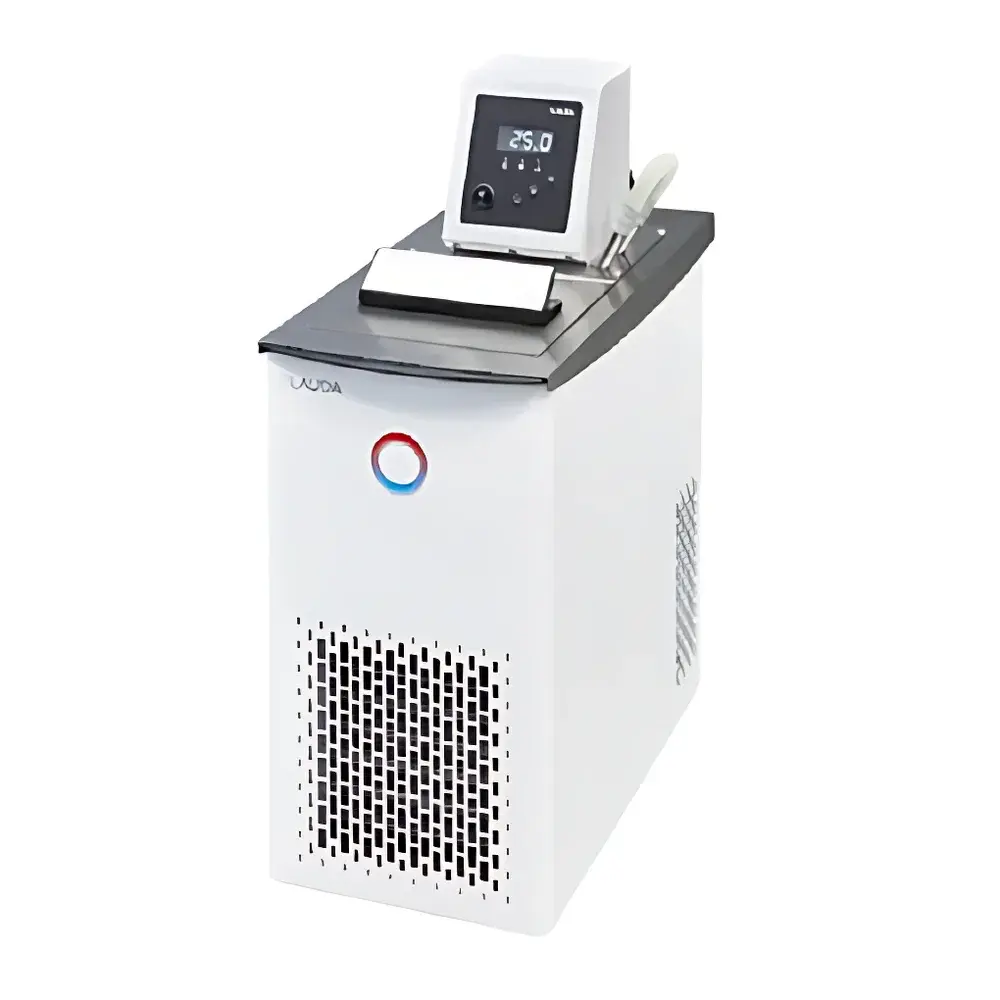
LAUDA Alpha Heating and Cooling Circulating Bath
| Brand | LAUDA |
|---|---|
| Origin | Germany |
| Model | Alpha |
| Instrument Type | Circulating Bath |
| Temperature Range | -25 to 100 °C |
| Temperature Stability | ±0.05 K |
| Bath Volume Options | 7.5 L – 22 L |
| Circulation Mode | Internal & External |
| Compatible Fluids | Water, Water/Glycol (non-flammable only) |
| Compressor Power | Up to 0.425 kW |
| Pump Flow Rate | Adjustable from 5 to 15 L/min |
| User Calibration | Single-point temperature calibration supported |
| Enclosure Access | Tool-free front panel removal for condenser maintenance |
Overview
The LAUDA Alpha Heating and Cooling Circulating Bath is an entry-level yet engineering-grade temperature control system designed for laboratories requiring precise, reliable, and energy-efficient thermal management across a broad operational range. Based on LAUDA’s decades of expertise in thermal instrumentation, the Alpha series employs a dual-mode refrigeration-heating architecture grounded in vapor-compression thermodynamics and PID-controlled resistive heating. It delivers stable thermal output without overshoot or drift—critical for applications demanding high reproducibility in sample conditioning, reaction control, or instrument jacketing. Its operating envelope of −25 °C to +100 °C accommodates standard aqueous and glycol-based heat transfer fluids, making it suitable for both low-temperature cryo-conditioning and high-temperature incubation protocols. Unlike simplified benchtop units, the Alpha integrates industrial-grade components—including hermetic compressors, corrosion-resistant stainless steel reservoirs, and thermally optimized pump manifolds—while maintaining a streamlined user interface focused on operational integrity rather than feature bloat.
Key Features
- Triple-button intuitive interface with large-format LED display enabling at-a-glance monitoring of setpoint, actual bath temperature, pump status, and real-time alarms—even from >2 meters distance
- Intelligent compressor modulation: dynamically adjusts refrigerant flow and compression load based on thermal demand, minimizing energy consumption and mechanical wear while extending service life
- Tool-free front access panel: enables rapid visual inspection and cleaning of the condenser coil without disassembly tools—reducing scheduled maintenance intervals by up to 40% compared to fixed-panel designs
- Adjustable circulation pump: flow rate continuously tunable between 5–15 L/min via integrated pressure regulation, supporting both low-backpressure internal baths and high-resistance external loops (e.g., jacketed reactors or calorimeters)
- Single-point user calibration capability: allows lab personnel to perform traceable offset correction using a NIST-traceable reference thermometer—supporting internal quality assurance procedures per ISO/IEC 17025 requirements
- Universal immersion mount: includes standardized threaded clamp assembly compatible with common bath vessel geometries (cylindrical, rectangular, jacketed), eliminating need for custom adapters
Sample Compatibility & Compliance
The LAUDA Alpha is validated exclusively for use with non-flammable heat transfer media, including deionized water and aqueous ethylene glycol solutions (up to 50% v/v). It is not rated for organic solvents, oils, or halogenated fluids. All wetted parts comply with EU Directive 2002/95/EC (RoHS) and are constructed from 316 stainless steel, PTFE, and EPDM elastomers to ensure chemical compatibility and long-term fluid stability. The unit meets EN 61000-6-3 (EMC emission) and EN 61000-6-2 (immunity) standards. While not certified for GMP manufacturing environments, its design supports GLP-aligned workflows through audit-ready calibration logging (via optional RS232/USB interface) and configurable alarm thresholds aligned with USP temperature uniformity criteria for controlled environment qualification.
Software & Data Management
The Alpha operates autonomously via embedded firmware with no proprietary software dependency. Temperature setpoints, pump speed, and alarm limits are configured directly on-device. For integration into centralized lab data systems, an optional RS232 or USB-to-serial adapter enables ASCII protocol communication (Modbus RTU support available upon request). Logged parameters—including timestamped temperature readings, compressor duty cycle, and error codes—can be exported as CSV files for trend analysis or inclusion in electronic lab notebooks (ELN). When paired with LAUDA’s optional LabView-compatible drivers, the Alpha satisfies FDA 21 CFR Part 11 requirements for electronic records when deployed with appropriate system validation documentation and role-based access controls.
Applications
- Precise pre-analytical sample conditioning in pharmaceutical QC labs—e.g., dissolution medium equilibration per USP , serum thawing at controlled ramp rates for clinical diagnostics
- Thermal stabilization of analytical instruments: HPLC column ovens, viscometer jackets, FTIR ATR accessories, and UV-Vis cuvette holders
- Reaction temperature control in synthetic chemistry: Grignard initiation, polymerization quenching, and enzymatic assays requiring sub-zero incubation
- Material testing support: coefficient of thermal expansion (CTE) measurements, rheological profiling under isothermal conditions, and accelerated aging studies per ASTM D3045
- Bioscience applications: cell culture media pre-warming, electrophoresis buffer conditioning, and cold-chain validation for biorepository workflows
FAQ
Can the LAUDA Alpha operate continuously at −25 °C with a 22 L bath volume?
Yes—provided ambient room temperature remains ≤25 °C and relative humidity is <60%. Continuous operation at extreme low temperatures requires adequate ventilation around the condenser and periodic defrost cycles every 72 hours under sustained load.
Is external temperature sensor feedback supported for cascade control?
No—the Alpha uses only its integrated Pt100 sensor in the bath reservoir. For process-critical applications requiring remote sensing, LAUDA recommends upgrading to the Proline or Variocool series with external probe input capability.
What maintenance schedule is recommended for optimal longevity?
Condenser cleaning every 3 months (or after 500 operating hours), annual inspection of pump seals, and biannual verification of temperature accuracy using a calibrated reference probe per ISO 17025 Clause 6.5.
Does the Alpha meet CE marking requirements for laboratory equipment?
Yes—it carries full CE marking under the Low Voltage Directive (2014/35/EU) and Electromagnetic Compatibility Directive (2014/30/EU), with technical documentation available upon request from authorized distributors.
Can glycol concentration be adjusted beyond 50% without compromising performance?
Not recommended. Higher glycol ratios increase viscosity and reduce heat transfer efficiency, potentially triggering overtemperature protection or pump cavitation—especially below −15 °C.



