
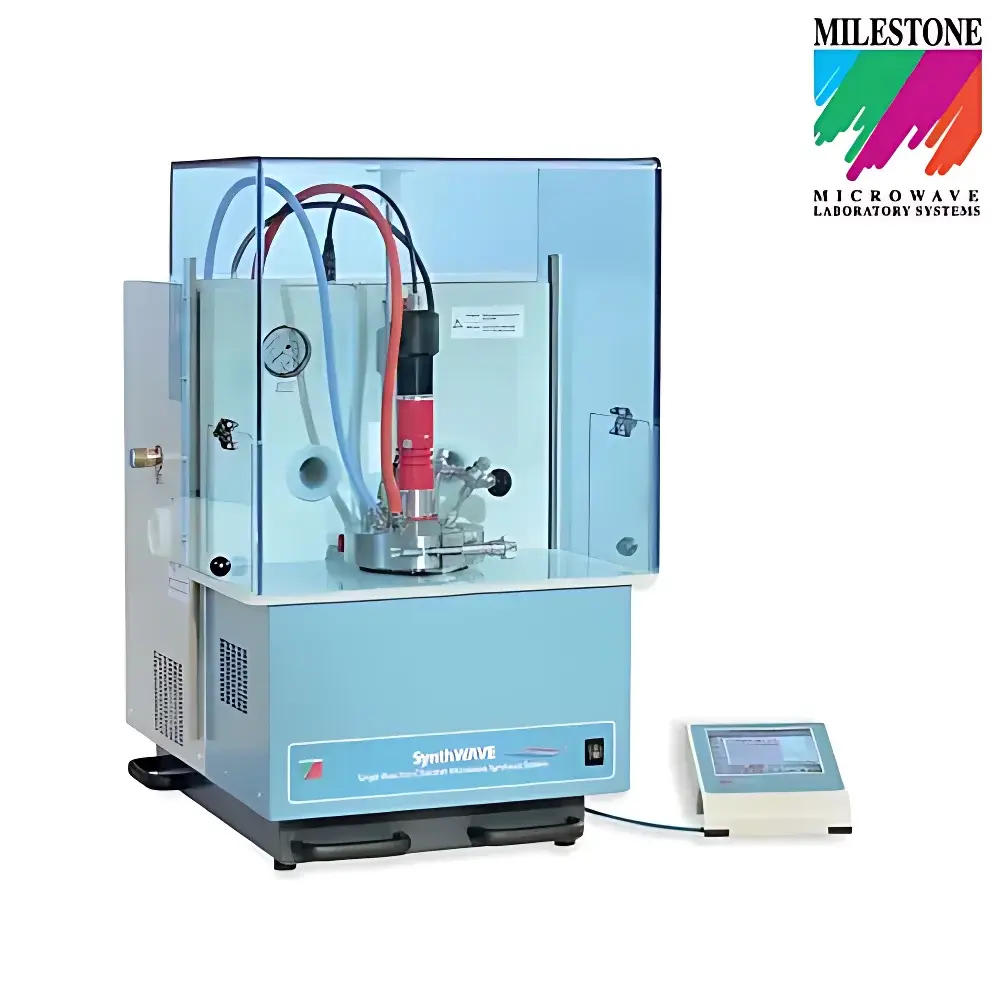
SynthWAVE Super Microwave Synthesizer by Milestone
| Brand | Milestone |
|---|---|
| Origin | Italy |
| Model | SynthWAVE |
| Type | Single-Reactor-Chamber Pre-Pressurized Microwave Synthesis System |
| Operating Temperature | Up to 280 °C (with pre-pressurization) |
| Maximum Pressure | 200 bar |
| Pre-Pressurization Range | 40–100 bar (inert gas) |
| Reaction Volume Capacity | 1–600 mL |
| Microwave Frequency | 2.45 GHz |
| Power Output | Adjustable, up to 1600 W |
| Stirring | Dual-mode — high-torque mechanical stirring + optional magnetic stirring |
| In-situ Sampling | Yes, under full temperature/pressure conditions |
| Chamber Material | Fully passivated 316L stainless steel |
| Compliance | FDA 21 CFR Part 11–compliant software architecture, GLP/GMP-ready audit trail |
Overview
The SynthWAVE Super Microwave Synthesizer is a high-performance, single-reaction-chamber microwave platform engineered by Milestone S.r.l. (Italy) for advanced synthetic chemistry under extreme process conditions. Unlike conventional multi-vessel microwave reactors, SynthWAVE implements the proprietary Pre-Pressurized Single Reaction Chamber (SRC) architecture — a technology pioneered by Milestone over two decades ago. This design eliminates the need for sealed individual vessels; instead, samples are loaded into open or vented reaction tubes placed inside a robust, fully sealed stainless-steel reaction chamber. The chamber is first pre-pressurized with inert or reactive gases (e.g., N₂, H₂, O₂, CO, CO₂), then heated rapidly and uniformly via 2.45 GHz microwave irradiation. This enables precise control of thermodynamic parameters — including simultaneous high temperature (up to 280 °C) and high pressure (up to 200 bar) — while maintaining exceptional reproducibility and inter-experimental comparability. The system is optimized for reaction discovery, optimization, and scale-up studies in pharmaceutical, fine chemical, and materials science laboratories where access to non-ambient reaction space is critical.
Key Features
- Pre-pressurized SRC architecture enabling true parallel reaction screening — multiple dissimilar reactions (different substrates, stoichiometries, catalysts, solvents) conducted simultaneously under identical thermal–pressure profiles.
- Integrated dual-stirring system: high-torque mechanical agitator (rated for viscous media and heterogeneous mixtures) supplemented by optional magnetic stirring for low-viscosity homogeneous systems.
- In-situ high-pressure/high-temperature sampling port allowing real-time extraction of reaction aliquots without depressurization or cooling — compatible with immediate analysis by TLC, GC, HPLC, or NMR.
- Full stainless-steel (316L) reaction chamber with passive passivation, rated for continuous operation at ≤300 °C and ≤200 bar; validated for long-term corrosion resistance under aggressive reagent environments.
- Intelligent touchscreen interface running Milestone’s SynthOS™ software — compliant with FDA 21 CFR Part 11 requirements, supporting electronic signatures, role-based user permissions, and immutable audit trails.
- Gas handling module with mass flow controllers and automated pressure regulation for inert blanketing, hydrogenation, oxidation, carboxylation, and other gas-mediated transformations.
Sample Compatibility & Compliance
The SynthWAVE accommodates a broad range of sample formats — from 1 mL microvials to 600 mL jacketed reactors — without requiring vessel-specific calibration or hardware modification. Its open-tube loading protocol supports slurries, suspensions, solid–gas reactions, and multiphase systems incompatible with sealed-vessel designs. All wetted components meet ASTM A240 and EN 10088-1 standards for austenitic stainless steel. System validation documentation supports IQ/OQ/PQ protocols aligned with ISO/IEC 17025 and ICH Q7 guidelines. Full traceability is maintained per GLP and GMP requirements, including timestamped parameter logging, user action records, and deviation alerts.
Software & Data Management
SynthOS™ provides a secure, browser-accessible platform for method development, execution, and data archival. Each method stores complete metadata: pressure ramp profiles, microwave power modulation curves, temperature feedback loops, gas composition history, and stirring speed sequences. Raw sensor data (±0.5 °C temp accuracy, ±1.5 bar pressure accuracy) is logged at 100 Hz and exported in CSV or .dx format for third-party kinetic modeling (e.g., MATLAB, KinTek Explorer). Electronic signatures adhere to ALCOA+ principles; audit logs are write-once, read-many (WORM), and exportable for regulatory submission.
Applications
- High-throughput reaction condition screening for asymmetric catalysis, C–H activation, and cross-coupling chemistry.
- Hydrogenation and oxidation under controlled H₂/O₂ partial pressures — eliminating batch-to-batch variability associated with autoclave-based methods.
- Synthesis of thermally labile metal–organic frameworks (MOFs) and covalent organic frameworks (COFs) requiring rapid nucleation kinetics.
- Continuous-flow–compatible precursor synthesis for semiconductor precursors (e.g., alkylmetal amides) under anhydrous, oxygen-free atmospheres.
- Accelerated aging studies of energetic materials and propellants under simulated storage conditions (T/P cycling).
FAQ
What distinguishes SynthWAVE’s SRC technology from conventional multi-vessel microwave synthesizers?
Unlike multi-vessel platforms that rely on statistical averaging across isolated cavities, SynthWAVE subjects all samples to identical electromagnetic field distribution, thermal gradient, and pressure history — ensuring direct comparability between reaction variants.
Can SynthWAVE perform reactions under reducing or oxidizing atmospheres?
Yes — integrated gas manifold supports programmable delivery of H₂, O₂, NH₃, CO, CO₂, or custom gas mixtures with precision mass flow control and real-time partial pressure monitoring.
Is remote monitoring and control supported?
Yes — SynthOS™ includes secure HTTPS-based remote access with TLS 1.3 encryption, enabling off-site method deployment and live parameter visualization via standard web browsers.
How is calibration verified and maintained?
System includes factory-certified reference sensors (NIST-traceable Pt100 RTD and piezoresistive pressure transducer); users may execute automated calibration verification routines prior to critical experiments.
What safety certifications does the instrument hold?
CE-marked per Machinery Directive 2006/42/EC and Pressure Equipment Directive 2014/68/EU; conforms to IEC 61010-1:2010 for laboratory equipment safety.



