
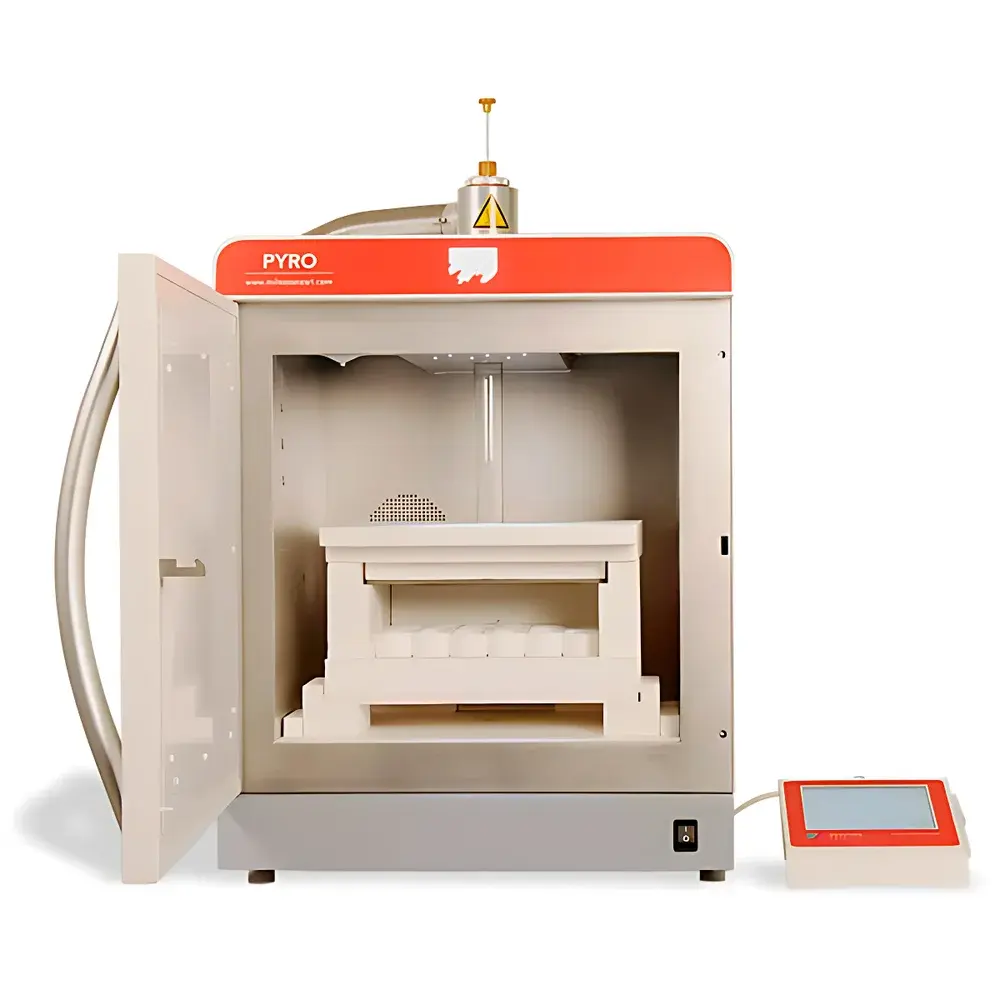
PYRO Microwave Ashing System by MILESTONE
| Brand | MILESTONE |
|---|---|
| Origin | Italy |
| Model | PYRO |
| Instrument Type | Crucible Furnace |
| Max Temperature | 1200 °C |
| Temperature Control | PID |
| Max Power | 1200 W |
| Ramp Time to Max Temp | 20 min |
| Heating Method | Resistance Wire / Silicon Carbide Rod / Molybdenum Disilicide Rod |
| Internal Dimensions | 480 mm × 550 mm × 560 mm (H) |
Overview
The PYRO Microwave Ashing System by MILESTONE is a high-performance, hybrid thermal–microwave laboratory furnace engineered for rapid, controlled dry ashing of organic and inorganic matrices. Unlike conventional muffle furnaces relying solely on conductive/convective heating, the PYRO integrates focused microwave energy with active oxygen-enriched airflow—enabling direct, non-carbonizing ashing through rapid oxidative decomposition. This dual-energy architecture operates on the principle of selective dielectric heating of polar components (e.g., water, organics) while simultaneously sustaining high-temperature oxidative conditions via a Venturi-driven, high-flow O₂ delivery system. Designed for compliance-critical laboratories, the PYRO achieves temperatures up to 1200 °C with PID-regulated stability ±5 °C across its full operating range, supporting standardized methods including ASTM D5630 (ash content of plastics), ISO 1171 (ash in coal and coke), and USP (residue on ignition). Its vacuum-formed alumina ceramic cavity—lined with high-density insulation and integrated overtemperature sensors—ensures thermal uniformity, energy efficiency, and operational safety during extended high-temperature cycles.
Key Features
- Hybrid heating platform combining 1200 W microwave power with resistive heating elements (silicon carbide or molybdenum disilicide rods) for rapid, reproducible temperature ramping—reaching 1000 °C from ambient in ≤8 minutes.
- Venturi-enhanced oxygen injection system delivering continuous, adjustable high-concentration O₂ flow into the reaction chamber, eliminating pre-charring steps and enabling direct ashing of wet, oily, or heterogeneous samples.
- Stainless steel reaction chamber with full front-access door and real-time visual monitoring capability—allowing safe observation of sample state without interrupting thermal or gas dynamics.
- Multi-stage airflow management: Porous honeycomb ceramic flow diffuser combined with adjustable multi-port venting ensures uniform oxygen distribution and efficient removal of volatile combustion by-products (e.g., NOₓ, SO₂, CO).
- Dual thermal protection architecture: Embedded overtemperature sensor + redundant ceramic insulation layer prevent thermal runaway and maintain structural integrity at sustained 1200 °C operation.
- Universal crucible compatibility—accepts standard porcelain, quartz, platinum, and graphite crucibles without modification or proprietary consumables.
Sample Compatibility & Compliance
The PYRO accommodates diverse sample types—including biological tissues, foodstuffs, polymers, pharmaceutical excipients, environmental filters (e.g., PM₂.₅ collection media), and geological matrices—without requiring acid digestion or lengthy carbonization. Its oxygen-rich environment minimizes reduction artifacts and ensures quantitative conversion of organic carbon to CO₂, yielding highly reproducible ash residue mass (RSD <1.2% for triplicate NIST SRM 1547 peach leaves). The system supports GLP/GMP-aligned workflows through traceable temperature logging, user-accessible calibration records, and hardware-level interlocks compliant with IEC 61000-6-4 (EMC) and IEC 61010-1 (safety). While not inherently 21 CFR Part 11–certified, its data output structure (CSV/TXT timestamped logs) is compatible with validated LIMS and ELN platforms for audit-ready reporting.
Software & Data Management
The PYRO operates via an integrated touchscreen HMI with embedded firmware supporting up to 99 programmable thermal profiles—each configurable with ramp rates, hold times, gas flow setpoints, and microwave power modulation. All process parameters are logged with millisecond-resolution timestamps and stored internally (≥10,000 cycles) or exported via USB 2.0. Optional Ethernet connectivity enables remote monitoring and integration with laboratory informatics systems using Modbus TCP protocol. Audit trails—including operator ID, parameter changes, and alarm events—are retained for ≥36 months and exportable in PDF or CSV format for regulatory review.
Applications
- Routine ash content determination per AOAC 942.05 (animal feed), EPA Method 1695 (biosolids), and ISO 2171 (cereals).
- Preparation of ash residues for subsequent elemental analysis (ICP-OES, ICP-MS) with minimized analyte volatility loss—particularly critical for As, Cd, Pb, and Hg.
- High-temperature fusion of silicates and oxides prior to XRF bead preparation.
- Thermal degradation studies of flame-retardant polymers and battery cathode materials under controlled oxidative atmospheres.
- Residue-on-ignition testing of sterile pharmaceutical packaging per USP and Ph. Eur. 2.4.13.
FAQ
Does the PYRO require special microwave-safe crucibles?
No—standard laboratory crucibles (porcelain, quartz, Pt, graphite) are fully compatible due to the system’s cavity design and oxygen-assisted combustion mechanism.
Can the PYRO be used for sulfur-rich samples without SO₂ corrosion issues?
Yes—the stainless steel chamber and ceramic-lined exhaust path are resistant to acidic condensates; optional alkali scrubber integration is available for extended high-sulfur applications.
Is validation documentation (IQ/OQ/PQ) provided?
MILESTONE supplies factory-verified IQ/OQ protocols and calibration certificates traceable to NIST standards; PQ templates are included for user-specific method adaptation.
What maintenance is required for the microwave generator?
The solid-state magnetron module is rated for ≥10,000 hours; routine checks include waveguide seal integrity and cooling fan performance—no periodic tuning or magnetron replacement is needed under normal use.
How does the PYRO compare to traditional box furnaces in terms of energy consumption?
Independent lab testing shows ~65% lower kWh/kg ash for typical food and tissue samples, primarily due to reduced ramp time and minimized standby heat loss from superior insulation.



