
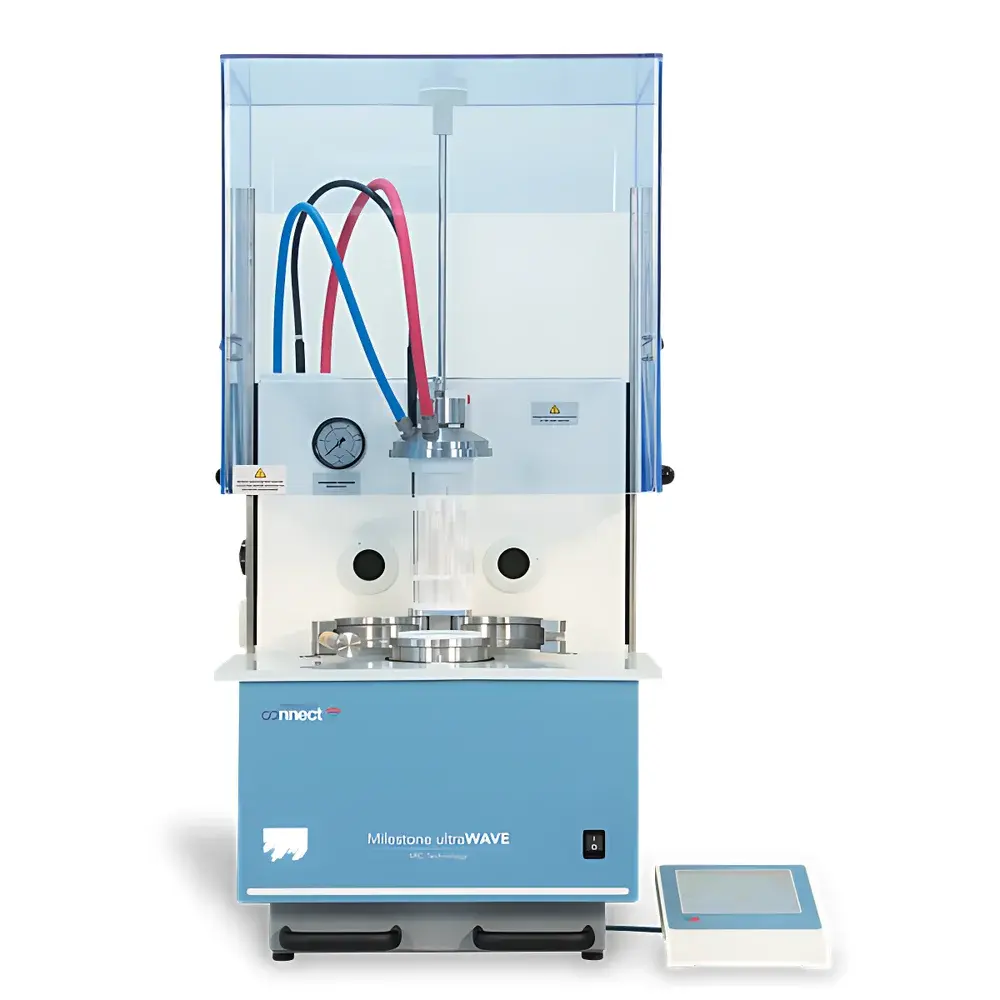
MILESTONE UltraWAVE Superwave Microwave Digestion System
| Brand | MILESTONE |
|---|---|
| Origin | Italy |
| Model | UltraWAVE |
| Cavity Class | Industrial-Grade |
| Batch Capacity | 1–22 samples |
| Microwave Source | Single Magnetron |
| Max Temperature | 320 °C |
| Max Pressure | 3000 psi (207 bar) |
| Reaction Chamber Volume | 4.2 L |
| Sample Mass Capacity | ≥25 g per vessel |
| Acid Consumption | 2–3 mL per sample |
| Vessel Compatibility | Standard quartz, borosilicate glass, or TFM-lined tubes |
| Automated Sealing/Unsealing Time | ~10 s per vessel |
| Pressure Relief | Fully automated and controlled |
Overview
The MILESTONE UltraWAVE Superwave Microwave Digestion System represents a paradigm shift in closed-vessel sample preparation for elemental analysis. Engineered on the principle of pre-pressurized single-chamber microwave digestion, it eliminates the need for individual sealed vessels by enclosing all samples within a single, robust 4.2 L reaction chamber. Unlike conventional multi-vessel rotor systems, the UltraWAVE applies uniform microwave energy to the entire chamber—where samples are placed in open or semi-closed standard tubes (quartz, borosilicate glass, or TFM)—and then pressurizes the environment prior to microwave irradiation. This architecture enables sustained operation at up to 320 °C and 3000 psi (207 bar), delivering thermodynamic conditions far exceeding those achievable with traditional rotor-based instruments. The system is particularly suited for laboratories requiring high-throughput, low-acid, high-mass digestion of heterogeneous, refractory, or high-silica matrices—including soils, ores, polymers, biological tissues, and metal alloys—without compromising reproducibility or safety.
Key Features
- Pre-pressurized single-chamber design: Eliminates vessel-specific pressure/temperature gradients; ensures uniform thermal and kinetic conditions across all samples in a batch.
- Industrial-grade cavity construction: Reinforced stainless-steel chamber with active cooling and real-time pressure monitoring via redundant transducers.
- High-mass digestion capability: Supports ≥25 g sample masses per tube—enabling direct digestion of large-volume environmental or geological specimens without subsampling.
- Ultra-low acid consumption: Requires only 2–3 mL of HNO₃, HCl, or HF per sample—reducing reagent use by >70% compared to conventional microwave digesters.
- Automated tube handling: Integrated pneumatic sealing/unsealing mechanism completes full batch closure and venting in ~10 seconds—removing manual torque application and eliminating operator-induced variability.
- No post-digestion acid removal step: Minimal residual acid volume allows direct dilution and instrumental analysis (ICP-OES, ICP-MS, AAS), bypassing time- and energy-intensive “acid evaporation” (‘赶酸’).
Sample Compatibility & Compliance
The UltraWAVE accommodates diverse sample types—including siliceous materials (e.g., clays, fly ash), organic-rich matrices (e.g., foodstuffs, plant tissue), halogen-containing polymers, and high-density metals—without requiring specialized consumables. Standard quartz, borosilicate glass, or TFM-lined tubes are sufficient under operational conditions, significantly lowering per-run cost and supply-chain complexity. The system complies with ISO/IEC 17025 requirements for method validation in accredited testing laboratories. Its pressure and temperature control architecture supports audit-ready documentation aligned with GLP and GMP environments. While not certified to specific FDA 21 CFR Part 11 out-of-the-box, its data logging and user-access controls can be configured to meet electronic record integrity requirements when integrated with validated LIMS or ELN platforms.
Software & Data Management
Controlled via MILESTONE’s proprietary ETHOS UP software, the UltraWAVE provides full method scripting, real-time graphical monitoring of chamber pressure, temperature, and microwave power, and automatic generation of digital log files compliant with ALCOA+ principles (Attributable, Legible, Contemporaneous, Original, Accurate, Complete, Consistent, Enduring, Available). All method parameters—including ramp profiles, hold times, pressure setpoints, and safety interlock states—are stored with user ID, timestamp, and version history. Export options include CSV and PDF reports suitable for regulatory submission. Software updates are distributed through MILESTONE’s secure customer portal and undergo internal verification per IEC 62304 medical device software standards (applicable to safety-critical instrument firmware).
Applications
- Multi-element quantification in environmental monitoring (EPA Methods 3050B, 3051A, 3052) and soil screening (ISO 11466, ISO 14869-1)
- Digestion of high-silica geological samples for rare earth element (REE) analysis by ICP-MS
- Direct digestion of polymer composites and electronic waste (e-waste) for RoHS and WEEE compliance testing
- High-precision trace metal analysis in clinical nutrition and pharmaceutical excipients
- Method development for novel biomass or nanomaterial digestion protocols requiring elevated thermal stability
FAQ
How does the UltraWAVE differ from conventional rotor-based microwave digesters?
It replaces individual sealed vessels with a single pre-pressurized chamber, enabling higher temperature/pressure endurance, greater sample mass capacity, and elimination of vessel-to-vessel variability.
Can standard laboratory glassware be used as digestion tubes?
Yes—quartz, borosilicate glass, and TFM-lined tubes rated for >300 °C and >3000 psi are compatible; no proprietary consumables are required.
Is acid evaporation (“赶酸”) necessary after digestion?
No. Due to minimal acid volumes (2–3 mL), digests are typically diluted directly into volumetric flasks for analysis—saving 60–120 minutes per batch and reducing fume hood energy consumption.
What safety mechanisms prevent over-pressurization or thermal runaway?
Dual independent pressure sensors, burst-disc protection, active chamber cooling, and automatic microwave cutoff at preset safety thresholds ensure compliance with EN 61000-6-4 and IEC 61010-1 standards.
Does the system support unattended overnight operation?
Yes—fully programmable methods with hardware-enforced safety interlocks allow extended runs; however, routine maintenance checks (e.g., gasket integrity, chamber seal inspection) must be performed per MILESTONE’s scheduled service protocol.
Related Products



