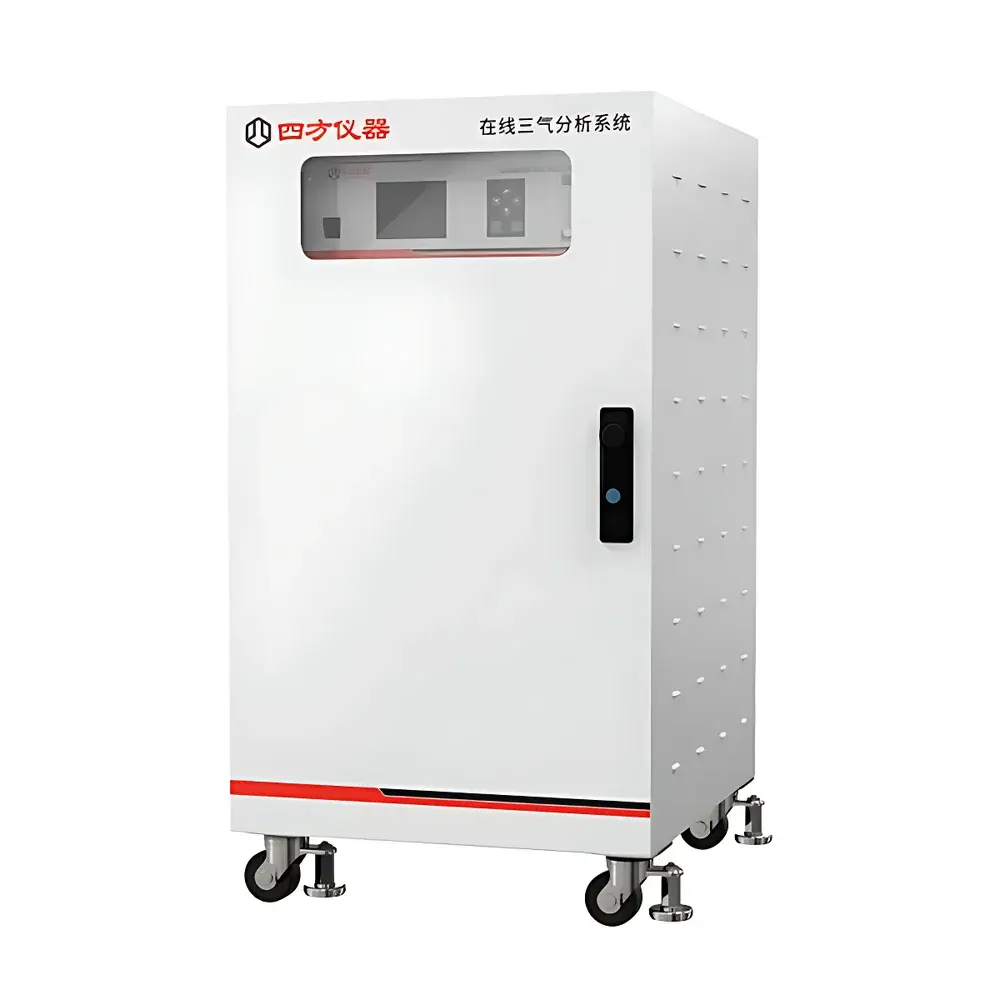
CUBIC INSTRUMENTS Online Tri-Gas Analyzer for CO/CO₂/CH₄
| Brand | CUBIC INSTRUMENTS |
|---|---|
| Origin | Hubei, China |
| Manufacturer Type | Authorized Distributor |
| Country of Origin | China |
| Model | Not Applicable |
| Price | Upon Request |
| Linearity Error | ±2% F.S. |
| Repeatability | ±2% F.S. |
| Response Time (T90) | <10 s |
| Measurement Ranges | CO₂: 0–5,000 ppm |
| CO | 0–30% vol |
| CH₄ | 0–10% vol |
| Resolution | CO₂: 0.1 ppm |
| CO | 0.01% vol |
| CH₄ | 0.01% vol |
| Accuracy | ±2% F.S. for all gases |
| Stability | ≤±2% per month |
| Response Time (T90) | ≤30 s |
Overview
The CUBIC INSTRUMENTS Online Tri-Gas Analyzer for CO/CO₂/CH₄ is an industrial-grade, continuous emission monitoring system engineered for real-time, simultaneous quantification of carbon monoxide (CO), carbon dioxide (CO₂), and methane (CH₄) in high-temperature thermal processing atmospheres. It employs non-dispersive infrared (NDIR) spectroscopy — a mature, interference-resistant optical absorption technique — where each target gas exhibits distinct fundamental vibrational absorption bands in the mid-infrared region (e.g., CO at ~4.6 µm, CO₂ at ~4.26 µm, CH₄ at ~3.3 µm). Dual-beam NDIR architecture with temperature-stabilized detectors and reference compensation ensures long-term signal integrity under fluctuating ambient conditions typical of heat-treatment furnaces and catalytic cracking environments. The analyzer is purpose-built for atmosphere verification in carburizing, carbonitriding, and endothermic gas generation processes, delivering trace-level CO₂ detection down to 0.1 ppm and percent-level CO/CH₄ measurement with metrological traceability aligned with ISO 17025–accredited calibration practices.
Key Features
- Triple-channel NDIR optical module with independent detector assemblies and wavelength-specific interference filters for CO, CO₂, and CH₄ — minimizing cross-sensitivity and enabling true simultaneous analysis without time-multiplexing delays
- High-temperature sample conditioning system rated to 200 °C inlet temperature, incorporating heated sampling lines, particulate filtration, and water vapor management to prevent condensation and maintain gas-phase integrity
- Dual-stage zero/span validation capability supporting automated or manual calibration routines compliant with ASTM D6216 and ISO 14687 protocols
- Integrated carbon potential (Cp) calculation engine that applies the established Ziegler–Harris equation using real-time CO/CO₂ ratios, with optional input from external oxygen probe signals for multi-method Cp cross-verification
- Rugged 19-inch rack-mount enclosure (IP65 front panel) with industrial-grade power supply (24 VDC or 100–240 VAC), EMC-compliant design, and SIL 2 functional safety readiness per IEC 61508
Sample Compatibility & Compliance
The analyzer is validated for use with dry or moderately humid process streams containing up to 5% O₂, <100 ppm H₂S, and particulate loadings <1 mg/m³. It complies with key industry requirements for thermal processing atmosphere control, including CQI-9 (Heat Treatment System Assessment) Section 9.3.2 on atmosphere verification methodology and frequency. Data logging and reporting functions support GLP/GMP audit trails per FDA 21 CFR Part 11 when paired with validated software platforms. All electrical interfaces meet ATEX Zone 2 / IECEx certification prerequisites for installation in classified areas adjacent to furnace zones (non-intrinsically safe configuration requires external barrier integration).
Software & Data Management
Firmware supports Modbus TCP/RTU and Profibus DP communication protocols for seamless integration into DCS, SCADA, or MES systems. Local HMI provides real-time trend visualization, alarm configuration (high/low, rate-of-change), and event-triggered data export in CSV format. Optional CUBIC Analytics Suite enables advanced diagnostics — including drift trending, sensor health scoring, and Cp deviation mapping against setpoint — with encrypted database storage and user-access role management. Audit logs record all parameter changes, calibration events, and system resets with timestamps and operator IDs, satisfying ISO 9001:2015 clause 8.5.2 on process monitoring and measurement traceability.
Applications
- Carburizing furnace atmosphere control: Continuous Cp monitoring and closed-loop adjustment of enriching gas flow rates based on CO/CO₂ ratio feedback
- Endothermic generator (Endo-gas) diagnostics: Detection of air ingress (elevated CO₂), catalyst deactivation (reduced CH₄ yield), or methanol decomposition inefficiency via stoichiometric imbalance analysis
- Leak detection in radiant tube furnaces: Identification of tube rupture through anomalous CO spikes concurrent with CO₂ decline
- Process validation for aerospace and automotive heat treatment: Documentation of atmosphere stability over full soak cycles per AMS 2750E pyrometry requirements
- Carbon balance auditing in energy-intensive thermal plants: Quantifying unburnt hydrocarbons (CH₄) and incomplete combustion products (CO) for emissions reporting under EU ETS or EPA Subpart C
FAQ
Does this analyzer require periodic recalibration?
Yes — quarterly zero/span verification is recommended under normal operation; calibration intervals may be extended to six months with documented stability data per ISO/IEC 17025 Clause 7.7.
Can it operate in reducing atmospheres containing H₂?
Yes — the NDIR optical path is chemically inert and unaffected by H₂; however, H₂ concentration >15% vol may require correction factors applied during Cp calculation due to thermal conductivity effects on gas density.
Is remote firmware update supported?
Firmware updates are performed via secure USB interface only; network-based updates are disabled by default to comply with IEC 62443-3-3 SL2 cybersecurity requirements for industrial control systems.
What maintenance is required beyond calibration?
Annual inspection of optical windows, replacement of particulate filters every 6 months, and verification of sample line heater functionality constitute the preventive maintenance schedule outlined in the Operations Manual Rev. 3.2.
How is compliance with CQI-9 demonstrated?
The system includes a built-in CQI-9 Atmosphere Verification Report Generator that auto-populates test records with timestamped CO/CO₂/CH₄ values, Cp calculations, uncertainty budgets, and signature fields for QA sign-off — exportable as PDF/A-1b for archival.
Related Products