
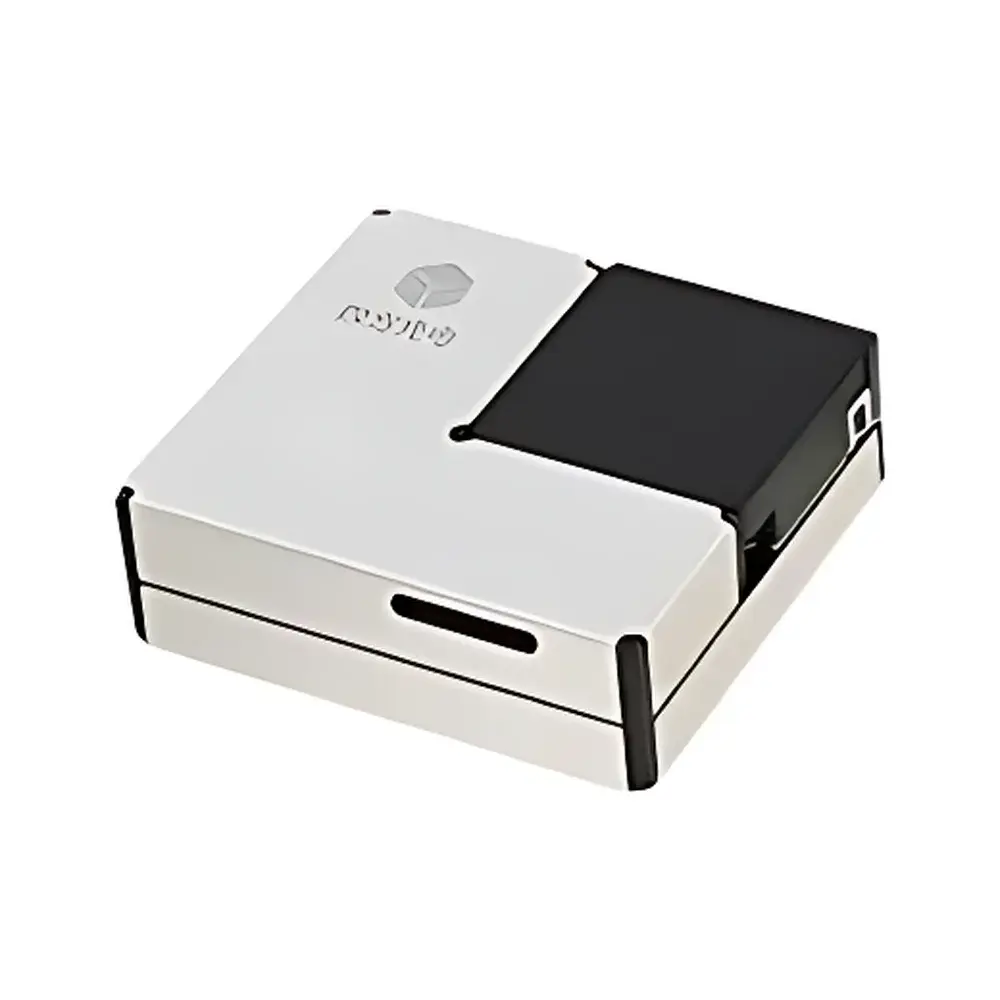


Cubic PM2012 Compact Laser-Based Particulate Matter Sensor
| Brand | Cubic |
|---|---|
| Origin | Hubei, China |
| Manufacturer Type | Authorized Distributor |
| Origin Category | Domestic (China) |
| Model | PM2012 |
| Pricing | Upon Request |
| Detection Principle | Laser Light Scattering |
| PM2.5 Range | 0–1000 µg/m³ (extendable to PM1.0 & PM10) |
| Warm-up Time | ≤8 s |
| Data Update Interval | 1 s |
| Accuracy | ±10 µg/m³ or ±10% of reading (at 25°C±2°C, 50%±10% RH |
| Operating Temp. | −10°C to +60°C |
| Operating Humidity | 5–95% RH (non-condensing) |
| Storage Temp. | −30°C to +70°C |
| Storage Humidity | 0–95% RH (non-condensing) |
| Supply Voltage | DC 5 V ±0.5 V (ripple <50 mV) |
| Operating Current | ≤100 mA |
| Standby Current | ≤200 µA |
| Output Interfaces | UART TTL (3.3 V / 5 V logic), I²C (3.3 V) |
| Dimensions | 38 mm × 35 mm × 12 mm (W×H×D) |
Overview
The Cubic PM2012 is a compact, OEM-grade laser scattering particulate matter sensor engineered for high-fidelity real-time monitoring of airborne aerosols in resource-constrained embedded environments. It operates on the principle of Mie light scattering: a collimated 650 nm laser diode illuminates suspended particles within a precisely defined airflow path; scattered photons are captured by a high-sensitivity photodiode array at fixed angular apertures. The resulting pulse-height distribution is digitized and processed via an on-board microcontroller using particle-size binning algorithms validated against gravimetric and reference optical counter standards (e.g., TSI AM510 and 8530). Unlike passive diffusion-based sensors, the PM2012 integrates a low-power axial fan to ensure consistent volumetric sampling flow—critical for reproducible mass concentration estimation (PM₁.₀, PM₂.₅, PM₁₀) under variable ambient pressure and turbulence conditions. Its core calibration traceability aligns with ISO 25358:2021 (ambient air—determination of PM mass concentrations) and supports secondary correlation to US EPA EQPM-0609-190 and EN 12341:2014 methodologies.
Key Features
- Miniaturized form factor (38 × 35 × 12 mm) optimized for integration into space-limited consumer and industrial platforms
- Dual-output interface support: hardware-configurable UART TTL (3.3 V / 5 V compatible) and standard I²C (3.3 V only), enabling seamless interoperability with ARM Cortex-M, ESP32, and Raspberry Pi Pico host controllers
- Robust electromagnetic compatibility (EMC) design featuring integrated metal shielding enclosure and ferrite-filtered power input—validated per IEC 61000-4-3 (radiated immunity) and IEC 61000-4-6 (conducted immunity)
- Configurable inlet/outlet orientation (top/bottom/side intake and exhaust) to accommodate divergent airflow architectures in HVAC ducts, purifier housings, or wearable monitors
- Fast thermal stabilization: full optical and electronic settling achieved within ≤8 seconds post-power-on, minimizing system boot latency
- Low-power operation architecture: typical active current draw ≤100 mA; standby mode consumes ≤200 µA—enabling battery-powered deployments with multi-week autonomy
Sample Compatibility & Compliance
The PM2012 is designed for continuous measurement of ambient and indoor air containing non-hygroscopic and moderately hygroscopic particulates—including combustion soot, road dust, pollen fragments, and industrial process aerosols. It is not intended for use in corrosive, explosive, or high-concentration (>2000 µg/m³) environments without external dilution or filtration. All firmware and calibration data adhere to GLP-aligned documentation practices, with version-controlled calibration certificates available upon request. While not certified as a regulatory-grade reference monitor, its performance characteristics meet the technical requirements for Class II indicative monitoring under EU Directive 2008/50/EC Annex XI and serve as a compliant component in devices targeting UL 867 (electrostatic air cleaners) and AHAM AC-1 (portable air cleaner) verification protocols.
Software & Data Management
The sensor outputs time-stamped, ASCII-formatted serial frames (UART) or register-mapped binary packets (I²C), each containing synchronized PM₁.₀, PM₂.₅, and PM₁₀ mass concentrations (µg/m³), particle count per 0.1 L (for >0.3 µm, >0.5 µm, >1.0 µm, >2.5 µm, >5.0 µm, >10 µm bins), and internal diagnostics (fan RPM, laser drive voltage, temperature, humidity). Cubic provides open-source Arduino and Python reference drivers, along with a Windows/Linux configuration utility supporting firmware updates, zero-point offset adjustment, and sensitivity recalibration using NIST-traceable polystyrene latex (PSL) aerosol challenges. Raw data streams are compatible with MQTT, Modbus RTU, and EdgeX Foundry edge frameworks—facilitating ingestion into cloud platforms such as AWS IoT Core or Azure IoT Hub with built-in audit logging for FDA 21 CFR Part 11–compliant deployments.
Applications
- OEM integration into residential and commercial air purifiers requiring responsive, low-footprint PM feedback control loops
- Real-time IAQ (Indoor Air Quality) modules for smart thermostats, building management systems (BMS), and demand-controlled ventilation (DCV) controllers
- Portable personal exposure monitors and occupational hygiene wearables compliant with ACGIH TLV® guidance thresholds
- Automotive cabin air quality subsystems with automatic recirculation triggering based on PM₂.₅ excursions
- Educational kits and university lab instrumentation for aerosol physics, environmental engineering, and sensor fusion coursework
- Smart home hubs and voice-assistant–enabled air quality dashboards with localized historical trend visualization
FAQ
Is the PM2012 suitable for outdoor ambient air monitoring?
It is rated for indoor and semi-outdoor enclosures (e.g., weatherproof kiosks with filtered intakes); direct unshielded outdoor deployment is not recommended due to condensation risk and UV-induced optical degradation.
Does the sensor require periodic factory recalibration?
Field recalibration using PSL aerosol challenge is supported via the configuration utility; annual verification against a reference instrument (e.g., GRIMM EDM 180) is advised for mission-critical applications.
Can the PM2012 distinguish between smoke, dust, and pollen?
No—it reports total mass concentration and size-resolved counts but does not perform chemical speciation or biological identification; classification requires coupling with VOC sensors or AI-driven multimodal pattern recognition.
What is the expected operational lifetime under continuous use?
Rated for ≥2 years of continuous operation at 25°C ambient; laser diode L50 lifetime exceeds 15,000 hours per IEC 62282-3-100 accelerated testing.
Is firmware update capability accessible over UART or I²C?
Yes—both interfaces support in-system programming (ISP) via bootloader mode; no JTAG debugger required.
Related Products







