
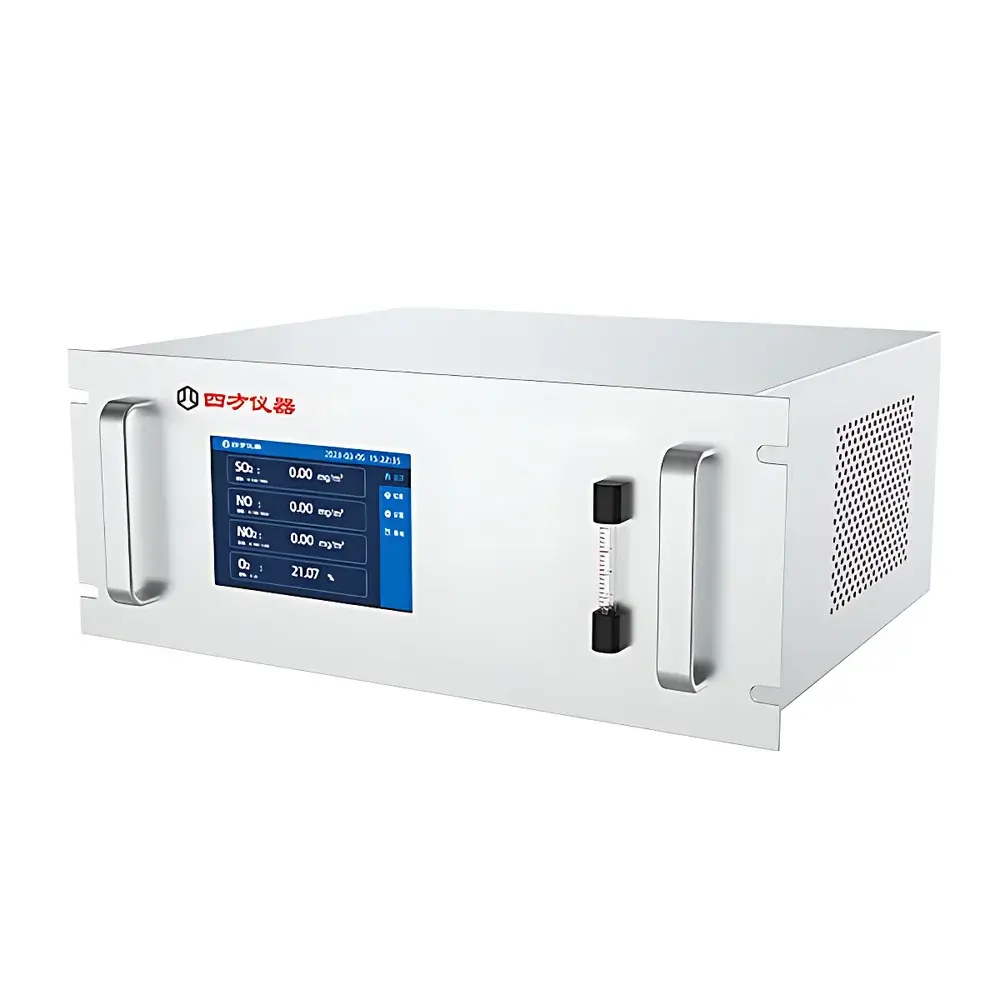
CUBIC INSTRUMENTS Gasboard-3000UV UV Differential Optical Absorption Spectroscopy (DOAS) Flue Gas Analyzer for Ultra-Low Emission Monitoring
| Brand | CUBIC INSTRUMENTS |
|---|---|
| Origin | Hubei, China |
| Model | Gasboard-3000UV |
| Measurement Principle | UV-DOAS (SO₂/NO/NO₂), Electrochemical (O₂) |
| Measurands | SO₂, NO, NO₂, O₂ |
| Range | SO₂/NO/NO₂: 0–100 mg/m³ |
| O₂ | 0–25% (selectable) |
| Accuracy | ±2% F.S. |
| Repeatability | ≤2% |
| Response Time (T90) | ≤30 s |
| Stability | ≤±2% F.S./24 h |
| Linearity Error | ≤±2% F.S. |
| Sample Requirements | Condensate-free, particulate filtration <1 µm |
| Operating Humidity | 5–85% RH |
| Ambient Pressure | 86–108 kPa |
| Communication | RS-232/RS-485 (Modbus RTU or customizable) |
| Power Supply | AC 220 V, 50 Hz |
| Max. Power Consumption | 200 W |
Overview
The CUBIC INSTRUMENTS Gasboard-3000UV is an industrial-grade, online flue gas analyzer engineered for continuous, real-time monitoring of regulated gaseous pollutants under ultra-low emission standards—particularly in coal-fired power plants, waste-to-energy facilities, and industrial boilers subject to stringent environmental compliance regimes. It employs ultraviolet differential optical absorption spectroscopy (UV-DOAS) as the primary analytical method for SO₂, NO, and NO₂, leveraging high-resolution spectral analysis across characteristic absorption bands in the 190–230 nm and 230–350 nm ranges. For oxygen measurement, a robust electrochemical cell (ECD) provides stable, drift-compensated readings independent of cross-interference from acidic or reducing gases. The instrument integrates a multi-pass optical cell with extended effective path length (>1.5 m), significantly enhancing detection sensitivity and signal-to-noise ratio—enabling reliable quantification down to sub-5 mg/m³ levels with high reproducibility. Its thermally stabilized optical module minimizes thermal drift, while proprietary spectral deconvolution algorithms correct for interferences arising from overlapping absorption features (e.g., NO₂ interference on NO, H₂O vapor broadening, and ozone residuals), ensuring metrological integrity in complex flue gas matrices.
Key Features
- UV-DOAS core technology optimized for ultra-low concentration measurement (0–100 mg/m³ range) with certified linearity error ≤±2% F.S.
- Multi-pass optical cell design delivering high absorbance sensitivity and long-term photometric stability
- Dual-channel communication interface (RS-232 & RS-485) supporting Modbus RTU protocol for seamless integration with EPA-compliant data acquisition systems (DAS) and CEMS platforms
- Active temperature control of optical chamber and detector assembly to mitigate ambient thermal influence on spectral baseline
- Imported pulsed xenon lamp source with >20,000-hour service life and spectral output stability <±0.5% over 1,000 hours
- Onboard particulate filtration system compatible with <1 µm cut-off filters; designed for direct hot/wet sampling without dilution or conditioning
- 4U rack-mount industrial chassis (19″ standard) compliant with IEC 61000-6-2/6-4 EMC requirements for harsh plant environments
Sample Compatibility & Compliance
The Gasboard-3000UV is validated for use with raw, hot, and humid flue gas streams containing typical combustion byproducts—including CO₂ (~10–15%), H₂O vapor (up to 15% v/v), and particulates—provided liquid condensate is removed upstream and aerosol loading remains below 10 mg/m³. It meets the functional requirements of Chinese HJ 75-2017 and HJ 76-2017 for CEMS performance verification, and its measurement uncertainty profile aligns with EN 15267-3:2019 (QAL1 certification pathway). While not pre-certified to U.S. EPA PS-11 or EU MCERTS, its DOAS architecture and documented traceability to NIST-traceable gas standards support validation under site-specific QA/QC protocols required by ISO 14001, ISO 50001, and EU Industrial Emissions Directive (IED) Annex V monitoring frameworks.
Software & Data Management
Embedded firmware supports dual operating modes: standalone local operation via 5.6″ color TFT touchscreen, and remote supervision via TCP/IP-enabled industrial gateway (optional). All measurement data—including raw spectra, calibrated concentrations, diagnostic flags (lamp intensity, cell temperature, flow status), and audit logs—are timestamped and stored internally (≥30 days at 1-min intervals). Data export complies with CSV and XML formats per EN 14181 requirements. Audit trail functionality records user login/logout events, parameter changes, and calibration actions with immutable timestamps—supporting GLP-aligned record retention and FDA 21 CFR Part 11 readiness when deployed with external electronic signature infrastructure.
Applications
- Continuous emissions monitoring (CEM) for SO₂, NOₓ, and O₂ in coal-, biomass-, and municipal solid waste-fired combustion units
- Performance verification of selective catalytic reduction (SCR) and flue gas desulfurization (FGD) systems
- Stack testing and periodic compliance auditing per national emission standards (e.g., GB 13223-2011, GB 18485-2014)
- Process optimization in cement kilns and glass melting furnaces where rapid NO/NO₂ speciation informs air staging control
- Research-grade flue gas characterization in pilot-scale carbon capture and storage (CCS) testbeds requiring high-fidelity, interference-resolved speciation
FAQ
What gas species does the Gasboard-3000UV measure, and how are they detected?
It measures SO₂, NO, and NO₂ using UV-DOAS, and O₂ via electrochemical detection. UV-DOAS resolves individual gas concentrations by fitting measured absorption spectra to reference cross-sections; O₂ is determined independently to avoid paramagnetic or zirconia-related drift.
Is the analyzer suitable for hot/wet sampling without gas conditioning?
Yes—it is designed for direct hot/wet sampling, provided upstream particulate filtration (<1 µm) and condensate removal are implemented. No dilution, cooling, or chemical drying is required.
Does it support regulatory data reporting formats such as EN 14181 or EPA Method 7E?
While not pre-certified, its measurement uncertainty, data logging structure, and audit trail capabilities are fully compatible with EN 14181 QAL3 and TÜV-certified validation procedures; adaptation to EPA Method 7E requires third-party QAL1 verification.
Can the instrument be integrated into existing CEMS infrastructure?
Yes—via RS-485 Modbus RTU, it interfaces directly with industry-standard DAS hardware (e.g., Siemens Desigo, Honeywell Experion) and supports custom register mapping for legacy SCADA compatibility.
What maintenance intervals are recommended for field operation?
Lamp replacement every 24 months; optical window cleaning every 3–6 months depending on dust loading; annual full calibration verification using certified span gases traceable to national standards.
Related Products







