
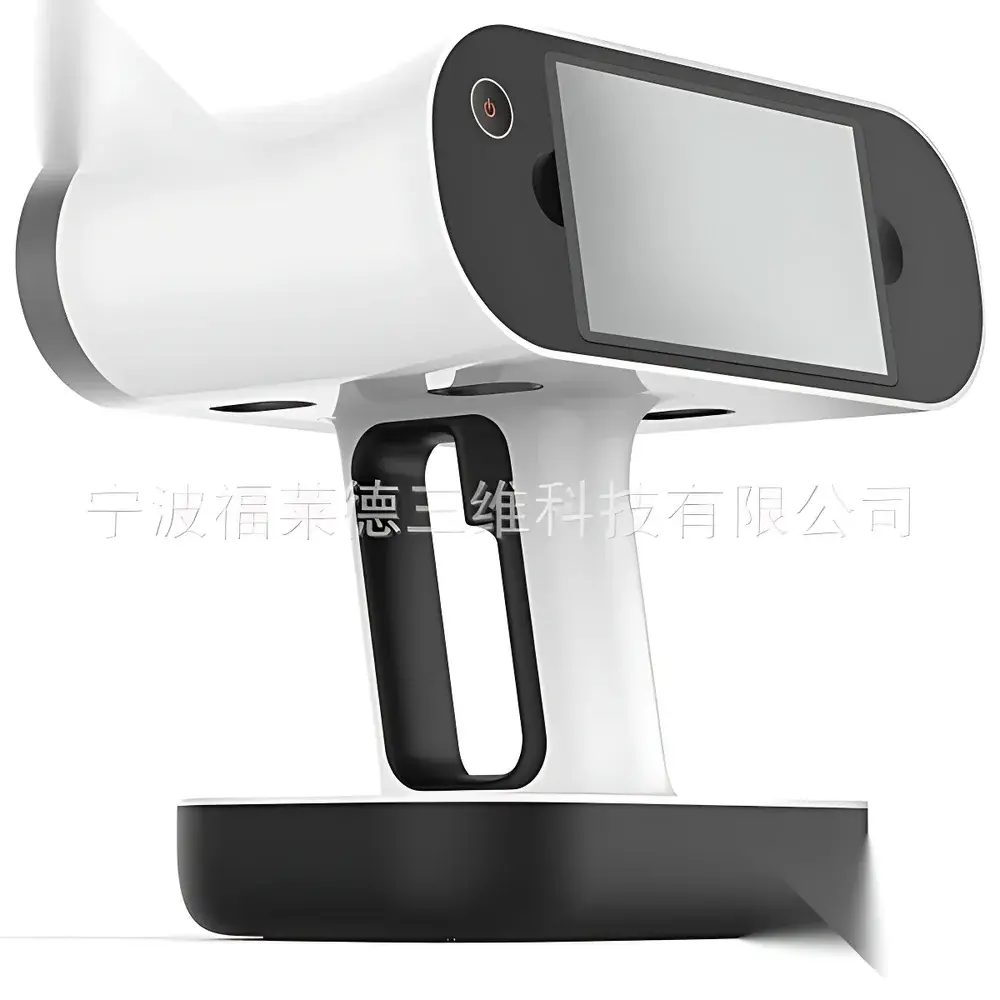
Artec Leo Portable Handheld 3D Scanner
| Brand | Artec |
|---|---|
| 3D Resolution | 0.25 mm |
| 3D Point Accuracy | ≤0.1 mm |
| Accuracy Drift | 0.03% per 100 cm |
| Light Sources | Dual-source — white-light 12-LED array + VCSEL 3D structured light |
| Near-range FOV | 246 × 153 mm |
| Far-range FOV | 843 × 527 mm |
| Working Distance | 0.35–1.2 m |
| Texture Capture | Yes |
| Video Frame Rate | ≤80 FPS |
| Data Acquisition Time | 0.0002 s |
| Capture Speed | ≤4 million points/sec |
| Weight | 1.8 kg |
| Power Supply | Integrated swappable battery or external 12 V DC |
| Dimensions (H×D×W) | 227 × 163 × 228 mm |
| Connectivity | Wi-Fi, Gigabit Ethernet, SD card slot |
| Onboard Processing | Yes — full real-time 3D reconstruction without external PC |
| Calibration | Self-calibrating |
Overview
The Artec Leo is a professional-grade, fully autonomous portable handheld 3D scanner engineered for high-fidelity, real-time geometric and photorealistic surface capture in diverse field and lab environments. Unlike traditional optical scanners requiring tethered workstations or post-acquisition processing pipelines, the Leo integrates a powerful onboard NVIDIA Jetson TX2 processor, a 5.5-inch HD touchscreen interface, and dual active illumination systems—white-light LED and VCSEL-based structured light—to deliver synchronized geometry and texture acquisition at up to 4 million points per second. Its measurement principle relies on triangulation-based stereo photogrammetry enhanced by adaptive pattern projection and real-time mesh generation, enabling sub-millimeter accuracy (≤0.1 mm) and 0.25 mm spatial resolution across variable working distances (0.35–1.2 m). Designed for metrology-adjacent applications—including reverse engineering, quality inspection, digital archiving, and additive manufacturing pre-processing—the Leo operates as a self-contained system with no dependency on external computing hardware or operating systems.
Key Features
- Real-time onboard 3D reconstruction: Full mesh generation, alignment, and texturing occur directly on the device—no laptop or desktop required.
- Dual illumination architecture: White-light LED array ensures consistent color fidelity and surface detail; VCSEL projector delivers robust depth data under varying ambient lighting conditions, including partial sunlight.
- Intuitive touch-guided workflow: The integrated HD display renders live 3D previews during scanning, allowing operators to rotate, zoom, and inspect coverage gaps instantaneously.
- Smart Mode & Manual Mode: Smart Mode automates registration, hole-filling, and smoothing using AI-assisted algorithms optimized for common object classes; Manual Mode grants granular control over alignment parameters, fusion thresholds, and outlier rejection criteria.
- Self-calibrating optical path: Factory-trimmed sensor alignment eliminates routine recalibration procedures—field deployment requires zero setup beyond power-on verification.
- Ruggedized ergonomic design: Weighing only 1.8 kg with balanced center-of-gravity distribution, the Leo supports extended handheld operation without fatigue-induced motion artifacts.
Sample Compatibility & Compliance
The Artec Leo captures geometry and texture from non-reflective, matte, and moderately textured surfaces—including plastics, composites, painted metals, ceramics, and organic materials—without requiring spray-based matting agents in most cases. It complies with IEC 60825-1:2014 Class 1 laser safety standards for VCSEL emission and meets CE, FCC, and RoHS directives for electromagnetic compatibility and environmental safety. While not certified to ISO/IEC 17025 or ASTM E2924 for metrological traceability, its performance specifications align with industrial benchmarks for non-contact 3D digitization used in ASME Y14.41-compliant GD&T workflows and ISO 10360-8 verification protocols when paired with certified reference artifacts.
Software & Data Management
Although fully functional as a standalone unit, the Leo seamlessly interoperates with Artec Studio 19+—a validated 3D processing suite supporting FDA 21 CFR Part 11-compliant audit trails, electronic signatures, and role-based access control for regulated environments. Export formats include STL, OBJ, PLY, AOP, and STEP (via optional CAD plugins), ensuring compatibility with major CAD platforms (Siemens NX, SolidWorks, Fusion 360) and slicers (Ultimaker Cura, Materialise Magics). All scan data can be stored locally on removable SD cards (up to 1 TB), streamed via Wi-Fi to network-attached storage, or transmitted over Gigabit Ethernet for centralized archival in LIMS or PLM systems.
Applications
- Reverse engineering of legacy components where original CAD is unavailable—enabling rapid iteration and tolerance validation against nominal models.
- In-field quality assurance of large-scale assemblies (e.g., aerospace fuselage sections, wind turbine blades) where portability and real-time feedback reduce downtime.
- Cultural heritage documentation: High-resolution digitization of sculptures, fossils, and archaeological artifacts with photorealistic texture preservation.
- Medical device prototyping: Accurate capture of anatomical phantoms and custom-fit orthotics for iterative design validation.
- Educational labs: Hands-on teaching of 3D perception principles, point cloud registration, and mesh topology without computational infrastructure overhead.
FAQ
Does the Artec Leo require a computer to operate?
No. All processing—including alignment, fusion, texturing, and export—is performed onboard. A computer is only needed for advanced post-processing or integration into enterprise data systems.
Can the Leo scan reflective or black surfaces without preparation?
It handles low-to-moderate reflectivity well due to VCSEL’s time-of-flight resilience, but highly specular or deep-black absorptive surfaces may require minimal matte spray for optimal point density.
Is firmware update supported over-the-air?
Yes—updates are delivered via Wi-Fi through Artec’s secure firmware portal and include enhancements to noise reduction, texture mapping stability, and multi-scan synchronization logic.
What is the recommended maintenance interval?
No scheduled maintenance is specified. Routine cleaning of lens elements and ventilation grilles with lens-grade tissue and isopropyl alcohol is advised every 200 operational hours.
How does the Leo ensure measurement repeatability across operators?
Through standardized scanning trajectories enforced by visual guidance overlays and built-in motion tracking—combined with deterministic algorithmic processing that eliminates subjective parameter tuning in Smart Mode.




