
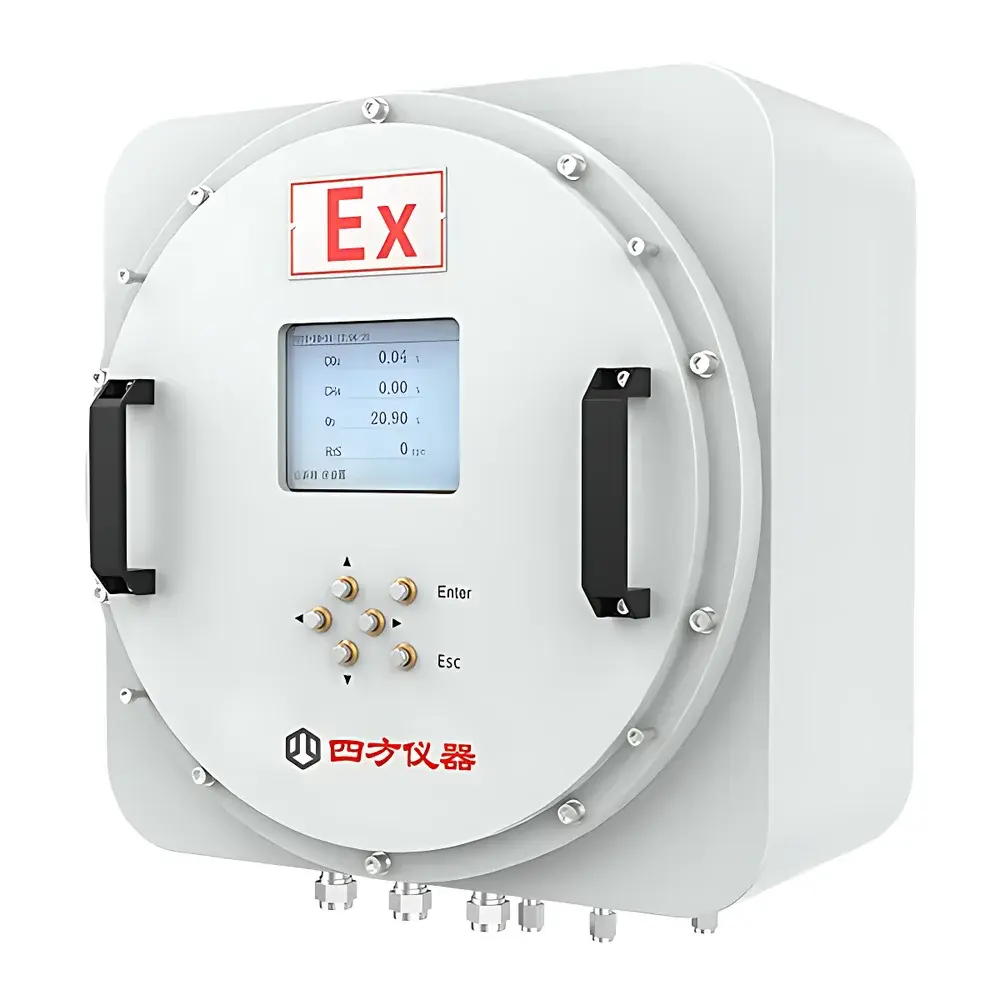
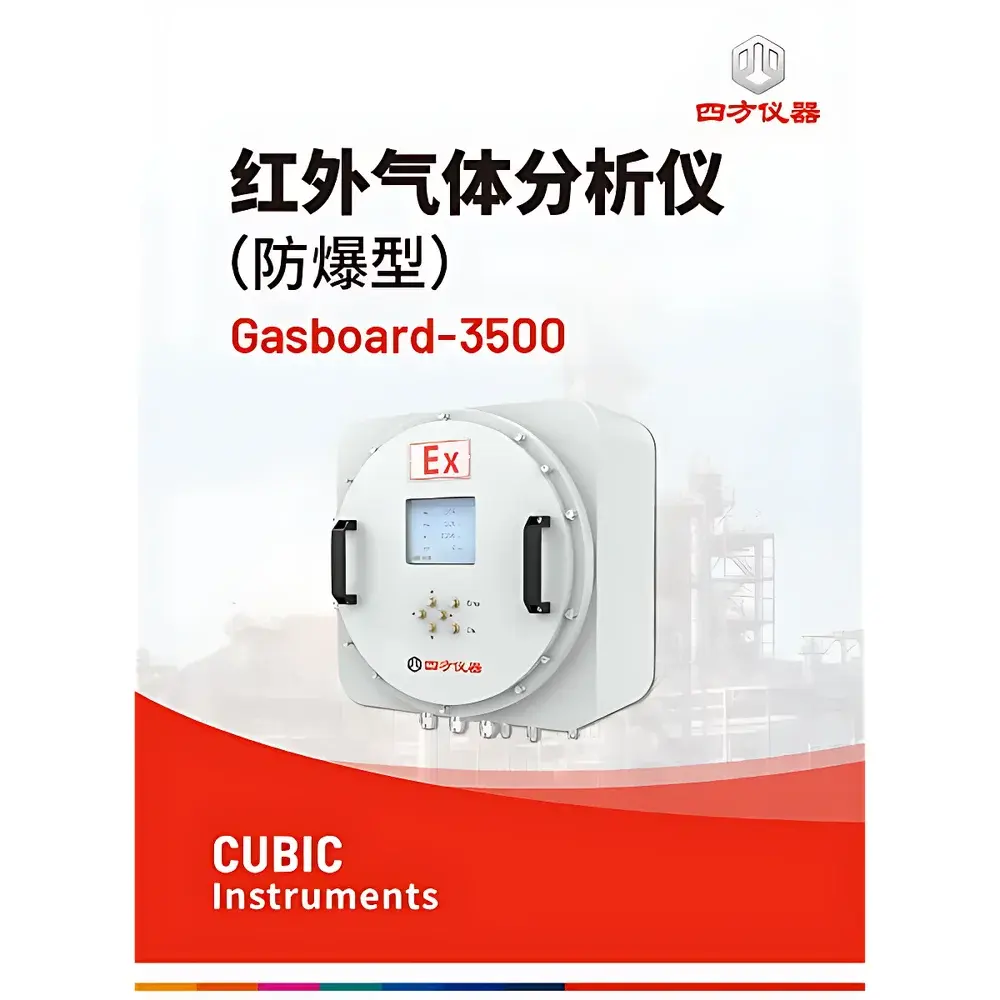
CUBIC Gasboard-3500 Intrinsically Safe Multicomponent Gas Analyzer for Anaerobic Digestion Monitoring
| Brand | CUBIC INSTRUMENTS |
|---|---|
| Origin | Hubei, China |
| Model | Gasboard-3500 |
| Measurement Principle | NDIR & Electrochemical Detection |
| Configuration | Fixed Online Analyzer |
| Response Time | T90 < 15 s (NDIR) |
| Repeatability | ≤2% FS |
| Accuracy | ±1% FS (CO/CO₂/CH₄/C₃H₈), ±2% FS (O₂/H₂S) |
| Resolution | 0.01% vol (low-range: 1 ppm) |
| Measured Gases | CO, CO₂, CH₄, C₃H₈, O₂, H₂S |
| Flow Rate | 0.7–1.2 L/min |
| Sample Pressure | 2–50 kPa |
| Explosion Protection | Ex d II CT6 / Ex tb IIIC T80°C Db |
| Output Interfaces | RS-485, RS-232, 4–20 mA, Ethernet |
| Power Supply | AC 220 V, 50 Hz |
| Display | LCD |
| Preconditioning | Integrated sample conditioning system (particulate filtration, moisture removal, oil exclusion) |
Overview
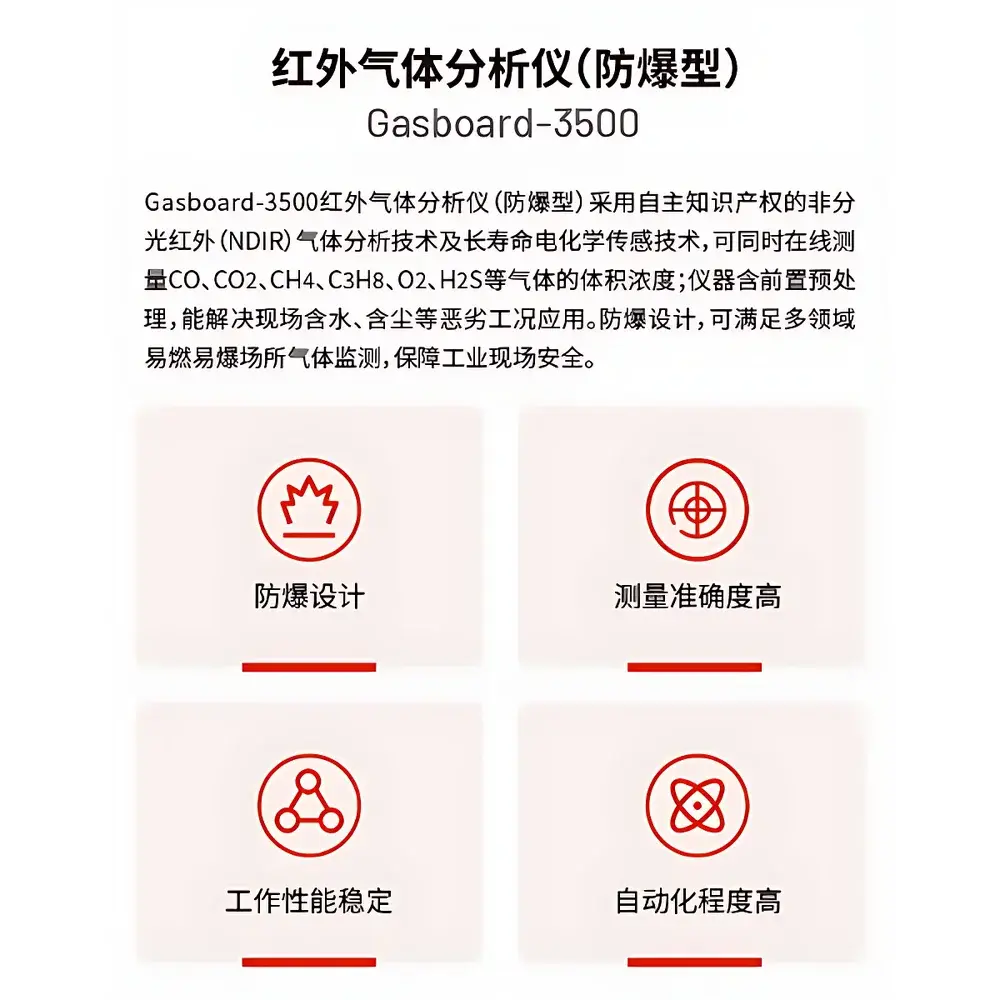
The CUBIC Gasboard-3500 is a certified intrinsically safe, fixed online multicomponent gas analyzer engineered specifically for continuous, real-time monitoring of biogas composition during anaerobic digestion in wastewater treatment plants, landfill sites, and industrial fermentation facilities. It employs dual-sensing architecture: non-dispersive infrared (NDIR) spectroscopy for quantitative detection of CO, CO₂, CH₄, and C₃H₈—gases exhibiting strong, spectrally distinct absorption bands in the mid-infrared region—and electrochemical cell (ECD) technology for selective, stable measurement of O₂ and H₂S. This hybrid optical–electrochemical design eliminates spectral cross-interference between co-present gases and ensures trace-level sensitivity without calibration drift under variable process conditions. The analyzer operates on the principle of Beer–Lambert law for NDIR channels and Faraday’s law of electrolysis for electrochemical sensors, delivering metrologically traceable concentration data compliant with ISO 14001 environmental management system requirements and supporting process optimization per EPA Method 25A and EN 15403 for biogas quality assessment.
Key Features
- Intrinsically safe and explosion-proof construction meeting Ex d II CT6 and Ex tb IIIC T80°C Db certification standards—validated for Zone 1 and Zone 21 hazardous areas in accordance with IEC 60079-0 and IEC 60079-11.
- Integrated sample preconditioning module featuring particulate filtration (≤0.3 µm), condensate separation, and hydrophobic membrane drying—enabling robust operation in high-humidity, high-dust biogas streams without external scrubbers or chillers.
- Dual-channel sensor architecture with temperature-compensated NDIR detectors and long-life electrochemical cells (>24 months typical service life), minimizing downtime and recalibration frequency.
- Onboard zero-gas pump and automatic air-based zero calibration routine—eliminating need for external calibration gas cylinders and supporting GLP-compliant operational verification.
- Full self-diagnostic capability: real-time monitoring of sensor health, optical path integrity, flow stability, and thermal equilibrium—logging fault codes with timestamped event history for audit readiness.
- All wetted materials constructed from 316L stainless steel and PTFE—resistant to H₂S-induced sulfide stress cracking and organic acid corrosion typical in digester off-gas.
Sample Compatibility & Compliance
The Gasboard-3500 accepts raw or partially conditioned biogas within specified physical limits: inlet pressure 2–50 kPa (gauge), sample flow 0.7–1.2 L/min, and dew point ≤5 °C post-conditioning. It tolerates particulate loadings up to 10 mg/m³ and total condensable hydrocarbons ≤100 ppmv when used with its integrated prefilter. Regulatory compliance includes CE marking under the ATEX Directive 2014/34/EU, RoHS 2011/65/EU, and EMC Directive 2014/30/EU. Data integrity features support FDA 21 CFR Part 11 compliance when deployed with validated SCADA integration—audit trails, electronic signatures, and user-access controls are enforced at the host system level.
Software & Data Management
The analyzer supports native Modbus RTU over RS-485 and ASCII protocol over RS-232 for seamless integration into DCS, PLC, or centralized EMS platforms. Analog 4–20 mA outputs provide redundant analog backup for critical safety loops. Optional Ethernet interface enables secure HTTP/HTTPS access to embedded web server for remote configuration, live data visualization, and firmware updates. Logged data—including raw sensor voltages, compensated concentrations, diagnostic flags, and calibration timestamps—is exportable as CSV or XML via USB or network transfer. All data fields are time-stamped using internal RTC synchronized to NTP servers, ensuring traceability across multi-site deployments.
Applications
- Real-time biogas composition tracking in municipal and industrial wastewater treatment digesters—enabling dynamic control of hydraulic retention time, organic loading rate, and pH stabilization.
- Landfill gas collection system optimization—monitoring CH₄/CO₂ ratio to assess decomposition stage and predict energy recovery potential.
- Process validation in anaerobic co-digestion trials involving food waste, agricultural residues, or sewage sludge—quantifying synergistic effects on gas yield and contaminant generation.
- Safety-critical monitoring of CO and H₂S in confined-space biogas handling areas—triggering ventilation or shutdown protocols per OSHA 1910.146 and EN 60079-29-1.
- Research-grade gas analysis in university laboratories conducting microbial ecology studies, metabolic pathway modeling, or biohydrogen production experiments.
FAQ
What gas components does the Gasboard-3500 measure simultaneously?
It measures CO, CO₂, CH₄, C₃H₈, O₂, and H₂S in a single stream—six components concurrently—with independent, interference-free quantification.
Is external calibration gas required for routine operation?
No. The built-in zero-air pump enables automated daily zero-point verification using ambient air; span calibration with certified gas mixtures is recommended quarterly or after maintenance.
Can the analyzer operate continuously in saturated biogas environments?
Yes—its integrated sample conditioning system removes >99.9% of liquid water and particulates, maintaining optical path clarity and sensor integrity without manual intervention.
How is explosion protection implemented?
Via flameproof enclosure (Ex d) for electronics and dust-ignition-proof (Ex tb) housing for sensor modules—both rated for surface temperature class T80°C to prevent ignition of combustible dust layers.
Does the device support regulatory reporting formats?
Yes. Output data conforms to EPA GHGRP Subpart MM and ISO 14064-3 QA/QC requirements—concentration values include uncertainty estimates derived from sensor repeatability and linearity specifications.







