
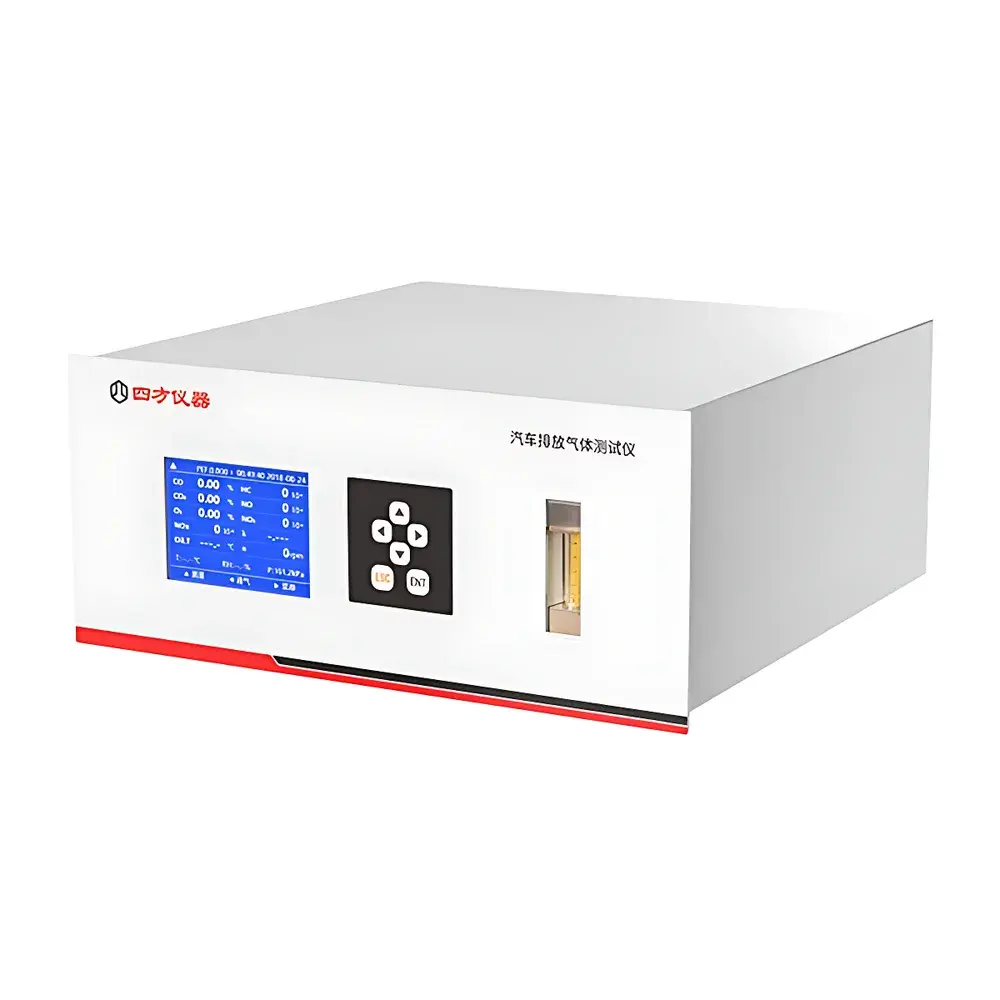
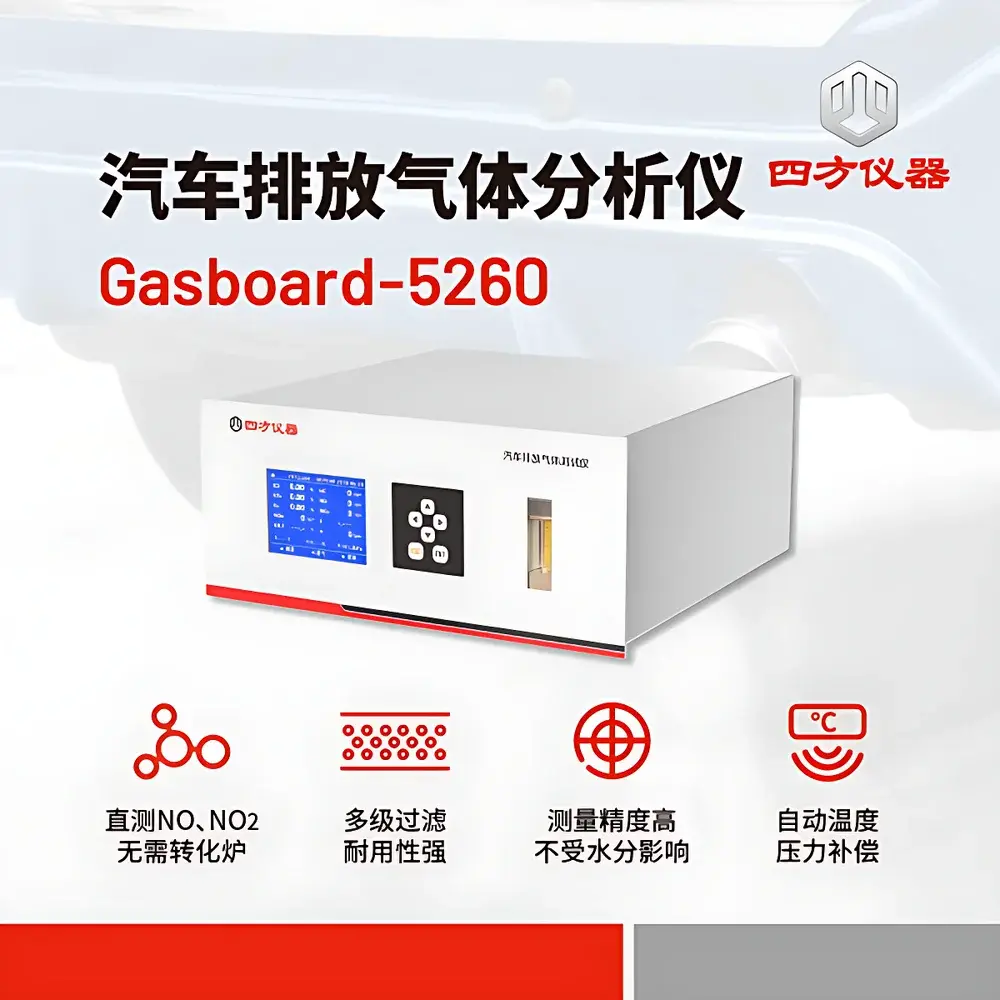
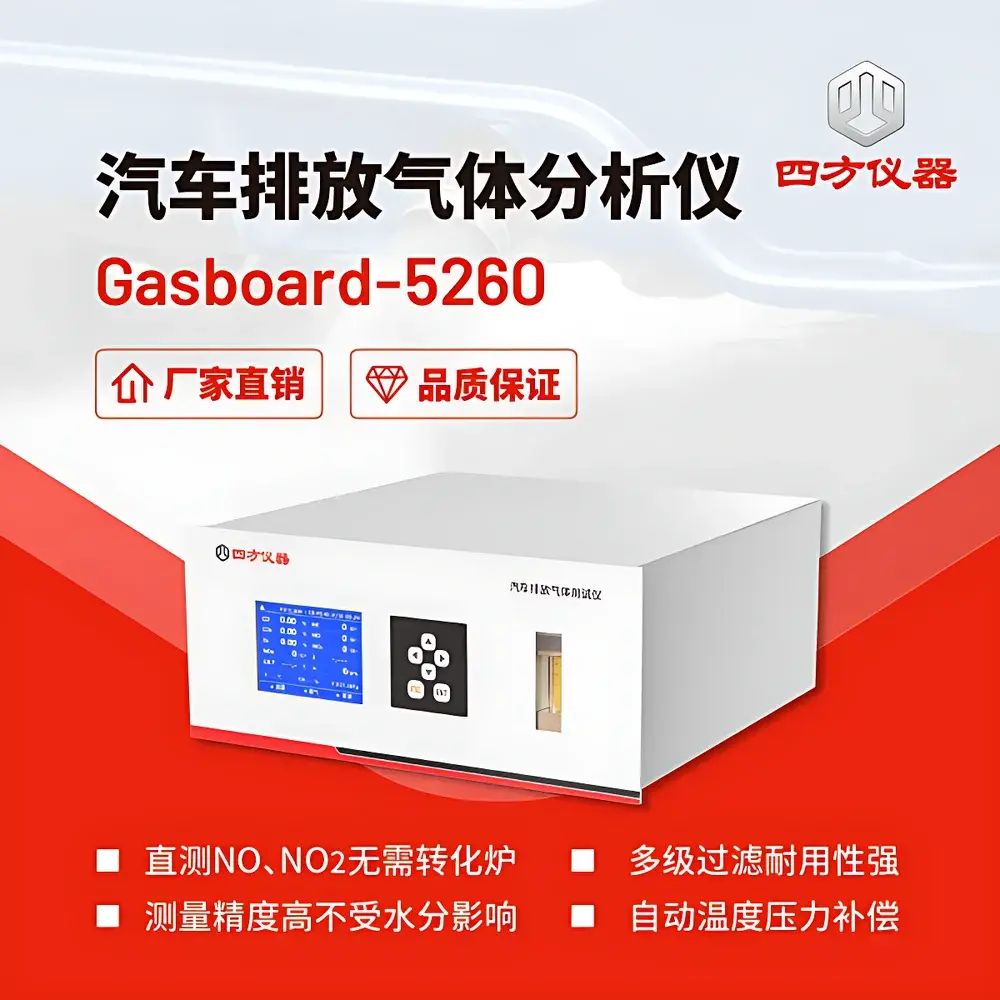
CUBIC INSTRUMENTS Gasboard-5260 Automotive Exhaust Gas Analyzer
| Brand | CUBIC INSTRUMENTS |
|---|---|
| Origin | Hubei, China |
| Model | Gasboard-5260 |
| Instrument Type | Online Analyzer |
| Detection Principles | Micro-flow Dual-chamber NDIR (for HC, CO, CO₂), Electrochemical (ECD) for O₂, Micro-flow Infrared Dual-chamber Sensor for NO, Non-dispersive Ultraviolet (NDUV) for NO₂ |
| Measured Gases | HC, CO, CO₂, NO, NO₂, O₂ |
| Measurement Ranges | HC (0–9999 ppm), CO (0.00–14.00% vol), CO₂ (0.0–18.0% vol), NO (0–5000 ppm), NO₂ (0–1000 ppm), O₂ (0.0–25.0% vol) |
| Accuracy | Compliant with JJG 688–2017 Class 00 and GB 18285–2018 |
| Resolution | NO/NO₂: 1 ppm |
| CO₂ | 0.01% vol |
| Response Time (T90) | HC/CO/CO₂ ≤ 8 s |
| Warm-up Time | 30 min |
| Power Supply | 100–240 VAC, 150 W |
| Communication Interface | RS-232 / RS-485 |
Overview
The CUBIC INSTRUMENTS Gasboard-5260 Automotive Exhaust Gas Analyzer is an online, multi-component emission measurement system engineered for regulatory-grade verification of gasoline-powered vehicle exhaust emissions. It operates on a hybrid optical and electrochemical detection architecture, integrating proprietary micro-flow dual-chamber non-dispersive infrared (NDIR) sensors for hydrocarbons (HC), carbon monoxide (CO), and carbon dioxide (CO₂); a temperature-stabilized micro-flow infrared sensor with dual reference chambers for nitric oxide (NO); non-dispersive ultraviolet (NDUV) absorption spectroscopy for nitrogen dioxide (NO₂); and long-life electrochemical cells (ECD) for oxygen (O₂). This configuration eliminates the need for catalytic NOx converters—reducing maintenance overhead, minimizing cross-sensitivity, and improving long-term signal stability under variable ambient conditions. The analyzer is designed to meet the metrological requirements of China’s national standards GB 18285–2018 (Limits and Measurement Methods for Pollutants from Gasoline Vehicles) and JJG 688–2017 (Verification Regulation for Automotive Exhaust Gas Analyzers), certified to Class 00 accuracy—equivalent to the highest permissible error tolerance defined for laboratory-grade calibration instruments used in statutory inspection environments.
Key Features
- Direct, simultaneous measurement of NO and NO₂ without NOx converter—enabled by dual-chamber micro-flow IR and NDUV technologies, ensuring structural compactness and zero consumable replacement over instrument lifetime.
- Multi-stage particulate and moisture filtration system integrated upstream of the gas sampling path, enhancing system durability in high-humidity or soot-laden exhaust streams typical of real-world vehicle testing.
- Real-time linearization algorithms embedded in firmware compensate for nonlinearity inherent in IR and UV absorption signals across full dynamic ranges, improving concentration fidelity at low- and high-end extremes.
- Automatic temperature and barometric pressure compensation applied to all gas channel outputs, referenced to standardized dry-gas conditions per ISO 8712 and ASTM D6584 protocols.
- Dedicated analog input interfaces for engine oil temperature and rotational speed (RPM), enabling synchronized emission profiling during transient test cycles such as ASM or IM240.
- Modular sensor architecture supports field-replaceable detection units with individual calibration traceability—facilitating GLP-compliant maintenance logs and audit-ready service records.
Sample Compatibility & Compliance
The Gasboard-5260 is validated for use with raw, un-diluted exhaust sampled directly from tailpipes or dilution tunnels operating within standard automotive test cell environments (−10 °C to +45 °C ambient, <90% RH non-condensing). Its optical and electrochemical sensing modules are calibrated against NIST-traceable gas standards and verified per ISO/IEC 17025 requirements when deployed in accredited laboratories. The analyzer complies with data integrity provisions aligned with FDA 21 CFR Part 11 (electronic record and signature controls), including secure user authentication, immutable audit trails for calibration events and configuration changes, and time-stamped raw signal logging. It supports integration into centralized fleet monitoring platforms via Modbus RTU over RS-485, meeting interoperability expectations for IEC 61131-3–based industrial control systems.
Software & Data Management
Built-in embedded firmware provides real-time display of all six gas concentrations, calculated air–fuel ratio (λ), and diagnostic status flags (e.g., filter saturation, sensor timeout, flow deviation). Data export is supported via ASCII-formatted CSV files over serial interface or USB host port, compatible with LIMS environments including LabWare, STARLIMS, and Thermo Fisher SampleManager. Optional PC-based software (Gasboard Control Suite v3.x) enables remote configuration, spectral view of IR/UV absorbance baselines, drift trending analysis, and automated report generation conforming to CNAS-CL01:2018 documentation templates. All calibration certificates include uncertainty budgets calculated per GUM (JCGM 100:2008), with expanded uncertainties (k=2) reported for each gas channel at multiple points across its range.
Applications
- Statutory emissions testing at MVI (Motor Vehicle Inspection) stations and provincial environmental protection bureaus conducting periodic technical inspections under GB 18285–2018.
- Production line QA/QC in OEM and Tier-1 powertrain facilities verifying aftertreatment system functionality prior to vehicle release.
- Research and development labs evaluating catalyst aging, EGR efficiency, and cold-start emission behavior using steady-state and transient dynamometer cycles.
- Third-party certification bodies performing type-approval testing per UN ECE Regulation No. 83 and GB 18352.6–2016 (China VI).
- Academic institutions studying combustion stoichiometry, NOx formation pathways, and real-driving emissions (RDE) correlation with laboratory bench data.
FAQ
Does the Gasboard-5260 require periodic NOx converter replacement?
No. The analyzer measures NO and NO₂ independently using dedicated micro-flow IR and NDUV channels—eliminating reliance on thermal or chemical conversion methods.
Is the device suitable for continuous unattended operation in a drive-through inspection lane?
Yes. With a 30-minute warm-up requirement and robust auto-compensation for ambient temperature and pressure fluctuations, it meets the uptime and repeatability demands of high-throughput inspection workflows.
Can raw exhaust condensate damage the internal optics?
No. Integrated thermoelectric cooling and multi-stage hydrophobic filtration prevent water vapor condensation and particulate deposition on optical windows, preserving measurement integrity over extended duty cycles.
How is calibration traceability maintained across regulatory audits?
Each unit ships with a factory calibration certificate referencing NIST SRM gases, and field calibrations can be performed using certified span gases with documented uncertainty—fully compliant with JJG 688–2017 verification procedures.
What communication protocols are supported for integration with existing test stand controllers?
RS-232 and RS-485 interfaces support ASCII command sets and Modbus RTU, enabling plug-and-play compatibility with AVL, Horiba, and custom-built chassis dynamometer control systems.
Related Products







