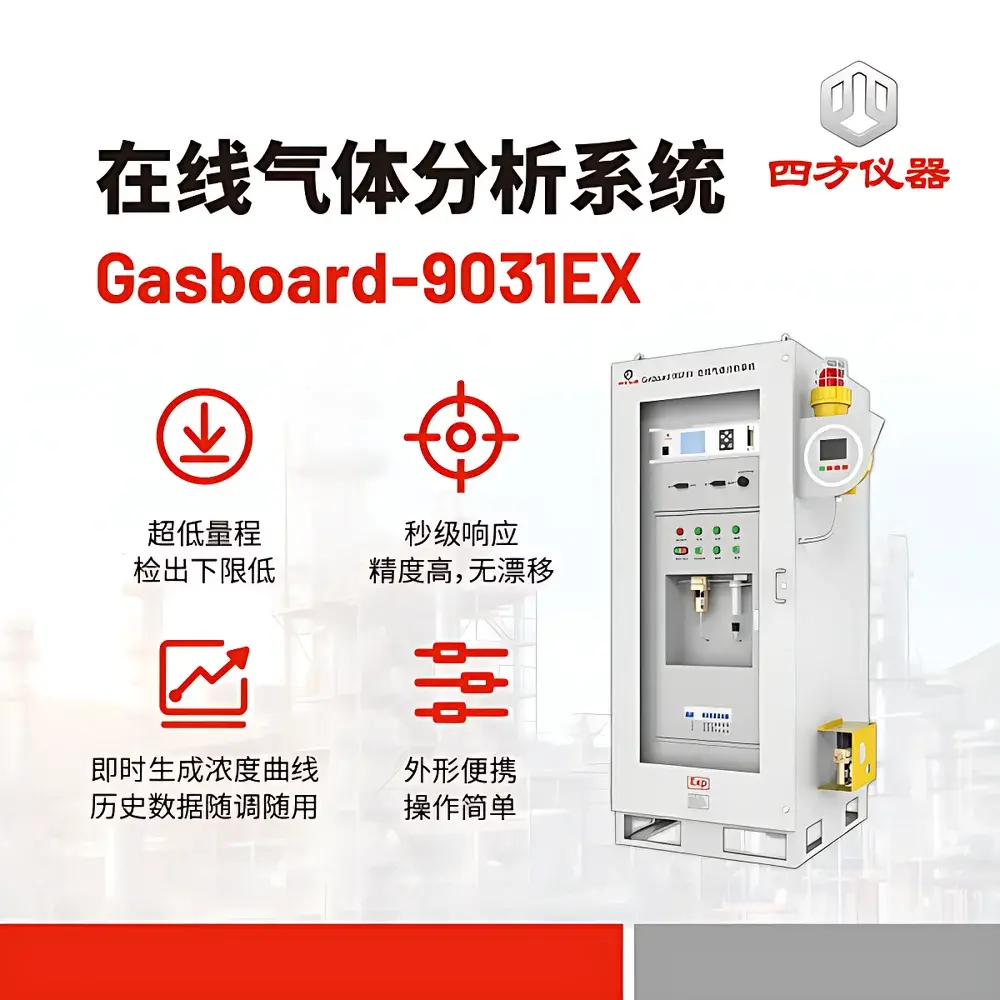
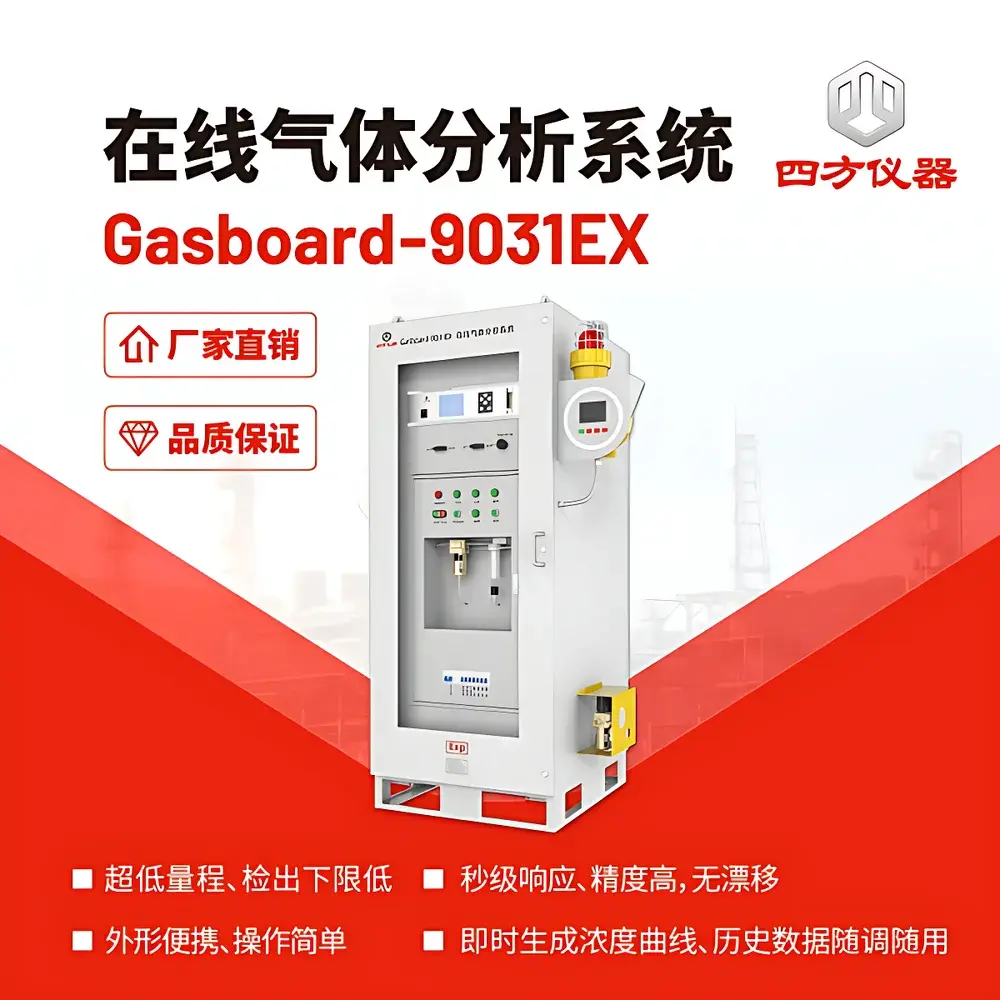
CUBIC INSTRUMENTS Gasboard-9031EX Online Biogas and Industrial Gas Analyzer
| Brand | CUBIC INSTRUMENTS |
|---|---|
| Origin | Hubei, China |
| Model | Gasboard-9031EX |
| Measurement Range | CO/CO₂/CH₄/H₂: (0–100)% |
| O₂ | (0–25)% |
| CnHm | (0–10)% (optional) |
| Resolution | CO/CO₂/CH₄/CnHm: ±1% FS |
| H₂/O₂ | ±2% FS |
| Response Time | 15 s (NDIR) |
| Operating Principle | NDIR + Electrochemical Cell (ECD) + Thermal Conductivity Detection (TCD) |
| Explosion Protection Rating | Ex d IIC T4 Gb |
| Output Interfaces | RS-232 / RS-485 / (4–20) mA / Ethernet |
| Display | LCD |
| Self-Diagnostic Function | Yes |
| Zero Calibration | Built-in air pump for automatic zeroing |
Overview
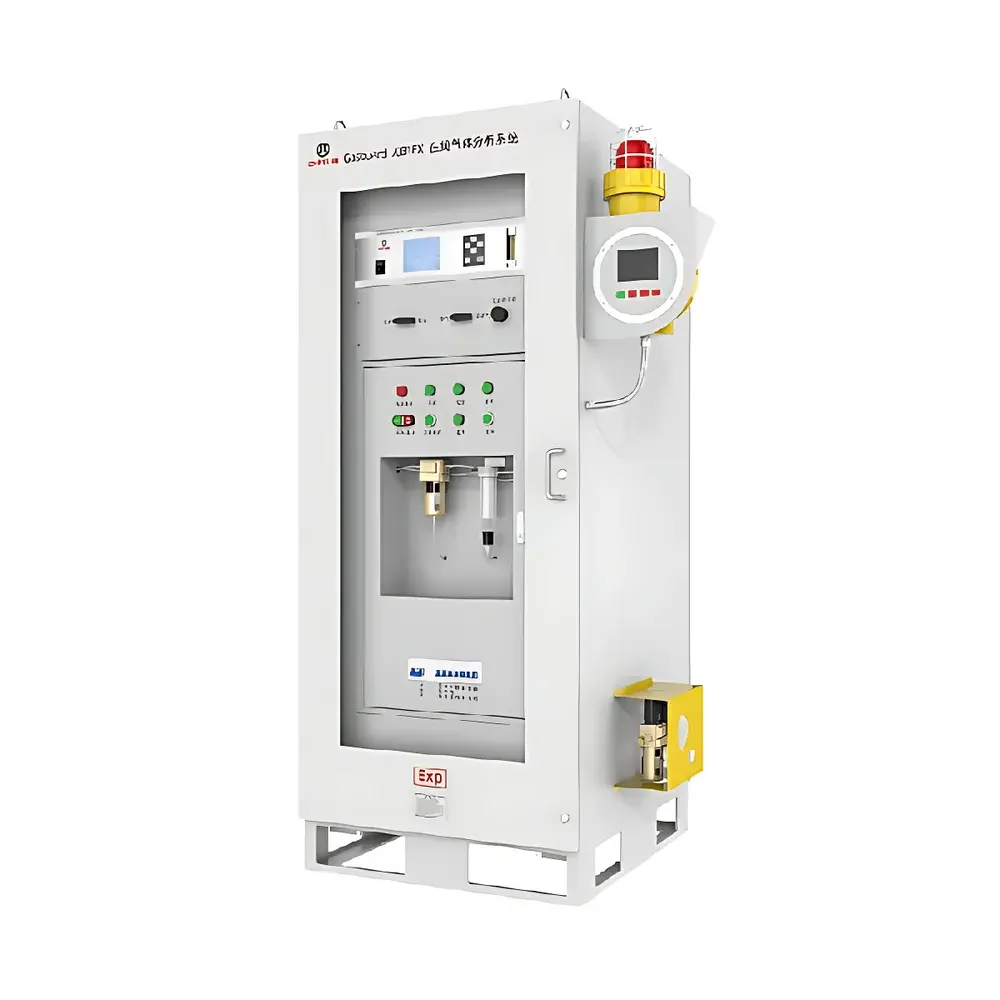
The CUBIC INSTRUMENTS Gasboard-9031EX is an integrated online gas analysis system engineered for continuous, real-time monitoring of multi-component industrial and biogas streams under low-dust process conditions. It employs a hybrid sensing architecture combining non-dispersive infrared (NDIR) spectroscopy for CO, CO₂, CH₄, C₂H₂, C₂H₄, and total hydrocarbons (CnHm), electrochemical detection (ECD) for O₂, and thermal conductivity detection (TCD) for H₂. This multi-principle approach ensures robust, cross-interference-resistant quantification across wide concentration ranges—critical for dynamic industrial environments such as blast furnace gas ducts, coke oven off-gas lines, dry-quenching circulating gas systems, and biogas upgrading plants. The system calculates higher heating value (HHV) in real time using ASTM D3588-17–based stoichiometric algorithms, eliminating the need for standalone calorimetric units. Its modular design—comprising a heated stainless-steel dry-sampling probe with reverse-purge capability, a single-stage refrigerated dryer, dual-stage particulate filtration, and a PLC-controlled automation module—ensures long-term stability, minimal drift, and unattended operation over extended maintenance intervals.
Key Features
- Explosion-proof enclosure rated Ex d IIC T4 Gb, certified for Zone 1 hazardous areas per IEC 60079-0 and EN 60079-1.
- Heated, corrosion-resistant stainless-steel sampling probe with programmable reverse-purge cycle to prevent dust accumulation and maintain flow integrity.
- Integrated refrigerative dryer and dual-stage mechanical filtration (coalescing + sintered metal) for effective water and particulate removal without chemical scrubbers.
- Automated PLC-based control sequence managing sample aspiration, condensate drainage, probe purging, and sensor zero calibration via built-in air pump.
- Real-time HHV computation compliant with ISO 6976:2016 and ASTM D3588-17 methodologies using measured volumetric concentrations of combustible species.
- Self-diagnostic firmware continuously monitors sensor health, signal-to-noise ratio, optical path integrity (for NDIR channels), and power supply stability—logging events for predictive maintenance.
Sample Compatibility & Compliance
The Gasboard-9031EX is validated for use with hot, humid, and mildly corrosive gas matrices typical of metallurgical, chemical, and anaerobic digestion processes—including blast furnace top gas, coke oven gas, syngas, landfill biogas, and digester biogas. Sample temperature tolerance extends up to 200 °C at the probe inlet (with active heating), while dew point suppression maintains analyzer inlet conditions below 5 °C. All gas contact materials meet ASTM A240 Type 316L requirements. The system supports compliance with ISO 14064-1 (GHG quantification), EPA Method 3A (O₂), EPA Method 10 (CO), and EN 15403:2006 (biogas quality). Data logging and audit trails align with GLP/GMP principles; optional firmware modules enable 21 CFR Part 11–compliant electronic signatures and user access controls.
Software & Data Management
Local operation is managed via a backlit monochrome LCD interface with intuitive menu navigation. All measurement data—including raw sensor outputs, compensated concentrations, HHV, and diagnostic flags—are timestamped and stored internally for ≥30 days. Standard communication protocols include RS-232, RS-485 (Modbus RTU), isolated 4–20 mA analog outputs (per channel), and Ethernet (TCP/IP, Modbus TCP). Integration with DCS/SCADA platforms (e.g., Siemens PCS7, Honeywell Experion, Emerson DeltaV) is achieved without proprietary gateways. Optional cloud-ready firmware enables MQTT-based telemetry to secure enterprise data lakes or IIoT dashboards, supporting OPC UA interoperability and TLS 1.2 encryption.
Applications
- Blast furnace gas optimization: Real-time CO/CO₂/CH₄/H₂ tracking for combustion efficiency modeling and slag chemistry control.
- Biogas upgrading plants: Continuous CnHm and O₂ monitoring to prevent explosive mixtures during membrane or PSA separation.
- Coke oven gas safety: Detection of C₂H₂ and C₂H₄ surges indicative of refractory failure or incomplete cracking.
- Dry quenching (CDQ) systems: O₂ and CO trending for inertization verification and fire risk mitigation.
- Waste-to-energy facilities: HHV-driven feedstock blending and boiler load forecasting.
- Research laboratories conducting gasification kinetics, catalyst deactivation studies, or anaerobic digestion modeling.
FAQ
What gas components does the Gasboard-9031EX measure simultaneously?
It measures CO, CO₂, CH₄, H₂, O₂, C₂H₂, C₂H₄, and total non-methane hydrocarbons (CnHm) in parallel, with real-time calculation of higher heating value (HHV).
Is the system suitable for high-temperature, high-humidity sampling environments?
Yes—the heated stainless-steel probe operates up to 200 °C, and the integrated refrigerative dryer maintains inlet dew point ≤5 °C, ensuring stable NDIR performance.
How is zero calibration performed?
An internal air pump draws ambient air through the optical path for automatic NDIR and ECD zeroing; TCD zero is maintained via reference gas compensation.
Does the analyzer comply with international explosion protection standards?
Yes—it carries full Ex d IIC T4 Gb certification per IEC 60079-1, approved for use in Zone 1 classified areas.
Can the system interface with existing plant DCS or MES platforms?
Yes—via native Modbus RTU/TCP, 4–20 mA outputs, or Ethernet, with no proprietary middleware required.