
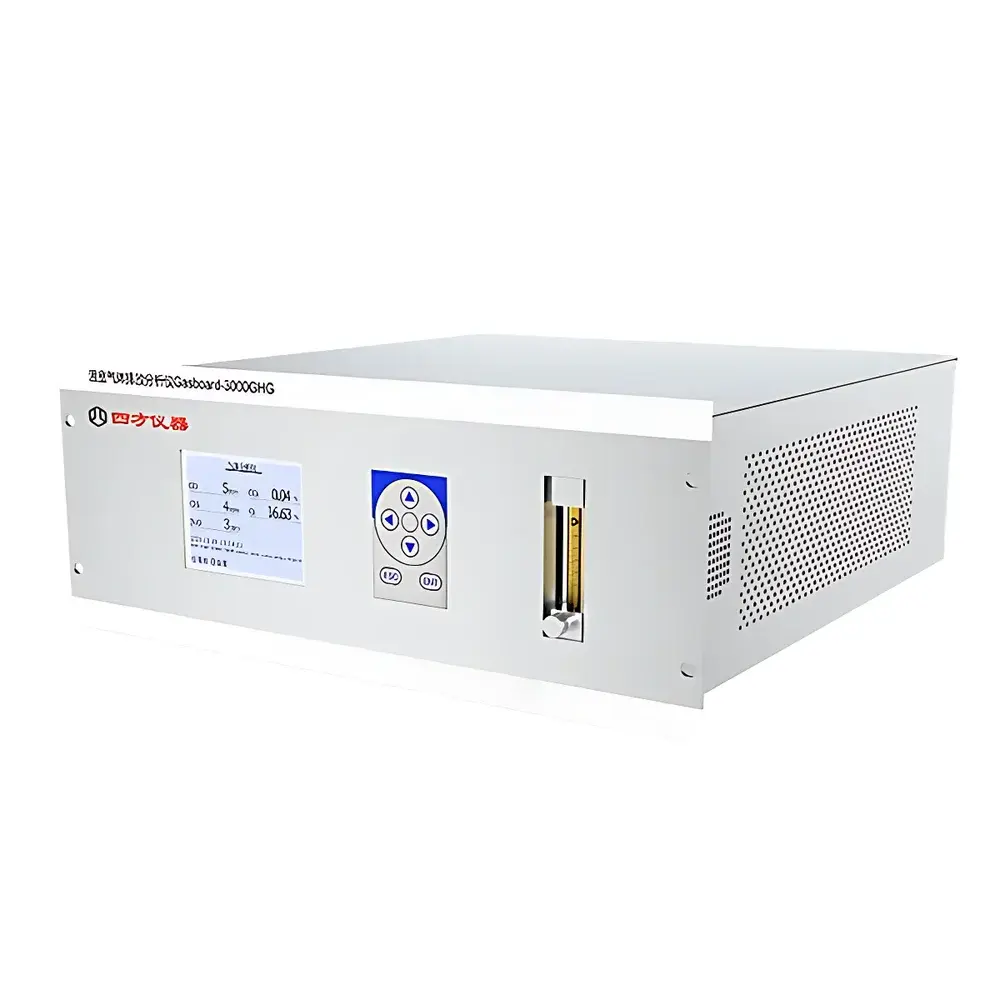
CUBIC Gasboard-3000GHG Greenhouse Gas Emission Analyzer for Iron & Steel Metallurgy
| Brand | CUBIC INSTRUMENTS |
|---|---|
| Origin | Hubei, China |
| Model | Gasboard-3000GHG |
| Detection Principle | Micro-flow NDIR (CO₂/CH₄/N₂O/CO) |
| Accuracy | ±1% F.S. (micro-flow NDIR), ±2% F.S. (dual-beam NDIR & ECD) |
| Measured Gases | CO₂, CH₄, N₂O, CO, O₂ |
| Response Time | T₉₀ < 25 s |
| Repeatability | ≤ ±1% |
| Flow Rate | 0.7–1.2 L/min |
| Inlet Pressure | 2–50 kPa |
| Output | RS-485/RS-232, 4–20 mA |
| Power | 100–240 VAC, max 300 W (heating), stable 100 W |
Overview
The CUBIC Gasboard-3000GHG is a dedicated multi-gas emission analyzer engineered for continuous, real-time monitoring of greenhouse gas (GHG) and combustion-related species in high-temperature, high-dust industrial exhaust streams—specifically optimized for iron and steel metallurgical processes including blast furnaces, basic oxygen furnaces (BOF), sintering plants, and coke oven gas systems. It employs three complementary sensing modalities within a single integrated platform: micro-flow non-dispersive infrared (NDIR) spectroscopy for low-concentration CO₂, CH₄, N₂O, and CO; dual-beam NDIR for robust high-range CO₂ (up to 100%) and mid-to-high-range CO (up to 5%); and electrochemical detection (ECD) for O₂ quantification. This hybrid architecture enables simultaneous, independent measurement of five critical gases with metrological traceability suitable for regulatory reporting under ISO 14064-1, EPA Method 21, and EU Monitoring Guidance for Industrial Emissions Directive (IED) compliance frameworks.
Key Features
- Patented micro-flow NDIR sensor with half-chamber reference design (PCT/CN2018100767, CN201710720122.1): eliminates baseline drift induced by ambient temperature fluctuations and water vapor interference—critical for wet, variable-composition flue gas from sinter coolers or BF stoves.
- Multi-range flexibility: CO₂ configurable across three spans—0–500 ppm (for fugitive emission verification), 0–20% (process control), and 0–100% (high-concentration stack monitoring)—all using the same optical path architecture.
- Sub-ppm resolution on CH₄ and N₂O channels (1 ppm), supporting Tier 2 GHG accounting per IPCC 2006 Guidelines and enabling detection of methane slip in coke oven gas recovery systems.
- Integrated sample conditioning: built-in heated sampling line (180 °C), particulate filter (<1 µm absolute rating), and condensate trap—designed to maintain sample integrity without external chillers or dilution systems.
- Dual analog (4–20 mA) and digital (RS-485 Modbus RTU, RS-232) outputs compliant with DCS/SCADA integration standards common in EAF and BOF automation environments (e.g., Siemens PCS7, Yokogawa CENTUM VP).
- Self-diagnostic firmware continuously monitors sensor health, zero/span stability, flow rate deviation, and heater status—generating event logs compatible with ISO/IEC 17025 audit trails.
Sample Compatibility & Compliance
The Gasboard-3000GHG accepts raw, hot, humid flue gas at inlet pressures of 2–50 kPa and flow rates of 0.7–1.2 L/min. Its internal heated path (180 °C) prevents condensation and preserves volatile organic compound (VOC) integrity during transit. All optical and electrochemical modules meet IEC 61000-6-2 (immunity) and IEC 61000-6-4 (emission) requirements for industrial electromagnetic environments. The analyzer supports GLP-aligned data integrity protocols—including user-accessible calibration history, time-stamped audit logs, and password-protected configuration—facilitating alignment with FDA 21 CFR Part 11 expectations where required for environmental QA/QC documentation. It is certified to CE marking (2014/30/EU EMC Directive, 2014/35/EU LVD Directive) and complies with EN 15267-3 for automated measuring systems used in waste incineration and metallurgical installations.
Software & Data Management
The embedded firmware provides local display of real-time concentration trends, alarm thresholds (configurable per gas), and diagnostic status. For enterprise-level deployment, CUBIC’s optional GasManager™ PC software enables remote configuration, batch calibration validation, and automated report generation (PDF/CSV) aligned with ISO 5167 and EN 14181 QAL2/QAL3 requirements. All measurement data include embedded timestamps, sensor ID, and uncertainty flags—enabling direct ingestion into environmental data management systems (EDMS) such as Sphera EHS or Intelex. Raw sensor output is stored internally for ≥30 days and exportable via USB or Ethernet—supporting third-party SCADA historians (e.g., OSIsoft PI System, AVEVA Historian) via OPC UA or Modbus TCP gateways.
Applications
- Real-time carbon intensity tracking in blast furnace top gas recycling loops, supporting decarbonization KPIs under the EU Carbon Border Adjustment Mechanism (CBAM).
- CH₄ and N₂O quantification in sinter plant exhaust to verify abatement efficiency of selective catalytic reduction (SCR) and thermal oxidation units.
- O₂ + CO co-monitoring in coke oven battery flues to optimize air-to-fuel ratios and minimize incomplete combustion losses.
- Continuous emissions monitoring system (CEMS) backup or redundancy for CO₂ and CO in basic oxygen furnace off-gas trains—meeting EN 14181 periodic QA/QC requirements.
- Stack testing support for EPA Method 3A (CO₂, O₂), Method 10 (CO), and ASTM D6522 (CH₄) in pre-compliance verification audits.
FAQ
Does the Gasboard-3000GHG require external gas calibration standards for routine operation?
No—zero calibration is performed automatically using internal N₂ purge; span calibration requires only certified gas standards at user-defined intervals (typically quarterly per EN 14181 QAL3).
Can the analyzer operate continuously in ambient temperatures exceeding 50 °C?
Yes—the enclosure meets IP54 ingress protection and is rated for operation at 0–50 °C ambient; optional air-cooled heat exchangers extend operational range to 60 °C.
Is the micro-flow NDIR technology susceptible to cross-sensitivity from SO₂ or NOₓ in steel mill flue gas?
No—optical bandpass filters and spectral deconvolution algorithms eliminate interference from SO₂ (7.3 µm), NO (5.3 µm), and NO₂ (6.2 µm) within the CO₂ (4.26 µm), CH₄ (3.3 µm), N₂O (4.5 µm), and CO (4.6 µm) detection windows.
How is data security ensured during remote access via RS-485 or Ethernet?
All communication layers enforce TLS 1.2 encryption (for Ethernet) and hardware-level write-protection on configuration registers (RS-485), preventing unauthorized parameter modification per IEC 62443-3-3 SL2 requirements.
What maintenance schedule is recommended for long-term field deployment?
Filter replacement every 3 months; optical window cleaning every 6 months; full sensor verification annually—documented in accordance with ISO/IEC 17025 Clause 7.7 for measurement traceability.
Related Products







