
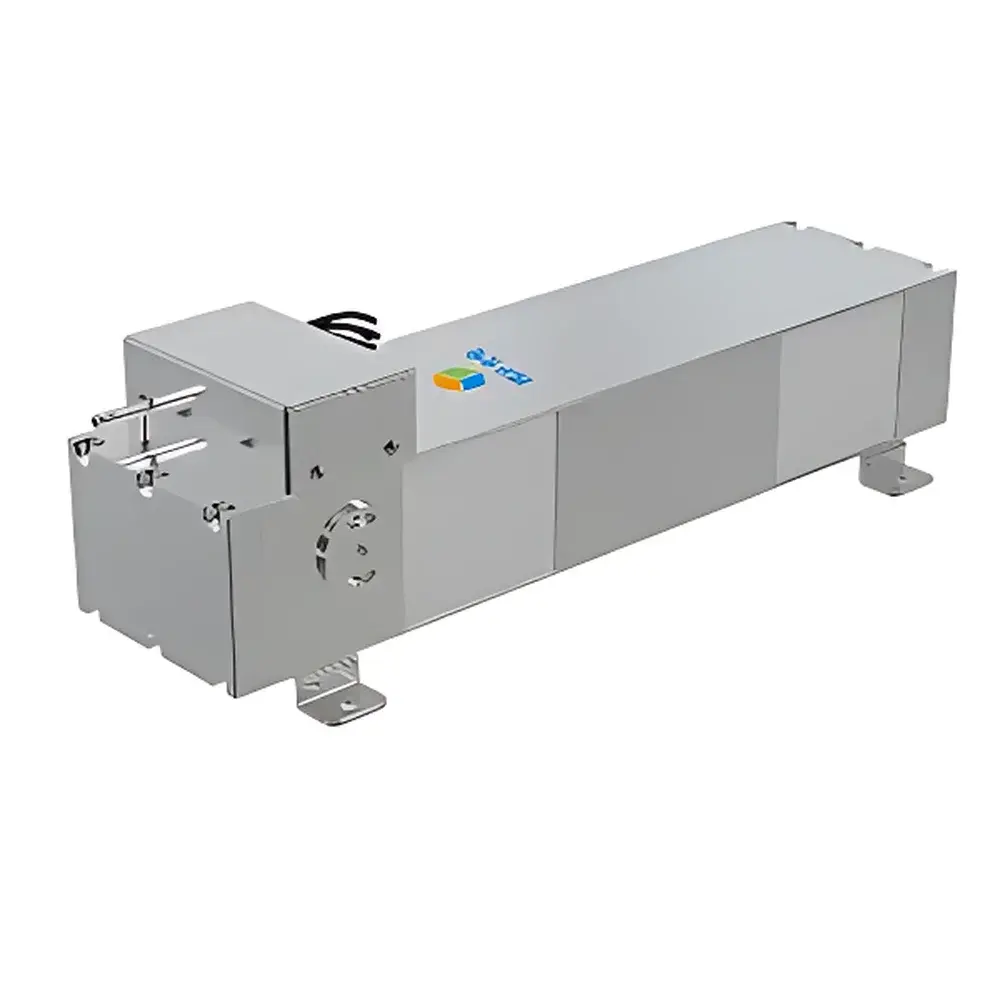
Cubic Gasboard-2502 TDLAS-Based Methane (CH₄) Sensor Module
| Brand | Cubic |
|---|---|
| Model | Gasboard-2502 |
| Detection Principle | Tunable Diode Laser Absorption Spectroscopy (TDLAS) |
| Target Gas | Methane (CH₄) |
| Measurement Range | 0–1000 ppm |
| Accuracy | ±5 ppm + 2% of reading |
| Resolution | 0.1 ppm |
| Warm-up Time | <10 s |
| Operating Temperature | −20 °C to +60 °C |
| Operating Humidity | 0–98% RH (non-condensing) |
| Operating Pressure | 80–120 kPa |
| Supply Voltage | 3.2–5.5 V DC |
| Current Consumption | <100 mA (@25 °C, 3.3 V) |
| Output Interface | TTL (3.3 V logic level) |
| Dimensions | 278 × 97 × 84 mm |
| Storage Conditions | −40 °C to +85 °C, 0–98% RH (non-condensing) |
| Selectivity | High (inherent spectral specificity of TDLAS) |
Overview
The Cubic Gasboard-2502 is a compact, OEM-grade methane (CH₄) sensor module engineered for continuous, real-time gas concentration monitoring in demanding environmental and industrial applications. It employs Tunable Diode Laser Absorption Spectroscopy (TDLAS), a physics-based optical measurement technique that exploits the unique near-infrared absorption line of methane at ~1653 nm. Unlike electrochemical or catalytic bead sensors, TDLAS provides inherent selectivity—eliminating cross-sensitivity to CO₂, H₂O vapor, CO, and common hydrocarbons—while delivering high reproducibility and long-term baseline stability. The sensor integrates a temperature-stabilized distributed feedback (DFB) laser diode, a precision-machined multi-pass absorption cell with proprietary surface passivation, and on-board temperature/pressure compensation algorithms compliant with ISO 14644-1 and ASTM D6725 for trace gas quantification under variable ambient conditions. Its robust architecture supports deployment in uncontrolled environments—including underground utility tunnels, LNG refueling stations, biogas upgrading facilities, and municipal natural gas distribution infrastructure—without requiring frequent recalibration.
Key Features
- True spectroscopic selectivity: No interference from water vapor, carbon dioxide, hydrogen sulfide, or volatile organic compounds (VOCs)
- Fast response dynamics: T90 < 2 seconds; warm-up time < 10 seconds—enabling rapid leak detection and transient event capture
- High metrological integrity: ±5 ppm absolute accuracy + 2% relative error across full 0–1000 ppm range, validated per ISO 12039 calibration protocols
- Low-power operation: <100 mA at 3.3 V DC enables battery-powered or energy-harvesting integration in remote monitoring nodes
- Modular mechanical design: Standardized 278 × 97 × 84 mm footprint with integrated mounting flanges and sealed I/O connector (JST VH series)
- Embedded digital compensation: Real-time correction for ambient temperature drift (−20 °C to +60 °C) and barometric pressure fluctuations (80–120 kPa)
- Extended service life: >5 years typical operational lifetime under continuous duty; no consumables or electrolytes to replace
Sample Compatibility & Compliance
The Gasboard-2502 is designed for direct in-situ sampling of ambient air or process gas streams containing methane within specified pressure and humidity limits. It complies with IEC 61000-6-2 (immunity) and IEC 61000-6-4 (emissions) for industrial electromagnetic compatibility. While not intrinsically safe certified, it meets EN 60079-0 general requirements for non-sparking electronic modules used in Zone 2 hazardous locations when integrated into an appropriately rated enclosure. The sensor’s optical path is resistant to particulate fouling due to internal purge channel geometry and hydrophobic coating on optical windows. All firmware and hardware design documentation align with ISO 9001:2015 quality management system requirements and support GLP/GMP-aligned validation protocols—including IQ/OQ/PQ documentation templates upon request.
Software & Data Management
The sensor communicates exclusively via TTL-level serial interface (3.3 V logic, UART protocol, 9600 bps default), supporting ASCII command sets for zero/span calibration, firmware version query, and real-time concentration streaming. No proprietary drivers or closed SDKs are required—integration is compatible with standard Linux RTOS, Arduino IDE, Raspberry Pi Pico, and industrial PLCs using Modbus RTU gateways. Raw analog output is not provided; all signal processing—including baseline subtraction, harmonic distortion correction, and Beer–Lambert law inversion—is performed internally. Audit-trail-capable logging requires external host-side timestamping; while the module itself does not implement FDA 21 CFR Part 11-compliant electronic signatures, its deterministic output format facilitates traceable data ingestion into validated LIMS or SCADA platforms.
Applications
- Urban gas infrastructure monitoring: Real-time CH₄ surveillance in underground utility corridors, valve pits, and metering stations
- Natural gas production & transmission: Leak detection at wellheads, compressor stations, and pipeline right-of-way patrol points
- Biogas and landfill gas upgrading: Process control feedback for methane enrichment and H₂S removal efficiency verification
- Hydrogen blending safety assurance: Detection of unintended CH₄ ingress in H₂-dominant distribution networks
- Smart city environmental networks: Integration into multi-gas urban air quality sensor nodes compliant with EU Directive 2008/50/EC
- Industrial safety systems: Triggering ventilation or alarm relays in confined-space entry protocols per OSHA 1910.146
FAQ
Is the Gasboard-2502 certified for use in hazardous areas?
No—this is an intrinsically safe *component*, not a complete device. It must be installed within an enclosure meeting ATEX/IECEx Zone 2 or Class I Div 2 requirements.
Can the sensor measure methane in high-humidity environments?
Yes—its optical design and embedded compensation algorithms maintain accuracy up to 98% RH (non-condensing); condensation must be prevented upstream via sample conditioning.
Does the module support automatic zero calibration?
Yes—via TTL command ‘AT+CAL=0’; however, this requires exposure to certified zero-air (CH₄-free N₂ or synthetic air) and is intended for periodic maintenance, not continuous auto-zero.
What is the recommended calibration interval?
Annual calibration is advised under normal operating conditions; semi-annual calibration is recommended in high-dust or corrosive chemical environments.
Is firmware update capability available?
Yes—field-upgradable via UART using Cubic’s documented bootloader protocol; version history and release notes are published in the OEM Integration Manual (Rev. 4.2+).







