
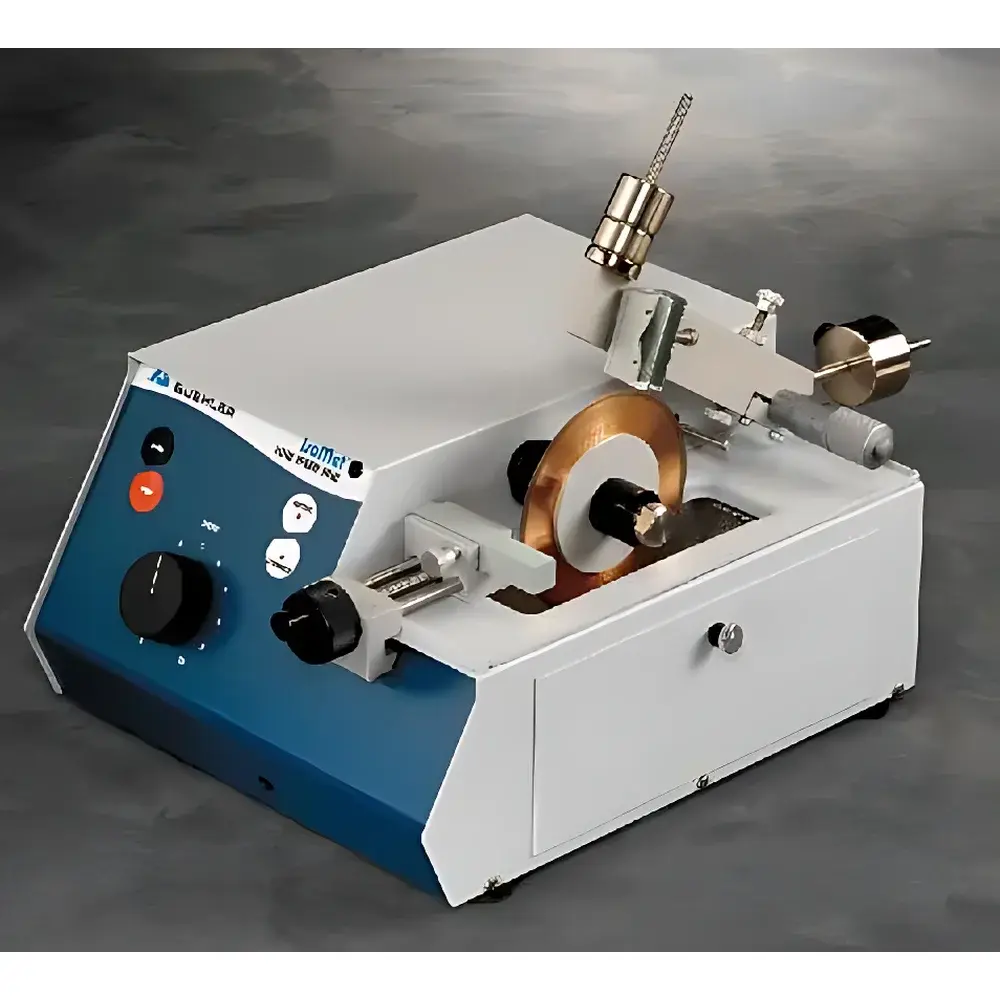
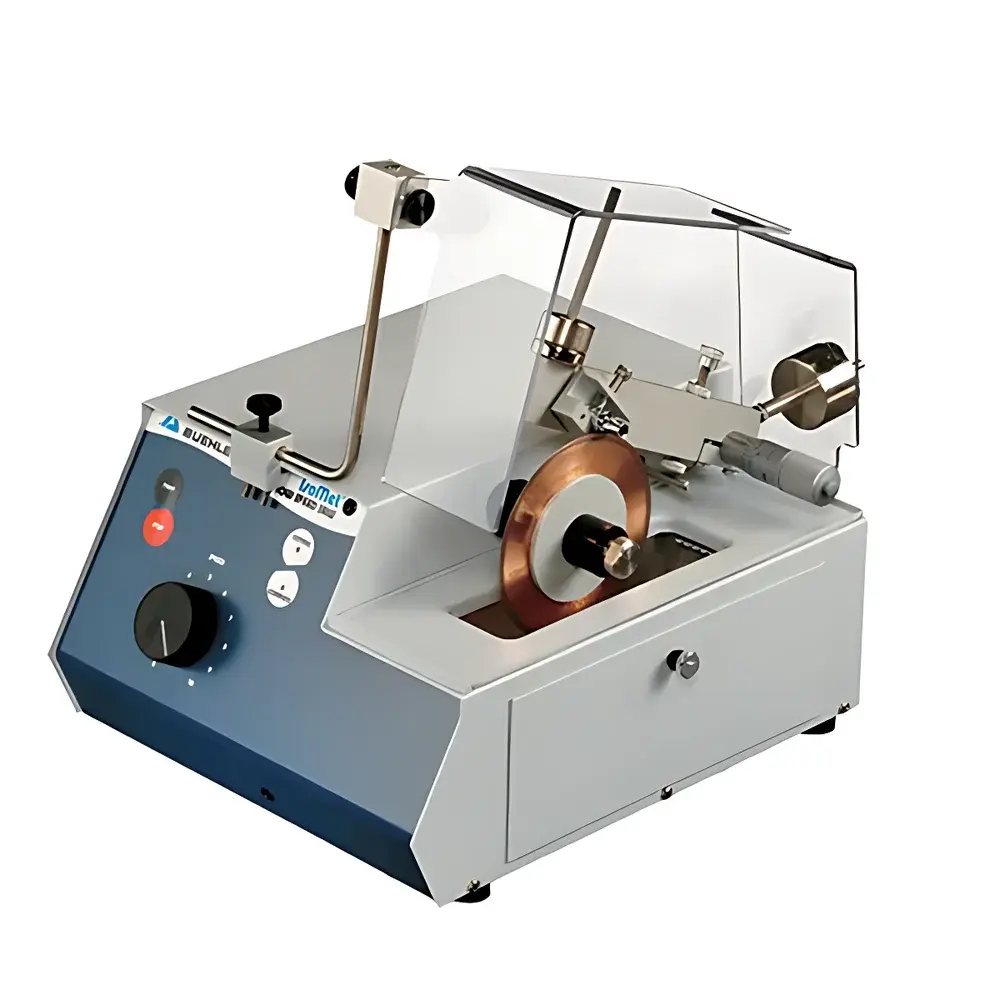
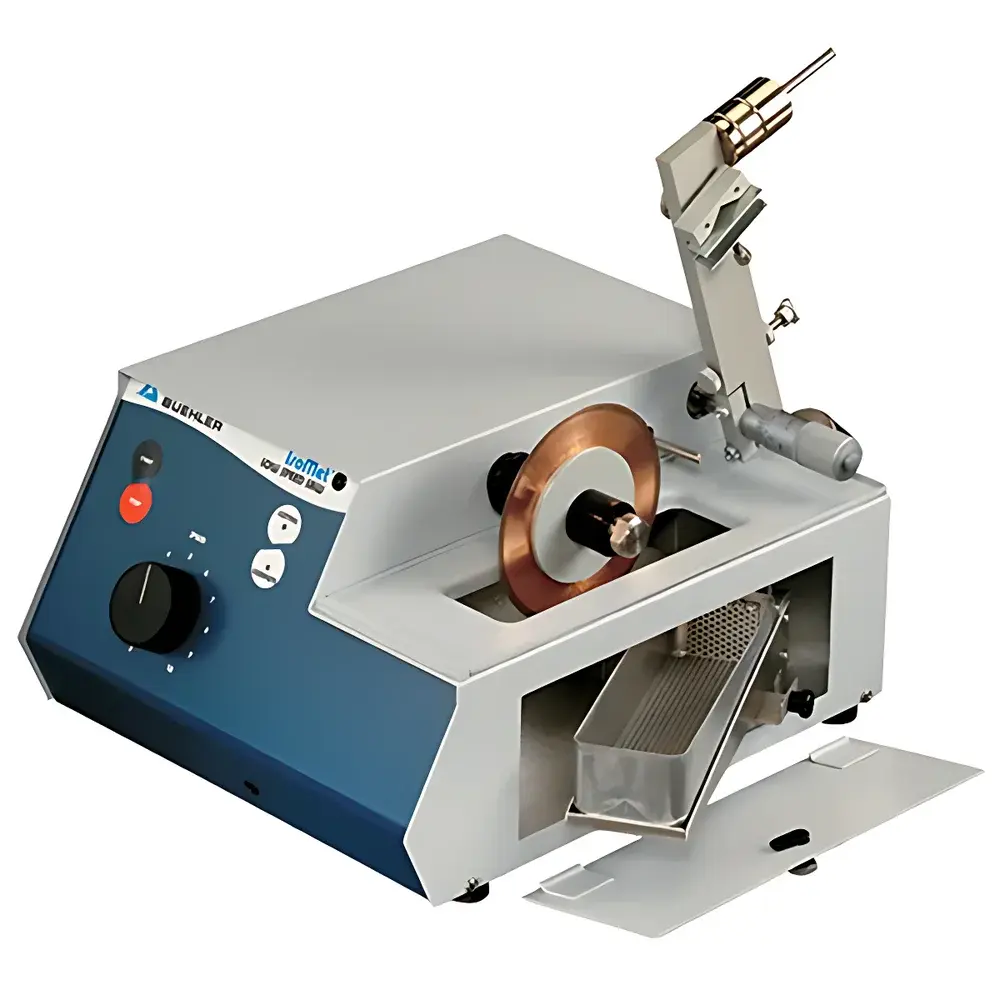
Buehler IsoMet™ Low Speed Precision Cutting Machine
| Brand | Buehler |
|---|---|
| Origin | USA |
| Model | IsoMet™ Low Speed Cutter |
| Cutting Speed Range | 0–300 rpm |
| Maximum Sample Height | 1.50 in (38.00 mm) |
| Blade Diameter | 5.00 in (127 mm) |
| Feed Mechanism | Gravity-fed |
| Positioning Accuracy | ±0.0001 in (±5 µm) |
| Cutting Type | Straight, Fixed-Angle Sectioning |
| Power Supply | 115 V / 220 V, 1-phase, 60 Hz |
| Compliance | Designed for ASTM E3, ISO 14487, and ISO 13009-compliant metallographic sample preparation |
Overview
The Buehler IsoMet™ Low Speed Precision Cutting Machine is an engineered solution for high-fidelity sectioning of materials where minimal thermal and mechanical deformation is critical. Operating on the principle of controlled gravity-fed feed and low rotational speed (0–300 rpm), the system minimizes shear stress, heat generation, and microstructural alteration during cutting—making it ideal for preparing specimens for optical microscopy, electron microscopy (SEM/TEM), hardness testing, and failure analysis. Unlike high-speed abrasive cutters that induce recast layers or grain boundary smearing, the IsoMet™ leverages precise kinematic control and optimized blade engagement to preserve native material integrity. Its rigid cast-iron base, vibration-damped column, and thermally stable design ensure consistent dimensional repeatability across extended operation cycles—key requirements in GLP/GMP-regulated labs and accredited metallurgical testing facilities.
Key Features
- Gravity-fed feed mechanism ensures constant, non-variable cutting force—critical for brittle ceramics, sintered carbides, semiconductor wafers, and calcified biological tissues.
- High-resolution micrometer positioning stage with ±5 µm (±0.0001 in) repeatability enables sub-millimeter slice thickness control and repeatable serial sectioning.
- Modular chuck system accommodates round, rectangular, irregular, and multi-part samples—including mounted specimens up to 38 mm in height.
- Variable-speed DC motor with closed-loop feedback maintains stable rpm under load, supporting optimal blade performance across diverse material classes (e.g., Ti-6Al-4V, SiC composites, CFRP laminates, PCBs).
- Ergonomic front-panel controls with tactile feedback and emergency stop integration meet IEC 61000-6-2 EMC and IEC 60204-1 safety standards.
- Integrated coolant delivery system with adjustable flow rate and directional nozzles suppresses debris accumulation and prevents localized heating at the cut interface.
Sample Compatibility & Compliance
The IsoMet™ supports a broad spectrum of heterogeneous materials without requiring process revalidation: ductile and brittle metals (e.g., aluminum alloys, tool steels), advanced ceramics (Al₂O₃, ZrO₂), polymer matrix composites, electronic substrates (Si, GaAs, flexible OLED panels), mineralogical specimens, and hydrated soft tissues (bone, dental enamel, vascular grafts). All cutting protocols align with ASTM E3 – Standard Guide for Preparation of Metallographic Specimens, ISO 14487 – Metallic Materials — Metallographic Examination, and ISO 13009 – Hardness Testing — Calibration of Reference Blocks. The machine’s mechanical traceability, documented calibration procedures, and absence of programmable logic controllers (PLCs) simplify audit readiness for ISO/IEC 17025-accredited laboratories.
Software & Data Management
As a manually operated, non-programmable instrument, the IsoMet™ does not incorporate embedded firmware or digital control interfaces. This architecture eliminates cybersecurity vulnerabilities, reduces validation burden under FDA 21 CFR Part 11, and facilitates straightforward IQ/OQ/PQ execution. All operational parameters—including blade type, coolant composition, feed rate setting (via weight stack configuration), and spindle speed—are recorded in paper-based or LIMS-integrated logbooks. Optional accessories such as digital height gauges and calibrated reference blocks enable metrological traceability to NIST standards. For labs implementing electronic record systems, Buehler provides SOP templates compliant with GLP Annex 11 and EU GMP Annex 11 requirements.
Applications
- Precision sectioning of turbine blade coatings prior to cross-sectional SEM-EDS analysis.
- Serial slicing of additively manufactured metal parts for porosity quantification per ASTM F2924.
- Cutting of orthopedic implant surfaces for wear scar evaluation under ISO 14242-1.
- Preparation of transmission electron microscopy (TEM) lamellae from battery electrode cross-sections.
- Controlled decapsulation of IC packages for failure root cause analysis (J-STD-033, IPC-A-610).
- Sectioning of geological core samples preserving fragile diagenetic features for petrographic imaging.
FAQ
What types of blades are compatible with the IsoMet™ Low Speed Cutter?
Standard 127 mm (5 in) diameter blades—including resin-bonded diamond, silicon carbide, and cubic boron nitride (cBN)—are supported. Blade selection must be matched to material hardness and required surface finish per Buehler’s Application Bulletin AB-204.
Is the IsoMet™ suitable for unmounted, friable samples?
Yes—when used with optional vacuum chucks, low-adhesion polymer fixtures, or epoxy embedding jigs, the gravity feed system avoids crushing forces that compromise fragile specimens such as sintered oxides or freeze-dried biomaterials.
Does the machine require annual recalibration?
While the micrometer stage is factory-calibrated and drift-resistant, users should verify positioning accuracy annually using certified gauge blocks traceable to NIST SRM 2101; documentation templates are available in Buehler’s Service Manual SM-IsoMet-LS.
Can the IsoMet™ be integrated into automated lab workflows?
No—it is a standalone manual instrument. However, its consistent mechanical output enables reliable interfacing with downstream robotic sample handlers via standardized mounting interfaces (ISO 9409-1-50-4-M6).
What safety certifications does the IsoMet™ hold?
It complies with UL 61010-1 (2nd Ed.), CSA C22.2 No. 61010-1, and CE marking per Machinery Directive 2006/42/EC, including full enclosure interlocks and splash-resistant coolant containment.



