
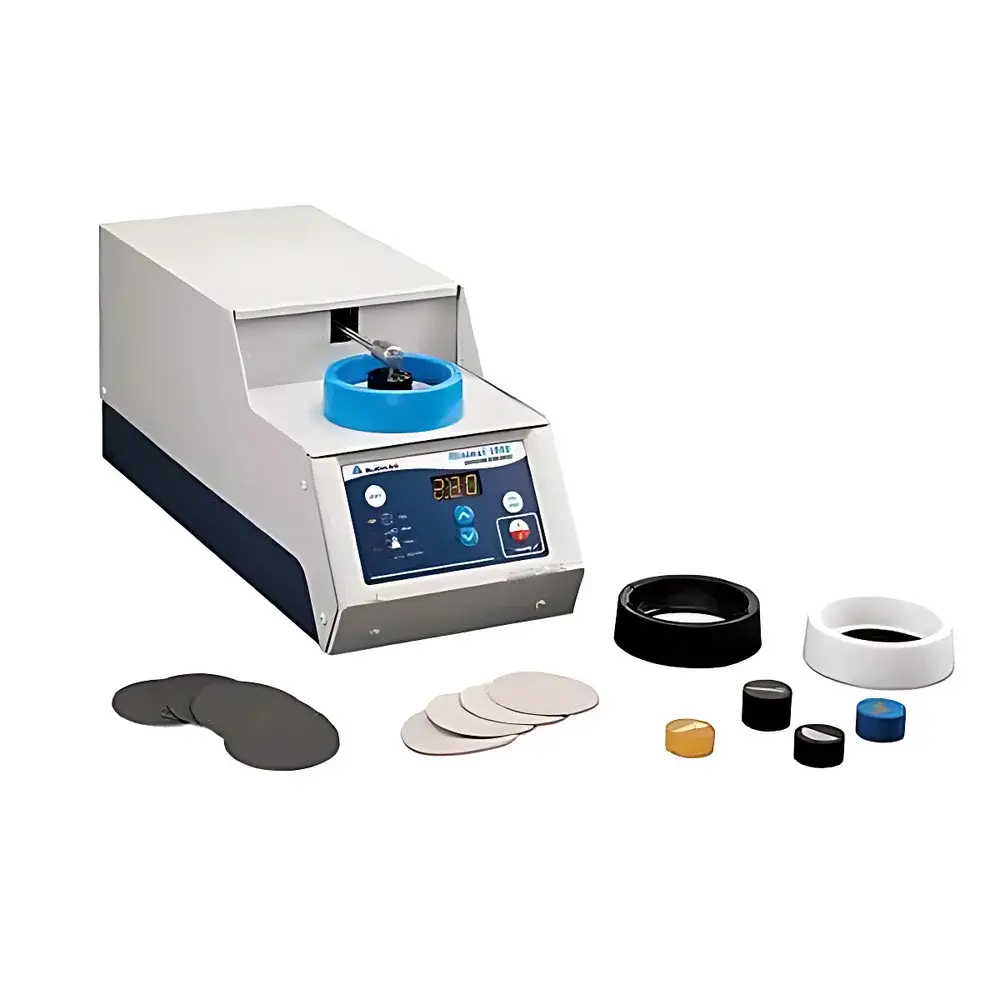
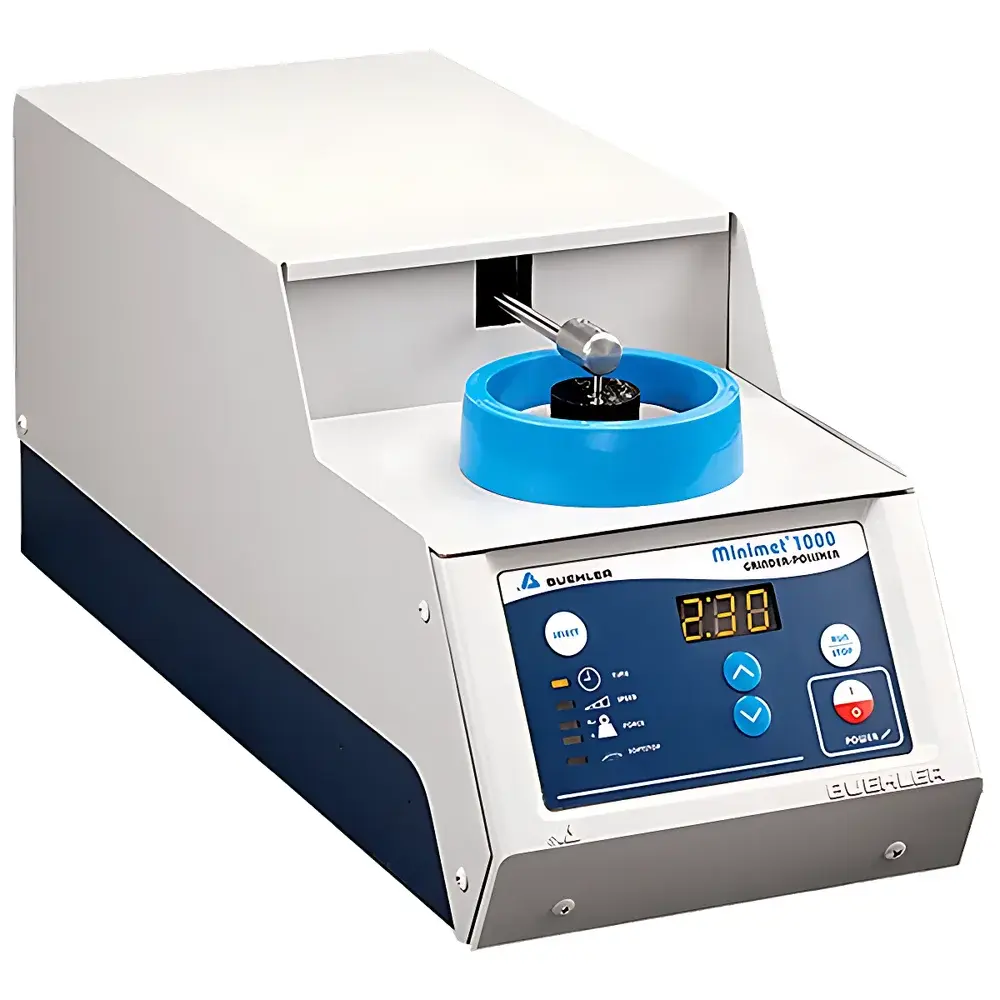
Buehler MiniMet 1000 Semi-Automatic Grinding and Polishing System
| Brand | Buehler |
|---|---|
| Origin | USA |
| Model | MiniMet 1000 |
| Grinding/Polishing Plate Diameter | 75 mm |
| Dimensions (L×W×D) | 180 mm × 400 mm × 200 mm |
| Number of Grinding/Polishing Plates | 1 |
| Power Supply | 85–264 V, 50–60 Hz, Single Phase |
| Weight | 11 kg |
| Operating Noise Level | <65 dB(A) at 1 m (unloaded) |
| Consumable Compatibility | 73 mm (2.875 in) abrasive papers and polishing cloths |
| Optional Configurations | Manual-only or semi-automatic with dual motorized heads |
Overview
The Buehler MiniMet 1000 is a compact, semi-automatic grinding and polishing system engineered for precision metallographic sample preparation in resource-constrained laboratory environments. Designed around the fundamental principles of controlled mechanical material removal—leveraging consistent pressure application, regulated rotational motion, and geometrically optimized kinematics—the MiniMet 1000 delivers high reproducibility in single-specimen preparation workflows. Its space-efficient footprint (180 × 400 × 200 mm) and modular architecture make it ideal for QC labs, R&D facilities, and educational institutions where benchtop real estate is limited but metallurgical integrity must remain uncompromised. Unlike fully automated systems requiring complex programming or large-scale infrastructure, the MiniMet 1000 balances operational simplicity with process control—supporting both manual operation and semi-automated protocols via optional dual motorized heads. The system adheres to core metallographic standards including ASTM E3, ISO 13022, and ASTM E407, ensuring compatibility with internationally accepted specimen preparation methodologies.
Key Features
- Compact footprint (7″ W × 16″ D × 8″ H) enables integration into dense lab layouts without sacrificing mechanical stability or thermal management.
- 75 mm grinding/polishing plate accommodates standard 73 mm (2.875″) abrasive papers and polishing cloths—reducing consumable waste and lowering per-sample cost compared to larger-diameter systems.
- Single-phase universal power input (85–264 V, 50–60 Hz) ensures global deployment readiness without voltage conversion hardware.
- Integrated retractable water delivery system provides targeted, adjustable rinse flow during polishing—eliminating cross-contamination between specimens and enabling rapid cleanup between cycles.
- Robust cast-aluminum housing and vibration-damped base minimize operational drift and enhance long-term repeatability across daily use.
- Tool-free consumable mounting system allows rapid changeover between silicon carbide papers, diamond suspensions, and cloth-based polishing media—critical for multi-step preparation sequences.
Sample Compatibility & Compliance
The MiniMet 1000 supports a broad range of conductive and non-conductive materials, including ferrous and non-ferrous metals, ceramics, composites, and sintered powders. Its low-force, high-precision motion profile is especially suited for brittle phases (e.g., intermetallics, carbides), soft alloys (e.g., aluminum, copper), and layered structures (e.g., coatings, brazed joints). All operational parameters—including dwell time, applied load (via optional force-controlled head), and slurry delivery rate—can be documented and audited in accordance with GLP and GMP requirements. While the base unit does not include built-in electronic data logging, its mechanical design conforms to the physical interface specifications referenced in ASTM E3-22 and ISO 13022-1:2021 for standardized metallographic specimen preparation equipment.
Software & Data Management
The MiniMet 1000 operates as a hardware platform compatible with Buehler’s integrated digital ecosystem. When equipped with optional motorized heads and the Buehler SmartConnect interface module, users gain access to protocol-driven operation via the Buehler OmniMet software suite. This environment supports user-defined method storage, cycle parameter recall (speed, time, pressure), and export of timestamped operation logs in CSV format—facilitating traceability under FDA 21 CFR Part 11-compliant workflows when deployed with validated IT infrastructure. Audit trails record operator ID, start/stop timestamps, and active configuration settings—enabling full procedural accountability during internal audits or regulatory inspections.
Applications
- Quality control of weld microstructures in aerospace and automotive components.
- Routine preparation of failure analysis specimens from fractured turbine blades or biomedical implants.
- Teaching laboratories conducting ASTM E3-compliant metallography training for undergraduate and graduate materials science curricula.
- Small-batch R&D of additively manufactured alloys where specimen geometry varies significantly and automation overhead is prohibitive.
- Preparation of cross-sections for SEM-EDS analysis of thin-film devices and PCB interconnects.
FAQ
Is the MiniMet 1000 suitable for hard ceramic materials such as silicon nitride or alumina?
Yes—the system’s rigid mechanical architecture and precise load control (when used with motorized heads) enable consistent planarization of hard, brittle ceramics without edge rounding or subsurface damage.
Can the MiniMet 1000 be integrated into an existing LIMS or ELN environment?
Direct API-level integration is not supported natively; however, exported CSV logs from OmniMet software can be ingested via standard ETL pipelines into validated LIMS or ELN platforms.
What maintenance intervals are recommended for optimal performance?
Daily cleaning of the water manifold and plate surface is required; bi-weekly inspection of the motor coupling and bearing assembly is advised; annual calibration of optional force-sensing heads is recommended per ISO/IEC 17025 guidelines.
Does the MiniMet 1000 meet CE or UKCA marking requirements?
Yes—the device complies with the EU Machinery Directive 2006/42/EC and EMC Directive 2014/30/EU, and carries CE marking for sale within the European Economic Area and Great Britain.



