
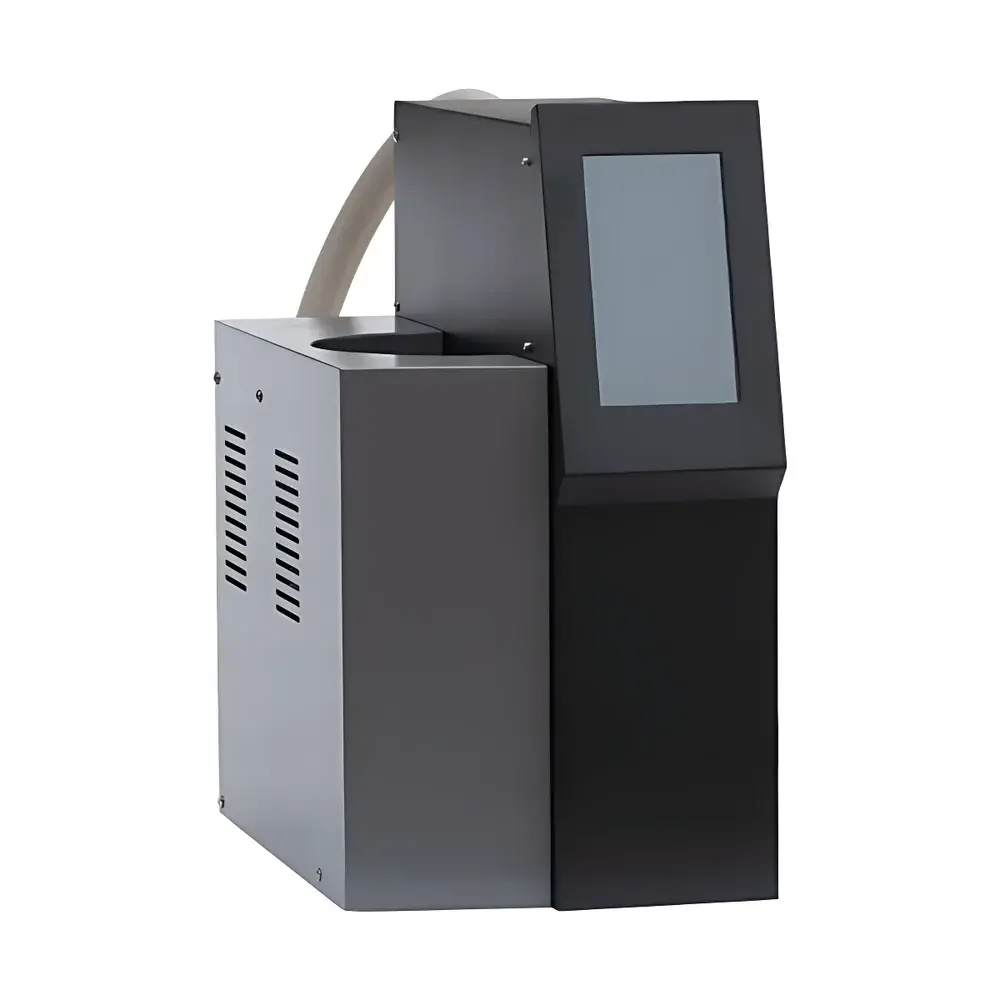
Zhonghuipu HS-24 Fully Automated Static Headspace Sampler
| Brand | Zhonghuipu |
|---|---|
| Origin | Beijing, China |
| Manufacturer Type | Direct Manufacturer |
| Instrument Type | Static Headspace Sampler |
| Automation Level | Fully Automatic |
| Sample Vial Capacity | 24 positions |
| Vial Sizes | 10 mL and 20 mL |
| Oven Temperature Range | 40–200 °C (optional up to 250 °C) |
| Valve & Transfer Line Temperature Range | 40–200 °C (optional up to 330 °C) |
| Quantitative Loop Volume | 1 mL (customizable up to 3 mL) |
| Temperature Control Accuracy | ±1 °C |
| RSD | ≤1.5% (for 100 ppm ethanol in water) |
| Power Consumption | Peak 350 W |
| Dimensions (L×W×H) | 430 × 270 × 500 mm |
| Net Weight | ~20 kg |
Overview
The Zhonghuipu HS-24 Fully Automated Static Headspace Sampler is an engineered solution for reproducible, unattended volatile compound analysis in compliance with ASTM D3699, ISO 11843, USP , and ICH Q3C guidelines. It operates on the principle of static headspace equilibrium—where a sealed sample vial is heated to promote partitioning of analytes between the liquid/solid phase and the gas phase above it. After thermal equilibration, a precise volume of headspace vapor is withdrawn via pressurized sampling and injected directly into a gas chromatograph (GC). Designed for laboratories requiring high throughput without operator dependency, the HS-24 supports method-defined temperature programming, timed pressurization, controlled agitation, and synchronized GC triggering—all within a single compact chassis constructed from precision-machined aluminum alloy for thermal stability and mechanical rigidity.
Key Features
- Fully automated 24-position carousel with intelligent vial detection: automatically skips empty or misaligned positions to prevent mechanical collision and ensure uninterrupted sequence execution.
- Triple-zone independent temperature control: sample oven, six-port valve housing, and transfer line—all heated and insulated to eliminate cold spots and preserve thermolabile analytes.
- Rotary agitation with three programmable intensity levels enhances mass transfer kinetics and reduces equilibrium time—critical for viscous matrices or low-volatility compounds.
- RESTEK Siltek®/Sulfinert®-treated 316L stainless steel flow path—including quantitative loop and valve internals—ensures inertness for polar, acidic, sulfur-containing, and reactive species; validated for trace-level benzene detection (≤1 ppb in aqueous matrix).
- Positive-pressure sampling mechanism eliminates baseline drift associated with vacuum-based systems and maintains constant inlet pressure to the GC, improving retention time stability and peak shape fidelity.
- Integrated microprocessor control with 7-inch capacitive touchscreen interface; supports full method parameter definition including equilibration (0–100 min), pressurization (0–10 min), sampling (0–10 min), loop equilibration (0–10 min), injection (0–10 min), and purge (0–100 min).
- No external gas supply required: all actuation is motor-driven, reducing infrastructure dependencies and enhancing operational safety in regulated environments.
Sample Compatibility & Compliance
The HS-24 accommodates standard 10 mL and 20 mL crimp-top or screw-cap headspace vials, compatible with widely adopted septa materials (e.g., PTFE/silicone, butyl rubber). Its inert flow path and validated RSD of ≤1.5% (measured using 100 ppm ethanol in water per ASTM D6300 repeatability criteria) support applications in pharmaceutical residual solvent testing, environmental VOC monitoring, food flavor profiling, and forensic toxicology. The system meets essential requirements for GLP and GMP workflows: audit-trail-capable software integration, hardware-initiated error logging, and deterministic motion control with automatic fault recovery. All firmware and hardware design align with IEC 61000-6-2/6-3 EMC standards and CE marking directives.
Software & Data Management
The HS-24 features dual-mode communication architecture: native RS-232/USB interface for direct connection to third-party GC data systems (e.g., Agilent OpenLab, Thermo Chromeleon, Shimadzu GCsolution), and optional Ethernet-enabled remote control via TCP/IP. The included Windows-based control software provides real-time status visualization—including vial position, current temperature setpoints, valve actuation timing, and error event history—with timestamped logs exportable in CSV format. For 21 CFR Part 11 compliance, the system supports user authentication, electronic signatures, and immutable audit trails when deployed with validated LIMS or chromatography data systems. Method files are encrypted and version-controlled to prevent unauthorized modification.
Applications
- Pharmaceutical QC: Residual solvents (Class 1–3) per USP and ICH Q3C, including acetone, methanol, dichloromethane, and ethyl acetate in active pharmaceutical ingredients (APIs) and excipients.
- Environmental analysis: BTEX (benzene, toluene, ethylbenzene, xylenes), chlorinated hydrocarbons, and trihalomethanes in drinking water, wastewater, and soil extracts.
- Food & beverage: Ethanol quantification in non-alcoholic beverages, off-flavor compound screening (e.g., geosmin, 2-methylisoborneol), and packaging migration studies.
- Forensics & toxicology: Blood alcohol concentration (BAC) determination, volatile organic poison screening (e.g., cyanide precursors, aliphatic hydrocarbons).
- Polymer & chemical manufacturing: Monomer residue analysis in PVC, styrene in polystyrene, and catalyst carryover assessment.
FAQ
Does the HS-24 support dynamic headspace (purge-and-trap) mode?
No—the HS-24 is a static headspace sampler only. It does not include trapping columns, cryofocusing, or carrier gas purging capabilities.
Can the instrument be integrated with Agilent 8890 GC systems?
Yes—via standard TTL or RS-232 handshake protocols; the HS-24 recognizes the GC’s ready signal and triggers injection synchronously.
Is validation documentation (IQ/OQ/PQ) available?
Factory-issued OQ protocols and calibration certificates are provided; site-specific IQ/PQ templates compliant with ISO/IEC 17025 and ASTM E2500 are available upon request.
What maintenance intervals are recommended for the quantitative loop and valve?
Under typical usage (≤100 injections/day), RESTEK-treated components require cleaning every 500 injections; full valve inspection is advised annually or after 2,000 cycles.
Can the system operate unattended overnight?
Yes—its fault-tolerant design, automatic vial skipping, and thermal runaway protection enable reliable 24/7 batch processing without supervision.





