
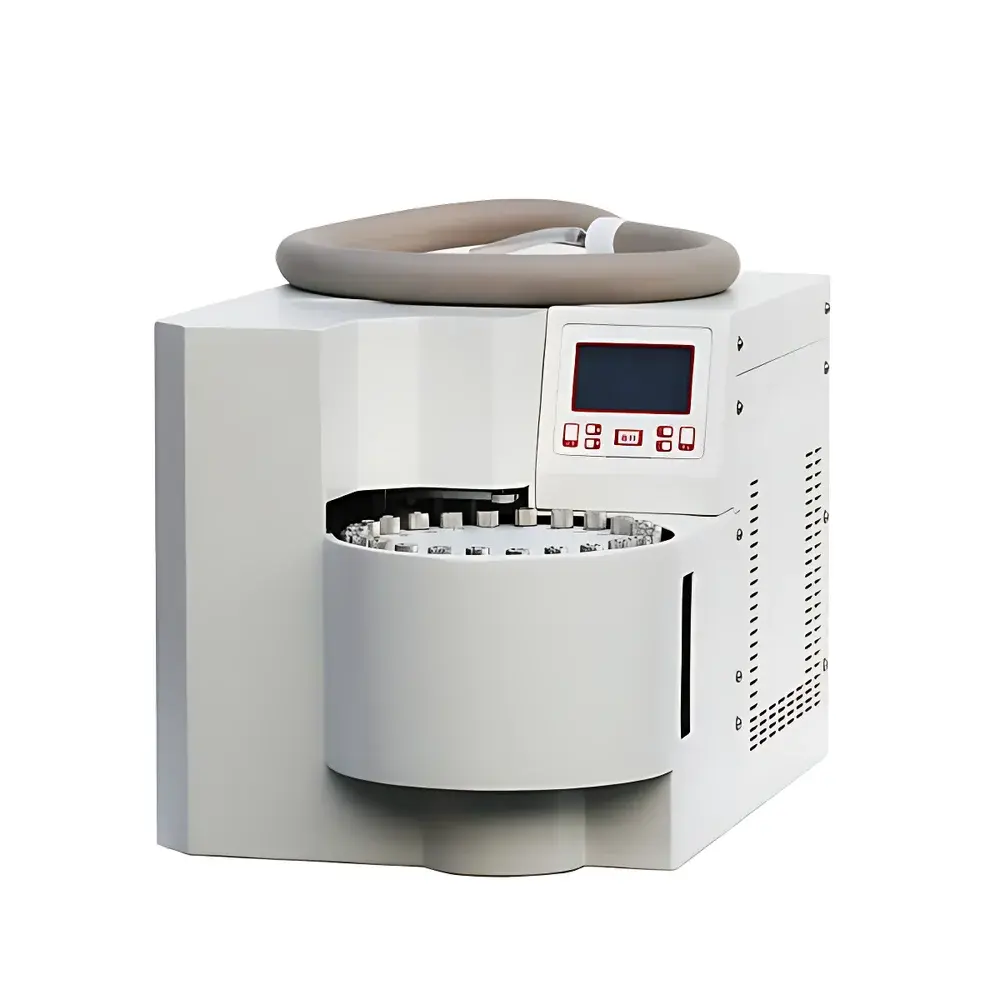
Zhonghuipu JX-9AT Fully Automated Single-Stage Thermal Desorber
| Brand | Zhonghuipu |
|---|---|
| Origin | Beijing, China |
| Manufacturer Type | Direct Manufacturer |
| Instrument Type | Single-Stage Thermal Desorber |
| Automation Level | Fully Automated |
| Desorption Zone Temperature Range | 40–400 °C, Control Accuracy: ±1 °C |
| Valve Zone Temperature Range | 40–240 °C, Control Accuracy: ±1 °C |
| Transfer Line Temperature Range | 40–240 °C, Control Accuracy: ±1 °C |
| Sample Tray Capacity | 24 positions |
| Sample Tube Dimensions | 6.35 mm OD × 88.9 mm L (1/4″ × 3.5″) |
| Desorption Time | 0–60 min |
| Injection Time | 0–10 min |
| Simulated Sampling Time | 0–60 min |
| Simulated Sampling Flow Rate | 0–200 mL/min |
| RSD | ≤2.5% (benzene in 0.05 μg methanol standard) |
| Peak Power Consumption | 500 W |
Overview
The Zhonghuipu JX-9AT Fully Automated Single-Stage Thermal Desorber is engineered for high-throughput, trace-level volatile organic compound (VOC) analysis in environmental air monitoring laboratories. It operates on the principle of thermal desorption — a quantitative sample introduction technique wherein analytes pre-concentrated on sorbent tubes are thermally released, transferred via heated gas flow into a gas chromatograph (GC) for separation and detection. Unlike multi-stage systems, the JX-9AT implements a single-stage desorption protocol optimized for benzene, toluene, ethylbenzene, xylenes (BTEX), and total volatile organic compounds (TVOC) per widely adopted regulatory methods. Its design emphasizes analytical reproducibility, system inertness, and seamless integration with both domestic and international GC platforms without hardware or firmware modification.
Key Features
- Fully automated batch processing of up to 24 sorbent tubes without operator intervention — ideal for routine compliance testing labs operating under ISO/IEC 17025 or EPA-equivalent quality frameworks.
- Motor-driven, high-precision sampling valve with zero dead volume and maximum operational temperature of 240 °C; eliminates need for external pneumatic drivers and reduces maintenance points.
- Triple-zone independent temperature control: desorption furnace (40–400 °C), valve oven (40–240 °C), and transfer line (40–240 °C), all maintained within ±1 °C accuracy via PID feedback loops.
- Gas pathways constructed entirely from electropolished, passivated 316 stainless steel tubing; all seals utilize PTFE gaskets rated for continuous service up to 260 °C, ensuring minimal background interference and long-term chemical inertness.
- Optimized flow dynamics achieved through calculated tapered fittings between sorbent tube and transfer line, minimizing cold spots and residual dead volume — critical for quantitative recovery of low-boiling VOCs such as benzene.
- Integrated simulated sampling module enabling precise calibration using certified gas standards; supports variable flow rates (0–200 mL/min) and duration (0–60 min) to replicate field sampling conditions.
Sample Compatibility & Compliance
The JX-9AT accommodates standard 1/4″ OD × 3.5″ (6.35 mm × 88.9 mm) stainless steel or quartz sorbent tubes packed with Tenax TA, Carbopack B/C, or equivalent media. It meets methodological requirements for multiple national and industry standards, including but not limited to: GB 50325–2020 (indoor air benzene and TVOC determination), HJ 583–2010 (ambient air BTEX analysis via solid-phase adsorption–thermal desorption–GC), and GB 11737–1989 (benzene/toluene/xylene in residential air). While not certified to ISO 16000 series or ASTM D6196 by default, its performance parameters align with the instrumental prerequisites defined in those standards for thermal desorption instrumentation used in indoor and ambient air quality assessment.
Software & Data Management
The JX-9AT operates via an embedded industrial controller with a dedicated touchscreen interface for method setup, real-time temperature monitoring, and run log review. All method parameters — desorption time, injection time, valve timing, and simulated sampling settings — are stored in non-volatile memory with timestamped audit trails. Raw run logs (including temperature profiles, valve actuation events, and error codes) can be exported in CSV format for integration into laboratory information management systems (LIMS). The system supports GLP-compliant operation through user-accessible password protection, electronic signature prompts for method changes, and immutable event logging — consistent with FDA 21 CFR Part 11 principles when deployed in regulated environments.
Applications
- Routine analysis of BTEX and TVOC in indoor air samples collected per GB 50325–2020 for building commissioning and post-renovation clearance testing.
- Ambient air monitoring programs requiring high-sample-volume throughput for regulatory reporting under China’s Environmental Monitoring Technical Specifications.
- Method validation studies where reproducibility (RSD ≤2.5% demonstrated for benzene at 0.05 μg level) and inter-instrument comparability are critical.
- Calibration verification using dynamic dilution standards generated via the built-in simulated sampling function.
- Research applications involving sorbent tube optimization, breakthrough volume evaluation, and thermal stability profiling of target analytes.
FAQ
Does the JX-9AT support direct connection to Agilent, Thermo Fisher, or Shimadzu GC systems?
Yes — it features universal GC interface compatibility via standard 1/8″ Swagelok fittings and configurable valve timing signals; no GC firmware or hardware modification is required.
What is the maximum recommended desorption temperature for common sorbent tubes?
For Tenax TA-packed tubes, the upper limit is 350 °C; for Carbopack-based tubes, 300 °C is advised to prevent degradation — both well within the instrument’s 40–400 °C range.
Can the JX-9AT perform cold trap focusing?
No — it is a single-stage thermal desorber and does not include cryogenic trapping capability; it delivers desorbed analytes directly to the GC inlet.
Is remote monitoring or network connectivity available?
The base configuration includes local touchscreen control only; optional RS-232 or Ethernet communication modules may be added for integration with centralized lab automation systems.
How often should the PTFE seals and stainless-steel tubing be inspected or replaced?
Under typical environmental testing workloads (200–300 runs/year), PTFE seals are recommended for replacement every 12 months, while passivated stainless-steel lines require inspection only during annual preventive maintenance — no routine replacement is necessary.





