
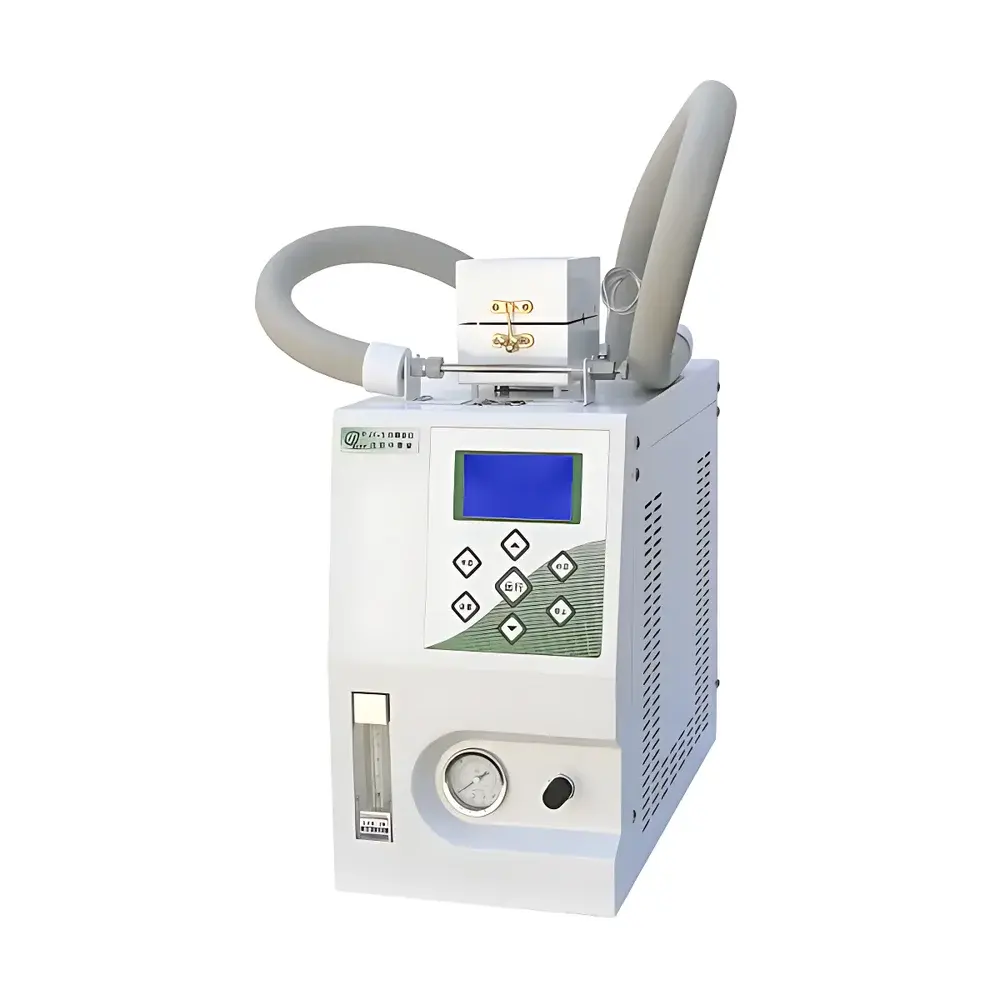
Zhonghuipu JX-5 Dual-Stage Thermal Desorber with Cryo-Focusing Trap
| Brand | Zhonghuipu |
|---|---|
| Origin | Beijing, China |
| Manufacturer Type | Direct Manufacturer |
| Instrument Type | Dual-Stage Thermal Desorber / Thermal Desorption Unit |
| Automation Level | Semi-Automatic |
| Primary Desorption Temp Range | 40–400 °C |
| Secondary Desorption Temp Range | −35–450 °C |
| Valve Oven Temp Range | 40–240 °C, ±1 °C accuracy |
| Transfer Line Temp Range | 40–240 °C, ±1 °C accuracy |
| Cryo-Trap Temp Range | −35 to −5 °C |
| Temp Control Accuracy | ±1 °C |
| Sample Position Count | 1 |
| Secondary Desorption Ramp Rate | >70 °C/s |
| Peak Width (at 450 °C) | <3 s |
| Sample Tube Dimensions | ≤6.5 mm OD, ≥120 mm length |
| Desorption Time | 0–60 min |
| Injection Time | 0–10 min |
| Simulated Sampling Time | 0–60 min |
| Simulated Flow Rate | 16–160 mL/min |
| RSD | ≤2.5% (benzene in 0.05 μg methanol) |
| Power Consumption | 500 W |
| Cold Stage | Peltier-based cryogenic trap |
Overview
The Zhonghuipu JX-5 Dual-Stage Thermal Desorber with Cryo-Focusing Trap is an engineered solution for trace-level volatile organic compound (VOC) and semi-volatile organic compound (SVOC) analysis in environmental air, indoor air, and industrial emission matrices. It operates on the principle of two-stage thermal desorption coupled with cryogenic focusing: analytes are first thermally released from sorbent tubes during primary desorption, then refocused onto a low-temperature trap (−35 °C to −5 °C) to sharpen analyte bands before rapid secondary desorption (>70 °C/s) directly into the GC or GC-MS inlet. This architecture minimizes band broadening, enhances sensitivity by up to two orders of magnitude over single-stage systems, and ensures reproducible quantitative transfer—critical for compliance with regulatory methods requiring sub-ppbv detection limits.
Key Features
- Peltier-based cryogenic trap delivering stable operation down to −35 °C without liquid nitrogen or mechanical refrigeration—reducing operational cost and logistical complexity.
- Motor-driven high-precision six-port valve housed in a fully integrated heated oven (up to 240 °C), eliminating external pneumatic actuation and minimizing dead volume through inert, de-activated 316 stainless steel flow paths and PTFE-sealed connections.
- Optimized variable-diameter ferrules and calibrated tube-to-line interfaces reduce system dead volume to <0.2 µL, preserving chromatographic integrity during transfer from trap to GC column.
- Three-in-one functional design supporting simulated sampling (16–160 mL/min, programmable duration), thermal desorption, and sorbent tube conditioning—all under unified software control.
- Full thermal management across all critical zones: primary furnace (40–400 °C), secondary desorption zone (−35–450 °C), valve oven (40–240 °C), and transfer line (40–240 °C), each with ±1 °C stability and independent PID control.
Sample Compatibility & Compliance
The JX-5 accommodates standard 1/4″ OD (≤6.5 mm) sorbent tubes up to 120 mm in length—including Tenax TA, Carbopack B/C, Carboxen, and multi-bed configurations—and maintains compatibility with both domestic and international GC/GC-MS platforms via universal pneumatic and electrical interfaces. Its performance aligns with key regulatory frameworks for ambient and indoor air monitoring, including but not limited to: ASTM D6196-22 (selection of sorbents), ISO 16017-1:2000 (indoor air VOC analysis), US EPA TO-17 (determination of VOCs in air), and Chinese national standards GB 50325-2020 (indoor benzene and TVOC), GB/T 18883-2002 (indoor air quality), HJ 583-2010, HJ 644-2013, and HJ 734-2014. The system supports audit-ready data handling when operated in GLP-compliant environments.
Software & Data Management
Control is executed via Windows-based instrument software offering method-driven workflow automation: users define desorption parameters (primary/secondary temperatures, ramp rates, hold times), simulated sampling profiles, and tube activation cycles within a single sequence. All temperature setpoints, actual readings, valve actuation timestamps, and pressure events are logged with millisecond resolution. Raw logs support export in CSV format for integration into LIMS or third-party data review tools. While the JX-5 does not embed 21 CFR Part 11-compliant electronic signatures or role-based access control natively, its deterministic event logging and uneditable timestamped records meet baseline requirements for method validation documentation and laboratory audit trails under ISO/IEC 17025 and CNAS accreditation criteria.
Applications
- Regulatory monitoring of benzene, toluene, ethylbenzene, xylenes (BTEX), and C2–C12 aliphatics in ambient and indoor air per GB 50325-2020 and HJ 583-2010.
- Quantitative analysis of total volatile organic compounds (TVOC) using defined surrogate mixtures and retention indexing protocols.
- Analysis of polar and thermally labile VOCs (e.g., formaldehyde derivatives, chlorinated solvents) leveraging cryo-focusing to prevent degradation during transfer.
- Method development for fixed-source emission testing (e.g., stack gas VOC profiling) under HJ 734-2014, where high-temperature secondary desorption (up to 450 °C) enables recovery of heavier SVOCs such as naphthalene and biphenyl.
- Routine reconditioning of reused sorbent tubes to restore breakthrough capacity and minimize carryover—programmable ramp-and-hold cycles ensure complete removal of residual organics without tube damage.
FAQ
What sample tube dimensions are supported?
The JX-5 accepts standard 1/4″ outer diameter sorbent tubes with maximum length of 120 mm and minimum wall thickness compatible with PTFE-sealed compression fittings.
Does the system require liquid nitrogen or compressed air for operation?
No—cryogenic trapping is achieved solely via solid-state Peltier cooling; valve actuation is motor-driven, eliminating dependency on external gas supplies.
Can the JX-5 be used with GC-MS systems?
Yes—the rapid secondary desorption (<3 s peak width at 450 °C) and low-dead-volume interface ensure optimal coupling with both quadrupole and time-of-flight GC-MS platforms.
Is the instrument compliant with ISO 17025 or GLP requirements?
While the hardware and firmware support traceable calibration and repeatable operation, full GLP/ISO 17025 conformance depends on site-specific SOP implementation, preventive maintenance records, and analyst training—not inherent to the device alone.
What is the typical detection limit improvement compared to single-stage desorption?
When paired with a modern GC-MS system, the cryo-focusing capability typically delivers 5–10× lower method detection limits (MDLs) for target VOCs versus direct thermal desorption without cold trapping, especially for early-eluting, low-boiling compounds.





