
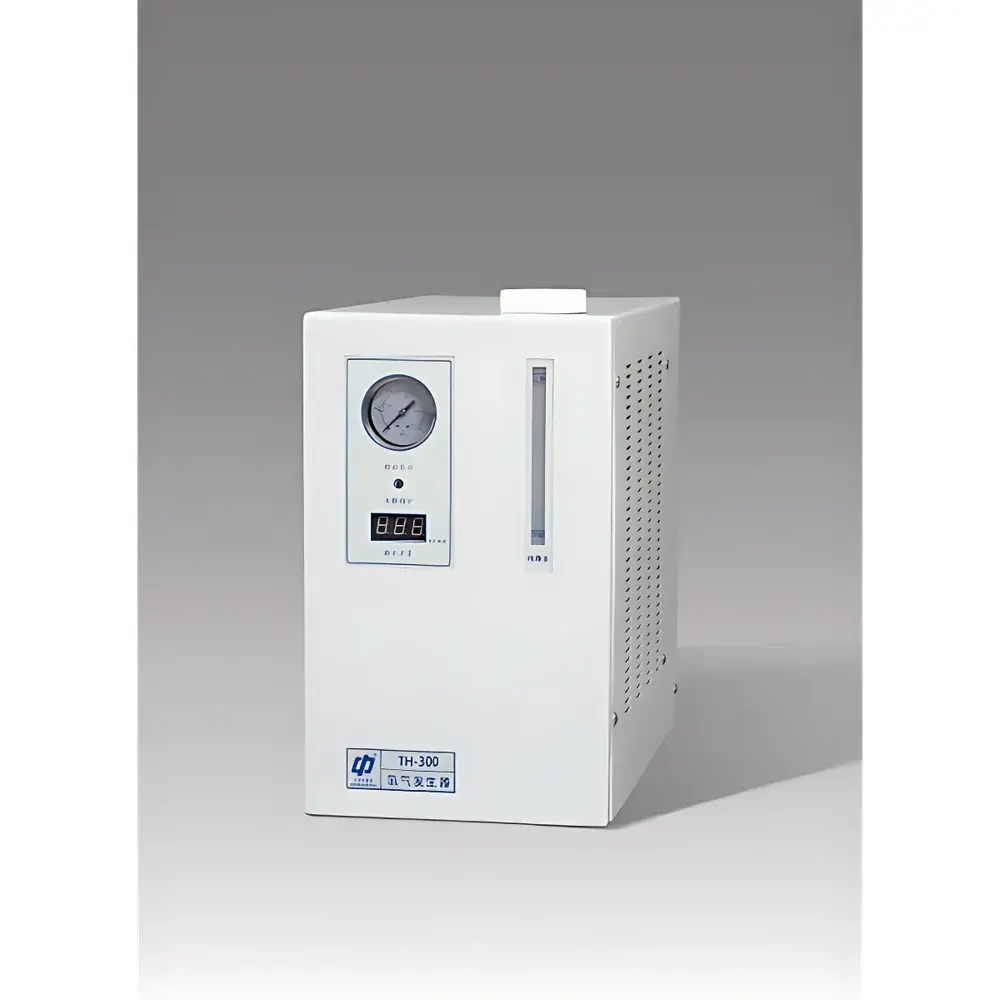
Zhonghuipu TH-300/500 High-Purity Hydrogen Generator (Pure-Water Electrolysis Type)
| Brand | Zhonghuipu |
|---|---|
| Origin | Beijing, China |
| Manufacturer Type | Direct Manufacturer |
| Model | TH-300/500 |
| Hydrogen Generation Principle | Pure-Water Electrolysis |
| Output Flow Rate | 0–300 mL/min (TH-300) / 0–500 mL/min (TH-500) |
| Output Pressure | 0–0.4 MPa |
| Hydrogen Purity | 99.999% |
| Power Consumption | 150 W (TH-300) / 250 W (TH-500) |
| Dimensions (W×D×H) | 400 × 360 × 220 mm |
| Net Weight | ~14 kg |
| Pressure Stability | < 0.001 MPa |
| Input Power | 220 V ±10%, 50 Hz |
| Water Level Auto-Control | Yes |
| Seal Material | Low-Sulfur Silicone Rubber Gaskets |
Overview
The Zhonghuipu TH-300/500 High-Purity Hydrogen Generator is an on-demand, laboratory-grade gas supply system engineered for continuous, reliable hydrogen production via proton exchange membrane (PEM) electrolysis of deionized water. Unlike traditional alkaline electrolyzers, this generator employs solid polymer electrolyte (SPE) technology—eliminating caustic KOH solutions and associated maintenance, corrosion, and contamination risks. The core electrochemical process occurs within a sealed PEM cell stack, where purified water is dissociated into high-purity H2 and O2 gases at the anode and cathode, respectively. Oxygen is safely vented, while hydrogen is conditioned through integrated catalytic purification and low-sulfur silicone sealing to achieve ≥99.999% purity—meeting stringent requirements for sensitive gas chromatography (GC) detectors including Flame Ionization (FID), Nitrogen-Phosphorus (NPD), and Flame Photometric (FPD) detectors. Designed for integration with any GC system—regardless of manufacturer or model—the TH series delivers stable, ultra-low-part-per-trillion sulfur and hydrocarbon content, ensuring baseline stability and extended column lifetime.
Key Features
- Solid Polymer Electrolyte (SPE) membrane stack using imported ion-exchange membranes for high efficiency and long-term operational stability
- Zero-alkali operation: Pure deionized water feed only—no KOH handling, disposal, or concentration calibration required
- Integrated low-sulfur silicone rubber gasketing throughout gas pathways to minimize sulfur-based interference critical for NPD/FPD applications
- Dual-parameter digital control: Independent real-time regulation of output pressure (0–0.4 MPa) and flow rate (0–300 mL/min or 0–500 mL/min) via embedded microprocessor
- Auto-water-level monitoring with fail-safe shutdown: Prevents dry-electrolysis damage and extends PEM stack service life beyond 8,000 operating hours
- CE-certified electrical architecture compliant with IEC 61010-1 for laboratory equipment safety
- Compact footprint (400 × 360 × 220 mm) and lightweight design (~14 kg) suitable for benchtop deployment in analytical labs, QC facilities, and mobile laboratories
Sample Compatibility & Compliance
The TH-300/500 is compatible with all major GC platforms—including Agilent, Thermo Fisher, Shimadzu, PerkinElmer, and Waters—without requiring hardware modification or external gas conditioning. Its certified hydrogen purity (99.999%, verified by online gas chromatographic analysis per ISO 8573-1 Class 1 compressed air/gas standards) satisfies method requirements for USP , ASTM D7217, and EPA Method 8260. The generator operates within GLP/GMP-aligned workflows: full audit trail capability (via optional RS-232/USB logging), password-protected parameter settings, and traceable event logs (power-on cycles, pressure deviations, low-water alerts). All wetted materials comply with FDA 21 CFR Part 11 data integrity principles when paired with validated LIMS or CDS software.
Software & Data Management
While the TH-300/500 operates as a standalone instrument with intuitive front-panel LED interface, optional firmware upgrade enables serial communication (RS-232 or USB virtual COM port) for remote monitoring and control. Compatible with third-party lab automation systems, it supports ASCII command protocols for integration into automated GC sequences. Real-time telemetry includes flow rate, outlet pressure, cell temperature, water level status, and cumulative runtime. Data export is supported in CSV format for trend analysis, preventive maintenance scheduling, and regulatory documentation. No proprietary software installation is required—standard terminal emulators or custom Python/Node.js scripts can poll status and trigger alarms.
Applications
- Carrier and fuel gas source for capillary GC and GC-MS systems
- Detector gas supply for FID, NPD, FPD, and helium-free GC configurations
- Hydrogenation reaction support in synthetic chemistry labs (low-flow, high-purity demand)
- Calibration gas generation for trace H2 analyzers and sensor validation
- On-site hydrogen supply for portable FTIR and laser-based gas sensors requiring ppm-level background purity
- Backup or primary gas source in regulated pharmaceutical QC labs where cylinder logistics pose audit risks
FAQ
What type of water must be used?
Deionized water with resistivity ≥15 MΩ·cm (ASTM Type I) is mandatory. Tap water, distilled water, or reverse-osmosis-only water will cause rapid membrane fouling and void warranty.
Does the generator require periodic electrolyte replacement?
No. The SPE membrane is a solid-state, non-consumable component. Only deionized water replenishment is required—typically every 3–7 days depending on usage profile.
Can it operate unattended overnight?
Yes. Integrated safety logic—including over-pressure shutoff, thermal cutoff, and auto-shutdown on low water—enables 24/7 operation under supervised lab conditions.
Is oxygen venting hazardous in enclosed spaces?
Oxygen is discharged at low flow (<1.5× H2 volume) and must be vented to ambient air via tubing routed outside the fume hood or to an exhaust manifold per local ventilation codes (e.g., ANSI Z9.5).
How often does the PEM stack require servicing?
Under normal operation with compliant water quality, the stack is rated for ≥8,000 hours. Annual verification of purity and pressure stability is recommended; replacement is typically required after 3–5 years of continuous use.



