
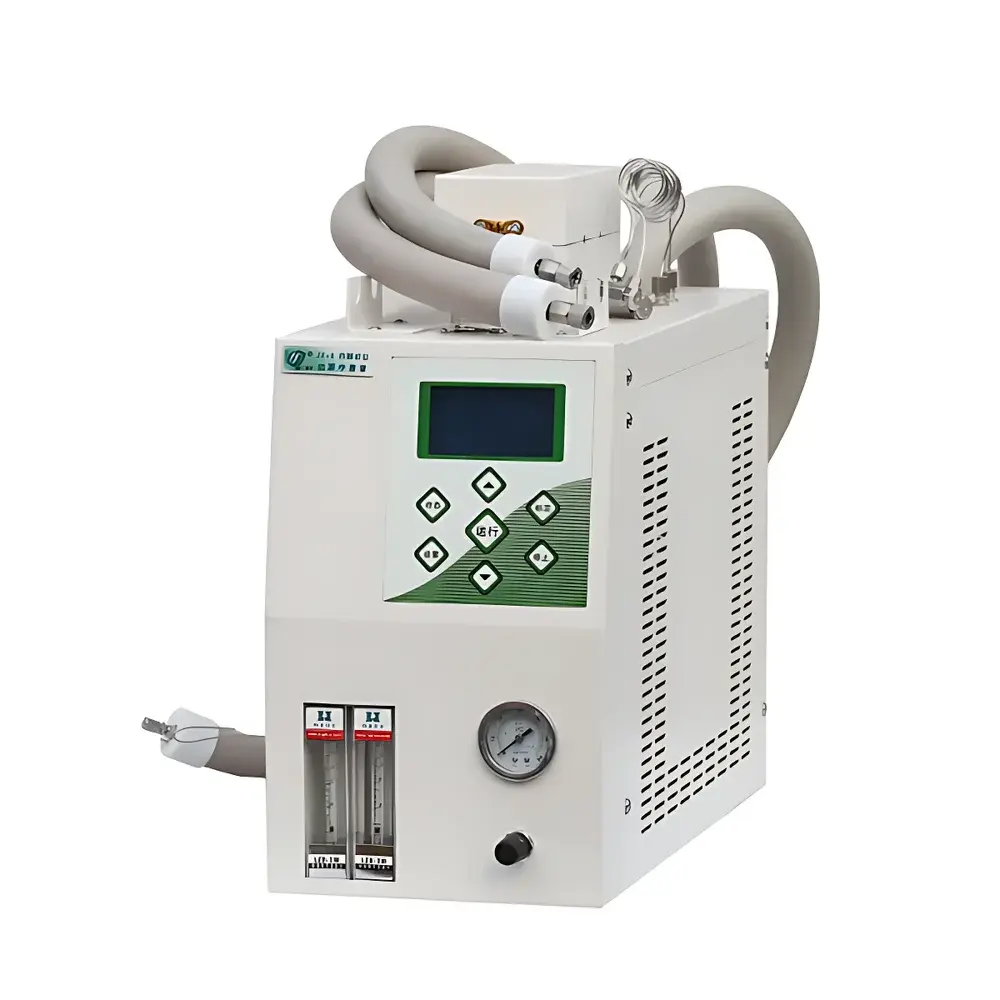
Zhonghuipu JX-4 Dual-Channel Thermal Desorber
| Brand | Zhonghuipu |
|---|---|
| Origin | Beijing, China |
| Manufacturer Type | Manufacturer |
| Product Category | Domestic |
| Model | JX-4 |
| Price Range | USD 1,400 – 7,000 |
| Instrument Type | Single-Stage Thermal Desorber |
| Automation Level | Semi-Automatic |
| Desorption Zone Temperature Range | Ambient to 380 °C, Control Accuracy ±1 °C |
| Valve Oven Temperature Range | Ambient to 240 °C, Control Accuracy ±1 °C |
| Transfer Line Temperature Range | Ambient to 240 °C, Control Accuracy ±1 °C |
| Sample Positions | 2 |
| Calibration Simulation Time | 0–60 min |
| Desorption Time | 0–60 min |
| Injection Time | 0–10 min |
| Trap Tube Dimensions | Ø6 mm, Length >120 mm |
Overview
The Zhonghuipu JX-4 Dual-Channel Thermal Desorber is a precision-engineered single-stage thermal desorption system designed for quantitative analysis of volatile and semi-volatile organic compounds (VOCs and SVOCs) adsorbed onto solid sorbent tubes. It operates on the principle of controlled thermal desorption—where analytes are thermally released from inert, packed sorbent media under precisely regulated temperature gradients and carrier gas flow—and transferred directly into a gas chromatograph (GC) for separation and detection. Unlike cryofocused systems, the JX-4 employs a direct thermal transfer architecture with no cold spots along the entire analytical pathway, ensuring minimal analyte loss, breakthrough, or condensation. Its dual-channel configuration enables concurrent desorption of two independent samples, effectively doubling laboratory throughput without compromising reproducibility or method integrity. The instrument is purpose-built for compliance-driven environments including occupational hygiene monitoring, indoor air quality assessment, and environmental field laboratories where adherence to standardized methods is mandatory.
Key Features
- Dual independent desorption channels with fully isolated temperature control zones: desorption furnace (ambient to 380 °C), valve oven (ambient to 240 °C), and heated transfer line (ambient to 240 °C), all maintained within ±1 °C accuracy.
- Integrated three-in-one functionality: standard sample simulation (calibration via dynamic spiking), thermal desorption, and sorbent tube reconditioning—eliminating the need for separate activation ovens or calibration rigs.
- Motor-driven high-temperature six-port switching valve (rated to 240 °C) with zero-dead-volume design; actuated electrically—no external pneumatic supply required.
- Entire gas path constructed from electropolished, deactivated 316 stainless steel tubing; all seals and ferrules utilize PTFE or high-purity fluoropolymer materials rated for continuous operation up to 240 °C.
- Optimized flow-path geometry featuring calculated-diameter transition fittings between trap tubes and transfer lines to minimize dead volume and maximize analyte transfer efficiency (>95% recovery typical for C2–C12 VOCs).
- Compact microcontroller-based control system with intuitive front-panel interface; supports one-touch method execution with programmable timing parameters for simulation, desorption, and injection phases.
- Universal GC interface compatible with all major domestic and international gas chromatographs—including Agilent, Thermo Fisher, Shimadzu, PerkinElmer, and domestic OEM platforms—without requiring hardware modification or firmware updates to the host GC.
Sample Compatibility & Compliance
The JX-4 accommodates standard 6 mm OD sorbent tubes (length >120 mm), including multi-bed configurations such as Tenax TA/Carbograph 1TD/Carboxen 1000. It supports both single-bed and mixed-bed tubes used in EPA TO-17, HJ 583–2010, GB 11737–1989, and GB 50325–2020 compliant workflows. The system meets critical performance criteria outlined in ISO 16000-6 for VOC analysis in indoor air and satisfies data integrity requirements for GLP and ISO/IEC 17025-accredited laboratories. While not inherently 21 CFR Part 11 compliant, its deterministic timing control, non-volatile parameter storage, and audit-ready method logs support integration into validated QC/QA frameworks when deployed with appropriate LIMS or electronic lab notebook (ELN) infrastructure.
Software & Data Management
The JX-4 operates via embedded firmware with real-time temperature monitoring, event logging, and cycle status reporting. All method parameters—including desorption time (0–60 min), valve switching sequence, simulation duration (0–60 min), and injection window (0–10 min)—are stored in non-volatile memory with timestamped execution records. Optional RS-232 or USB-to-serial interface enables remote triggering and synchronization with GC start signals. While the base unit does not include PC-based software, it is fully compatible with third-party chromatography data systems (CDS) that accept TTL or contact-closure triggers. Method templates can be exported/imported via ASCII text files for centralized protocol management across multi-instrument labs.
Applications
- Occupational exposure assessment per OSHA/NIOSH methods and Chinese occupational health standards (e.g., benzene, toluene, xylene, styrene in workplace air).
- Indoor air quality testing for residential and commercial buildings in accordance with GB 50325–2020, focusing on benzene and TVOC quantification.
- Environmental ambient air monitoring for aromatic hydrocarbons and aliphatic VOCs using HJ 583–2010-compliant sampling and analysis protocols.
- Method development and validation studies requiring precise thermal desorption reproducibility and low carryover (<0.1% typical after tube bake-out).
- Quality control of activated carbon filters, air purification devices, and sorbent media performance evaluation.
FAQ
Is the JX-4 compatible with GC-MS systems?
Yes—the JX-4 delivers clean, pulse-free analyte introduction suitable for both FID and MS detection. Its inert flow path and absence of silicone-based components prevent column contamination or spectral interference.
Can I use non-standard tube dimensions?
The instrument is mechanically optimized for 6 mm OD tubes >120 mm in length. Use of undersized or oversized tubes may compromise seal integrity and thermal coupling, affecting desorption efficiency and reproducibility.
Does the system support automated tube loading?
No—the JX-4 is semi-automatic and requires manual placement of sorbent tubes into the dual desorption wells. Fully automated tube handling is available in higher-tier models (e.g., JX-8 series).
What maintenance intervals are recommended?
Valve rotor seals should be inspected every 500 cycles; transfer line frits cleaned quarterly; and furnace insulation verified annually. Full preventive maintenance is advised every 12 months or after 2,000 desorption cycles, whichever occurs first.
How is calibration traceability ensured?
The JX-4 supports dynamic calibration via built-in simulation mode, enabling certified gas standard delivery directly into the sorbent tube at known mass flow rates. When paired with NIST-traceable permeation tubes or dynamic dilution calibrators, full metrological traceability to SI units is achievable.
Related Products







