
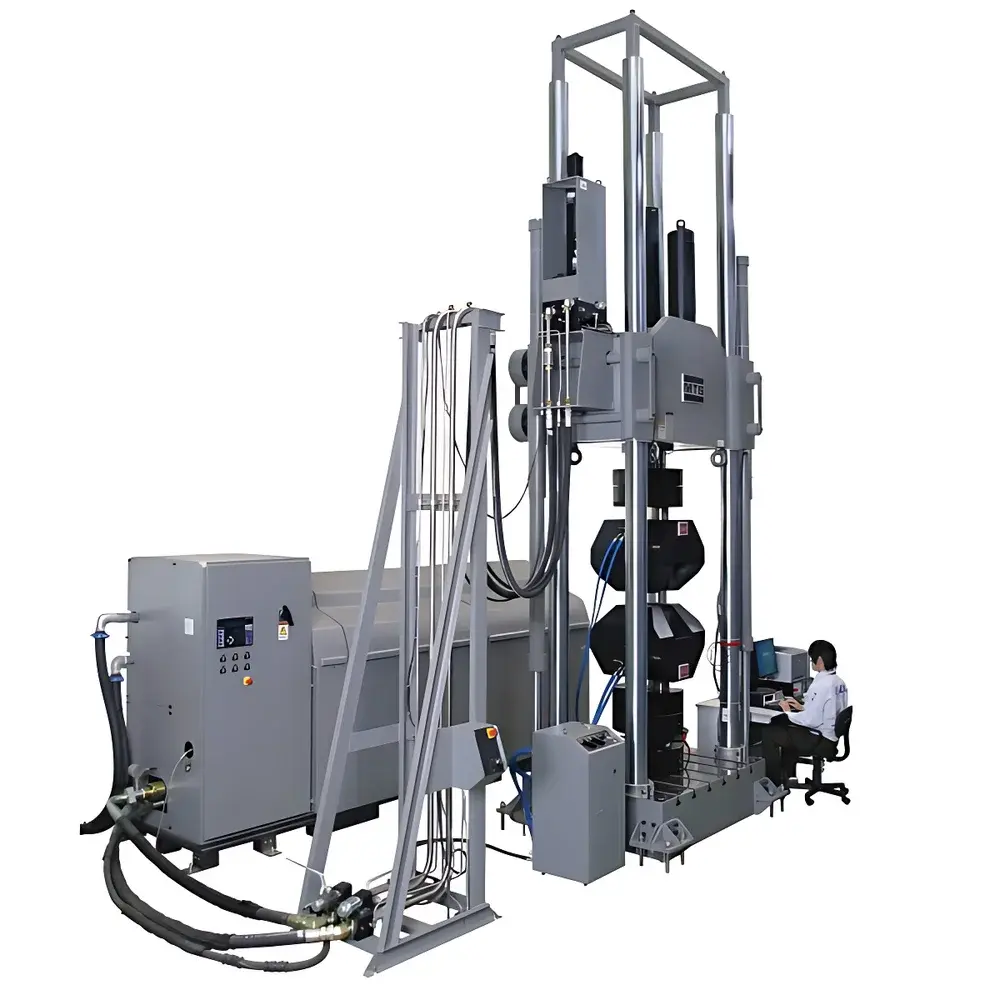
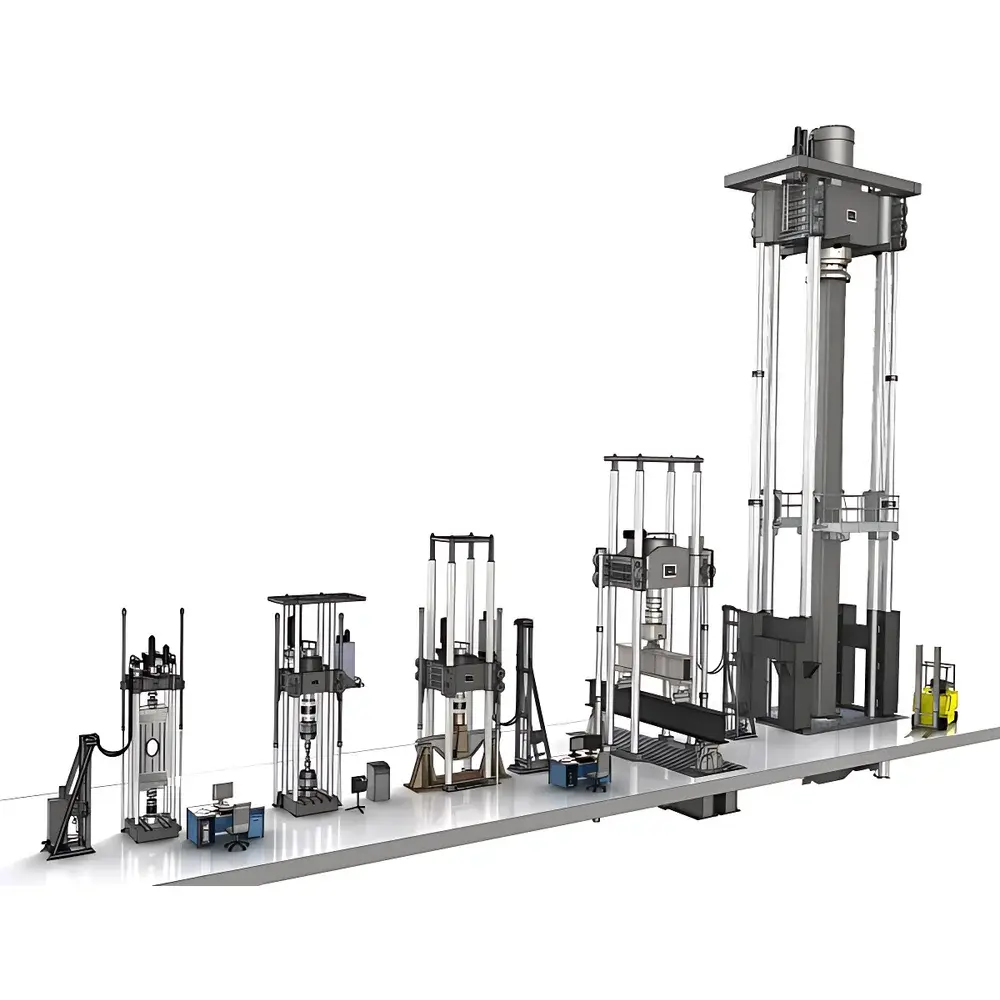
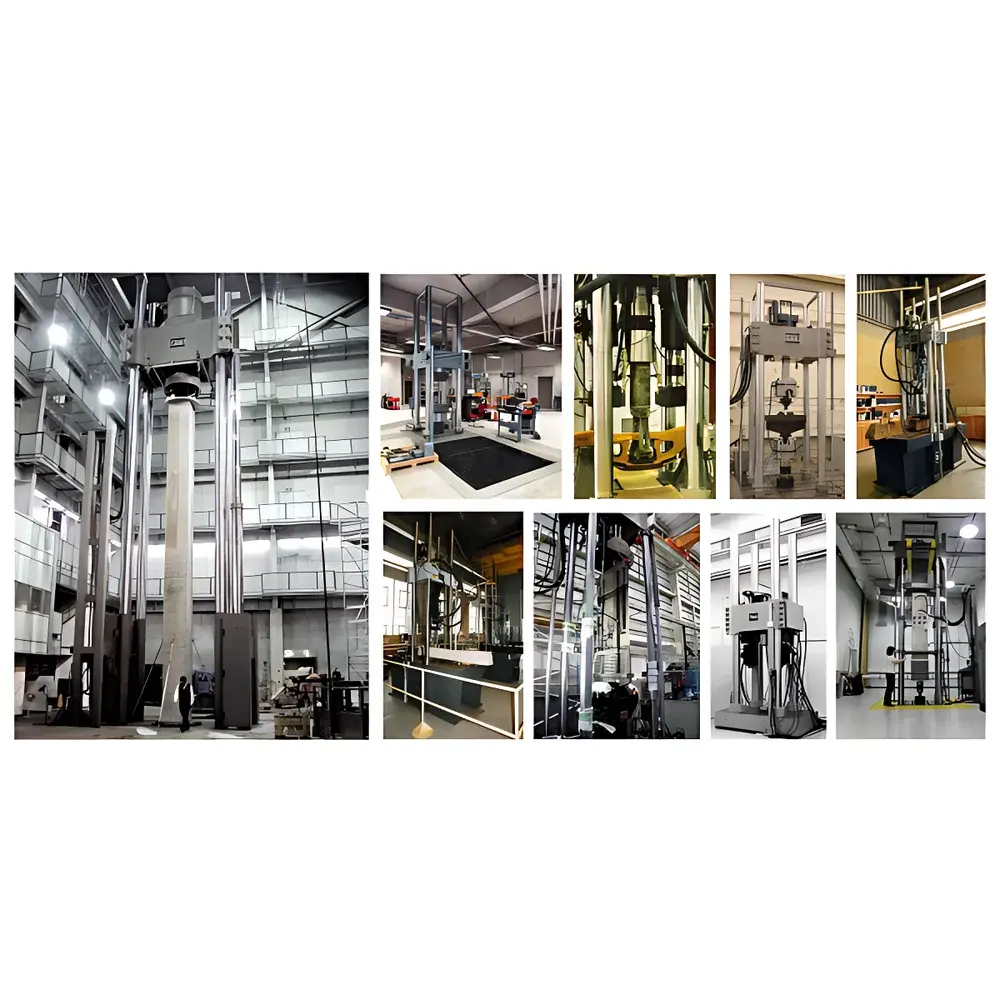
MTS 311 Series High-Load Electro-Hydraulic Servo Testing System
| Brand | MTS |
|---|---|
| Origin | USA |
| Instrument Type | Electro-Hydraulic Servo Fatigue Testing Machine |
| Maximum Test Force | 1,000 kN to 30,000 kN |
| Frame Mass | 4,100 kg to 275,000 kg |
| Column Diameter | 101.6 mm to 203.2 mm |
| Column Spacing (W × D) | 711.2 mm × 406.4 mm to 1016.0 mm × 812.8 mm |
| Standard Dynamic Stroke | 150 mm to 300 mm |
| System Stiffness | 1.6 × 10⁹ N/m to 3.9 × 10⁹ N/m |
Overview
The MTS 311 Series High-Load Electro-Hydraulic Servo Testing System is a modular, four-column structural test frame engineered for high-fidelity mechanical characterization under static, quasi-static, and dynamic loading conditions. Based on the Couette-flow principle of hydraulic actuation and closed-loop servo control, the system delivers precise force and displacement regulation across multi-megaton load ranges—up to 30,000 kN (6.74 million lbf). Its monolithic steel frame architecture, reinforced with high-strength alloy columns and preloaded tie rods, ensures exceptional axial and torsional rigidity (>1.6 × 10⁹ N/m), minimizing parasitic deflection and enabling accurate measurement of material stiffness, hysteresis, and energy dissipation in large-scale specimens. Designed for structural integrity validation, the system complies with fundamental requirements of ASTM E4, ISO 7500-1, and EN 10002-2 for verification of testing machines, supporting traceable calibration protocols and uncertainty budgets required for accredited laboratories.
Key Features
- Modular four-column frame architecture with standardized and custom-configurable column diameters (101.6–203.2 mm) and spacing (711.2 × 406.4 mm up to 1016.0 × 812.8 mm), optimized for specimen geometry and test boundary conditions.
- Electro-hydraulic servo actuation with dual-stage proportional valves and high-bandwidth pressure transducers, delivering stable force control across full dynamic range (1–30 MN) with ≤±0.5% of full scale accuracy per ASTM E1012.
- High-stiffness crosshead assembly with integrated guide rails and self-aligning bearing mounts to minimize moment-induced bending during off-axis loading or asymmetric specimen configurations.
- Integrated base plate with precision-machined T-slots and anchor bolt patterns compatible with MTS FlexTest® digital controllers and third-party data acquisition systems meeting IEEE 1451.4 transducer electronic data sheet (TEDS) standards.
- Thermally stabilized hydraulic power unit (HPU) with filtration to NAS 1638 Class 6, redundant cooling circuits, and real-time oil temperature/pressure monitoring to ensure long-term repeatability in extended fatigue campaigns.
- Compliance with mechanical safety requirements per ISO 13857 and ANSI B11.1; includes emergency stop interlocks, hydraulic pressure relief cascades, and frame-mounted limit switches certified to SIL2 per IEC 62061.
Sample Compatibility & Compliance
The MTS 311 Series accommodates full-scale structural components including wind turbine blade subassemblies, aircraft fuselage panels, reinforced concrete beams, offshore pipeline segments, prestressed concrete piles, and heavy-duty chain assemblies. Specimen envelope spans from 254 mm to 4,500 mm in vertical working height and up to 1,903 mm in base width (including lifting fixtures), permitting direct mounting of industry-standard grips, wedge-action clamps, and custom reaction fixtures. All standard configurations meet ISO 9001:2015 design control requirements and support GLP-compliant test execution when paired with MTS TestSuite™ software configured for 21 CFR Part 11 audit trails, electronic signatures, and role-based access control. Calibration documentation conforms to ISO/IEC 17025:2017 and includes as-found/as-left reports with uncertainty statements referenced to NIST-traceable force standards.
Software & Data Management
Control and data acquisition are executed via MTS TestSuite™ v8.x, a deterministic real-time platform compliant with IEC 61131-3 structured text programming. The software supports synchronized acquisition of up to 128 analog channels at 10 kHz sample rate, including load cell outputs, LVDT displacement feedback, strain gauge rosettes, and environmental sensor inputs (temperature, humidity). Built-in test method libraries include ASTM D7264 (flexural properties), ASTM E606 (strain-controlled fatigue), ISO 12106 (metal fatigue), and EN 1992-1-1 Annex C (concrete cyclic loading). Raw data is stored in HDF5 format with embedded metadata (test parameters, operator ID, calibration IDs, timestamps), ensuring FAIR (Findable, Accessible, Interoperable, Reusable) principles. Export modules generate ASTM E1434-compliant .tdms files, CSV archives, and PDF-certified reports with digital signatures and hash-verified integrity logs.
Applications
- Structural fatigue evaluation of wind turbine composite blades under simulated operational spectra (IEC 61400-23).
- Cyclic compression-tension testing of high-strength steel cables and anchor systems for bridge stay cables and suspension applications.
- Quasi-static and dynamic fracture mechanics studies (KIc, J-integral) on thick-section welded joints per ASTM E1820 and BS 7448.
- Mechanical property mapping of ultra-high-performance concrete (UHPC) under biaxial loading using multi-axial load frames interfaced with the 311 base.
- Full-scale qualification testing of aerospace primary structure subcomponents per MIL-STD-1540D and NASA-STD-5019.
- Seismic performance validation of base-isolated building foundations and energy-dissipating dampers under time-history loading protocols.
FAQ
What is the maximum usable stroke for the MTS 311.71 configuration with 300 mm nominal actuator travel?
For the MTS 311.71 model, the usable specimen height range is 450–4500 mm (17.8–177 in) with a 300 mm stroke actuator; actual clearance depends on grip geometry and fixture stack-up.
Can the system be upgraded to support higher frequency harmonic loading?
The base MTS 311 Series is optimized for low-to-medium frequency structural testing (DC to ~5 Hz typical); higher-frequency capability requires integration with MTS FlexTest® HF controllers and specialized high-response actuators—not part of standard 311 configurations.
Is hydraulic fluid conditioning included in the standard maintenance schedule?
Yes—preventive maintenance includes quarterly NAS 1638 Class 6 fluid analysis, filter replacement, and moisture content verification per ISO 4406; full HPU servicing is recommended annually or after 2,000 operating hours.
Does MTS provide installation supervision and foundation design support?
MTS application engineers perform site readiness assessments, including floor loading analysis, seismic anchorage review, and utility interface verification; foundation drawings are provided as part of the engineering package upon order confirmation.
How is traceability maintained for force calibration across multiple load cells and ranges?
Each load cell is individually calibrated against NIST-traceable deadweight machines; calibration certificates include polynomial correction coefficients and uncertainty budgets per ISO 376, with automated application of corrections within TestSuite™ during test execution.



