
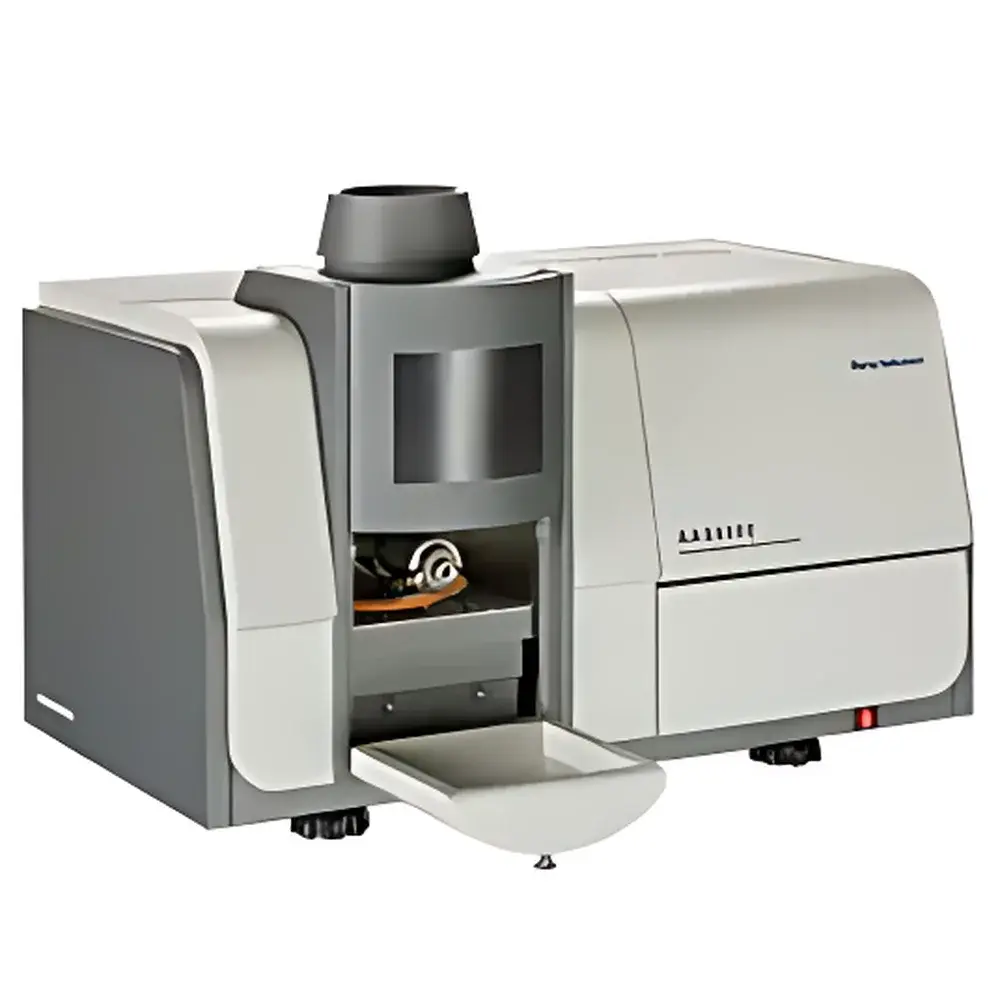
SkyRay AAS6000 Flame Atomic Absorption Spectrometer
| Brand | SkyRay Instrument |
|---|---|
| Origin | Jiangsu, China |
| Manufacturer Type | OEM Manufacturer |
| Country of Origin | China |
| Model | AAS6000 |
| Instrument Type | Flame Atomic Absorption Spectrometer |
| Wavelength Range | 190–900 nm |
| Spectral Bandwidth | 0.1 / 0.2 / 0.4 / 0.7 / 1.4 nm (auto-switching) |
| Grating | 1800 lines/mm, blaze wavelength 230 nm |
| Wavelength Accuracy | ±0.25 nm |
| Wavelength Repeatability | < 0.10 nm |
| Resolution | < 0.3 nm |
| Characteristic Concentration (Cu) | < 0.025 µg/mL per 1% absorption |
| Detection Limit (Cu) | < 0.006 µg/mL |
| Precision (Cu) | < 0.8% RSD |
| Baseline Stability | 0.003 Abs (static), 0.004 Abs (dynamic) |
| Background Correction | D₂ lamp + Self-absorption (up to 1 A) |
Overview
The SkyRay AAS6000 Flame Atomic Absorption Spectrometer is a fully automated, PC-controlled analytical instrument engineered for high-precision quantitative determination of metallic and semi-metallic elements at trace to major concentration levels in liquid samples. Based on the fundamental principle of atomic absorption spectroscopy—where ground-state atoms in a flame absorb characteristic radiation emitted by a hollow cathode lamp—the AAS6000 delivers robust performance in routine laboratory environments requiring regulatory compliance, method reproducibility, and long-term operational stability. Its optical architecture employs a Czerny-Turner monochromator with an 1800-line/mm holographic grating blazed at 230 nm, enabling optimal throughput across the UV–Vis spectral range (190–900 nm). The system integrates flame atomization with air-acetylene combustion, optimized for sensitivity and inter-element interference mitigation in diverse sample matrices.
Key Features
- Achromatic All-Reflective Optical System: Utilizes concave mirrors instead of refractive lenses to eliminate chromatic aberration across wavelengths—ensuring consistent focal alignment for multi-element analysis without manual realignment.
- Full Automation via USB 2.0 Interface: Replaces legacy RS-232 connectivity with high-speed, plug-and-play USB 2.0 communication; enables synchronized control of wavelength scanning, peak search, slit width selection, burner height adjustment, gas flow regulation, lamp current, and PMT voltage—all from the host PC.
- 8-Position Rotating Lamp Holder: Supports simultaneous preheating of seven hollow cathode lamps while one is actively measuring—reducing turnaround time between elemental analyses and improving workflow continuity.
- Corrosion-Resistant Atomization System: Features a pure titanium nebulizer chamber and burner head, providing exceptional resistance to acidic aerosols generated during sample introduction—critical for prolonged operation in environmental and geochemical labs.
- High-Efficiency Glass Nebulizer: Incorporates a custom-designed Wirsching-type glass nebulizer delivering superior nebulization efficiency (>10% uptake) and broad compatibility with aqueous and low-viscosity organic solutions.
- Mass Flow Controlled Acetylene Delivery: Employs a precision mass flow controller (MFC) for dynamic, closed-loop regulation of acetylene flow—ensuring stoichiometric combustion, minimizing carbon deposition, and enhancing flame stability and safety.
- Dual-Mode Background Correction: Combines deuterium arc (D₂) and self-absorption (HCL) techniques—each capable of correcting up to 1.0 A background absorbance—enabling accurate quantification in complex matrices such as digested soils or wastewater sludge extracts.
- Comprehensive Safety Architecture: Includes real-time monitoring of acetylene leakage, fuel gas pressure, oxidant (air) pressure, explosion-proof switch status, and flame ignition state—meeting IEC 61010-1 requirements for laboratory instrumentation safety.
Sample Compatibility & Compliance
The AAS6000 is validated for use with acid-digested aqueous samples prepared per ASTM D1976, EPA Method 200.7, ISO 11885, and GB/T 5750.6–2023. It supports direct aspiration of clarified liquids (e.g., drinking water, leachates, process streams) and accommodates optional accessories—including the HG600 hydride generation system for As, Se, Sb, Bi, Te, and the AS100 136-position autosampler—for unattended batch analysis. The instrument’s hardware and software design align with GLP/GMP documentation requirements: audit trails record all parameter changes, calibration events, and measurement history; data files are stored in vendor-neutral formats (CSV, TXT) compatible with LIMS integration. While not FDA 21 CFR Part 11–certified out-of-the-box, its logging architecture supports validation protocols required for regulated pharmaceutical and clinical testing environments.
Software & Data Management
Controlled via SkyRay’s proprietary Windows-based AAS Analysis Suite, the software provides bilingual (English/Chinese) GUI navigation, automated qualitative identification, linear/non-linear calibration curve fitting (including quadratic and cubic models), internal standard correction, spike recovery calculation, and customizable report generation compliant with ISO/IEC 17025 reporting clauses. All method parameters—including lamp current, slit width, burner height, integration time, and background correction mode—are saved with calibration curves and raw absorbance data in encrypted project files. Software updates are distributed via secure HTTPS download channels, and firmware upgrades maintain backward compatibility with existing method libraries. Raw spectral scans and time-resolved absorbance profiles are exportable for third-party chemometric analysis.
Applications
The AAS6000 serves as a core elemental analyzer in accredited testing laboratories across multiple sectors: geological surveys (rock, ore, sediment digestion analysis); metallurgical QC (Fe, Al, Cu, Zn, Pb, Ni in alloys and smelter outputs); environmental monitoring (Cd, Cr, Cu, Mn, Zn in surface water, groundwater, and EPA 6010-compliant wastewater); petrochemical QA (Na, V, Ni in crude oil and lubricants); food safety screening (Pb, Cd, As in infant formula, rice, seafood per EU Commission Regulation (EU) No 1881/2006); pharmaceutical excipient testing (catalytic metal residues per ICH Q2(R2)); and construction materials certification (Ca, Mg, Fe, Ti in cement, glass, and ceramic glazes).
FAQ
What sample preparation methods are recommended for optimal AAS6000 performance?
Standard hotplate or microwave-assisted acid digestion using HNO₃/HCl/HF mixtures (per EPA 3050B or ISO 14869-1) is advised for solid matrices. Filtration through 0.45-µm PTFE membranes is required prior to aspiration.
Can the AAS6000 be upgraded for graphite furnace analysis?
No—the AAS6000 is a dedicated flame-AAS platform. SkyRay offers the AAS8000 series for electrothermal atomization applications.
Is the software compliant with 21 CFR Part 11 for electronic records?
The base software includes audit trail functionality and user access controls; however, formal Part 11 compliance requires site-specific validation and configuration by the end-user’s IT/QA team.
What maintenance intervals are recommended for the titanium burner head?
Visual inspection after every 100 analyses; ultrasonic cleaning in 10% HNO₃ solution weekly; replacement recommended every 12–18 months under continuous operation.
Does the system support external standards addition (e.g., internal standard correction)?
Yes—the software allows user-defined internal standard ratios (e.g., Yttrium for rare earths, Scandium for environmental metals) with automatic correction applied during quantitation.
Related Products






