
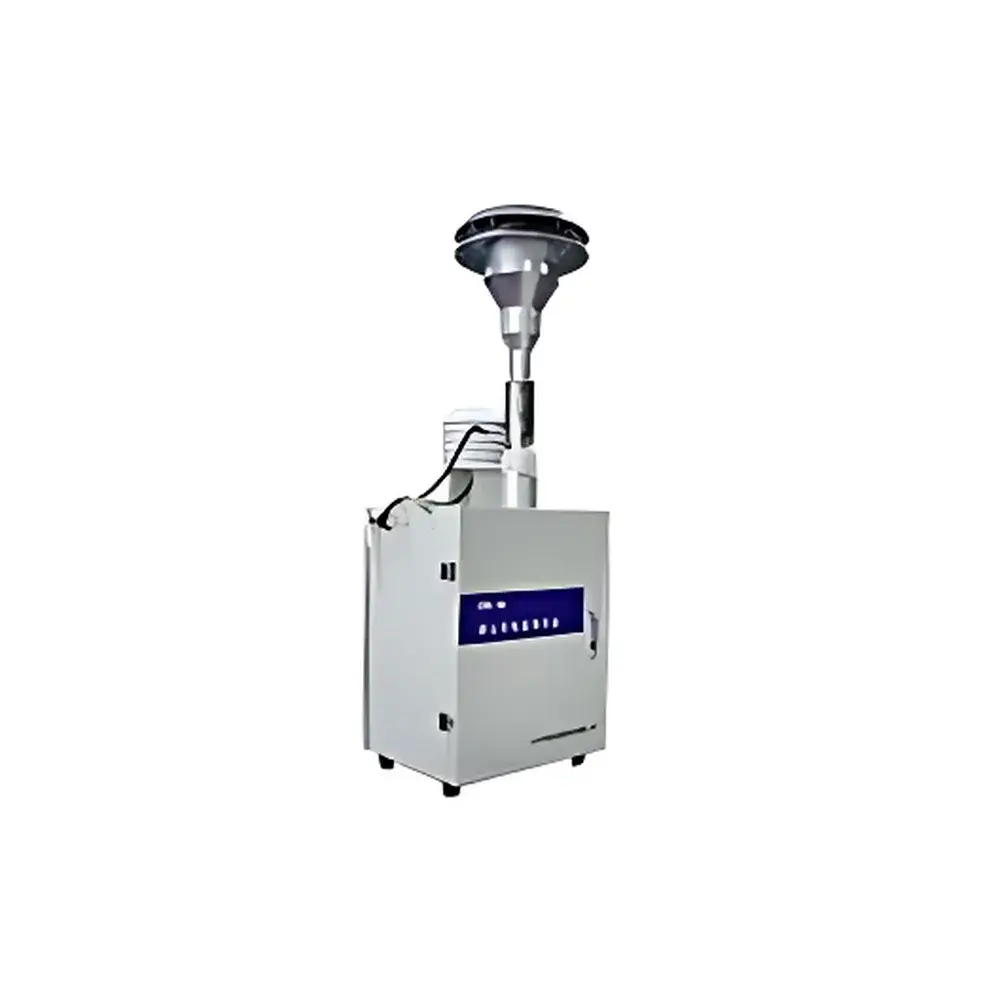
SkyRay Instrument EPM-100 Beta-Ray Particulate Mass Monitor
| Brand | SkyRay Instrument |
|---|---|
| Origin | Jiangsu, China |
| Manufacturer Type | Direct Manufacturer |
| Regional Classification | Domestic (China) |
| Model | EPM-100 |
| Price Range | USD 7,000 – 14,000 (FOB) |
| Measurement Principle | Beta-ray Absorption (C-14 source) |
| Safety Classification | Non-explosion-proof |
| Measurement Range | 0–20 mg/m³ |
| Resolution | 0.1 µg/m³ |
| Accuracy | ±20% (full scale) |
| Relative Error | ≤20% |
Overview
The SkyRay Instrument EPM-100 Beta-Ray Particulate Mass Monitor is a regulatory-grade ambient particulate matter (PM) monitoring system engineered for continuous, unattended measurement of airborne particulate mass concentration using the beta-ray absorption method—fully compliant with Chinese national standard HJ 653-2013 and internationally aligned with ISO 10473:2001 (Determination of mass concentration of suspended particulate matter by beta attenuation). The instrument operates on the principle that beta particles emitted from a low-activity carbon-14 (¹⁴C) source experience attenuated transmission through a deposited aerosol filter tape; the degree of attenuation correlates directly with the accumulated mass loading, enabling real-time quantification of PM mass concentration. Designed specifically for open-site, non-stack emission monitoring—including construction sites, bulk material handling terminals, and industrial perimeters—the EPM-100 integrates dynamic heating, environmental hardening, and standardized telemetry to deliver stable performance under variable temperature, humidity, and wind conditions.
Key Features
- Beta-ray absorption detection using a certified ¹⁴C source (activity < 37 kBq), fully shielded in accordance with GBZ 128-2019 and IAEA SSG-46 radiation safety guidelines
- Integrated Dynamic Heating System (DHS) maintains filter tape temperature at 50 °C ± 3 °C, minimizing hygroscopic bias while preserving semi-volatile organic compounds (SVOCs) and ammonium nitrate fractions
- Modular inlet configuration supporting interchangeable PM-selective impactors: TSP, PM₁₀, and PM₂.₅ (all compliant with ISO 7708:1995 and EN 12341:2014)
- IP65-rated enclosure with corrosion-resistant aluminum alloy housing and sealed optical path, rated for continuous outdoor deployment (−30 °C to +50 °C, 0–95% RH non-condensing)
- Onboard data logger with ≥1-year local storage capacity (compressed binary format), automatic power-resume and time-synchronized timestamping upon AC recovery
- Embedded GPRS/4G LTE module supporting HJ 212-2017 protocol stack, including mandatory data framing, checksum validation, and retry-on-failure logic
Sample Compatibility & Compliance
The EPM-100 is validated for ambient air matrices containing mineral dust, cement fugitives, coal dust, soil resuspension, and mixed urban aerosols. It meets the performance requirements specified in HJ 653-2013 for reference-equivalent PM monitoring and satisfies field verification criteria under China’s “Technical Guidelines for Supervision of Unorganized Dust Emissions” (MEP Notice No. 88, 2019). While not certified to EU MCERTS or US EPA EQPM specifications, its measurement traceability is established via gravimetric calibration against NIM-certified standard filters and cross-validation against co-located TEOM-FDMS reference systems. The instrument supports GLP-aligned audit trails, including operator ID logging, calibration event records, and environmental parameter stamping (temperature, pressure, RH).
Software & Data Management
Data acquisition and device control are managed via SkyRay’s proprietary EPM-Link firmware (v3.2+), accessible through secure HTTPS web interface or Modbus TCP integration. Raw beta attenuation counts, temperature-compensated mass loadings, flow rate logs, and heater status are stored at 1-minute intervals. Export formats include CSV (time-series), XML (HJ 212-compliant), and SQLite archives. Remote firmware updates, configuration push, and diagnostic telemetry (e.g., tape tension, pump vacuum, source decay compensation) are supported. All data transfers comply with HJ 212-2017 Annex A encryption and authentication requirements. Audit logs retain full metadata for ≥18 months and support export for regulatory inspection or QA/QC review.
Applications
- Real-time compliance monitoring at construction sites, concrete batching plants, open-pit mines, and port coal/unloading facilities
- Perimeter air quality surveillance in industrial parks, especially near material transfer points and stockpile areas
- Urban roadside and residential buffer zone monitoring for dust dispersion modeling and exposure assessment
- Baseline ambient PM characterization during environmental impact assessments (EIA) and permit applications
- Early-warning input for predictive air quality models integrating meteorological inputs (optional anemometer/thermohygrometer integration)
- Supplemental verification for enforcement actions related to unorganized emission violations under Article 117 of China’s Air Pollution Prevention and Control Law
FAQ
Is the EPM-100 suitable for indoor or confined-space monitoring?
No—this instrument is designed exclusively for outdoor ambient air monitoring. Its flow path, heating strategy, and regulatory calibration are optimized for open-air dilution environments, not recirculated or pressurized indoor spaces.
Does the C-14 source require periodic replacement or licensing?
The ¹⁴C source has a half-life of 5,730 years; functional decay is negligible over the instrument’s service life. However, users must obtain local radiation safety registration per provincial regulations (e.g., Jiangsu Provincial Ecology and Environment Department requirements) prior to installation.
Can the EPM-100 be integrated into third-party SCADA or EMS platforms?
Yes—via Modbus TCP (register map provided in technical manual) or HJ 212-2017 HTTP POST interface. Custom API wrappers are available upon request for Siemens Desigo, Honeywell Experion, or Schneider EcoStruxure compatibility.
What maintenance intervals are recommended?
Filter tape replacement every 30 days (standard mode); bi-weekly visual inspection of inlet nozzle and impactor; annual calibration verification using NIST-traceable PM standards; source activity verification every 5 years per GBZ 128-2019.







