
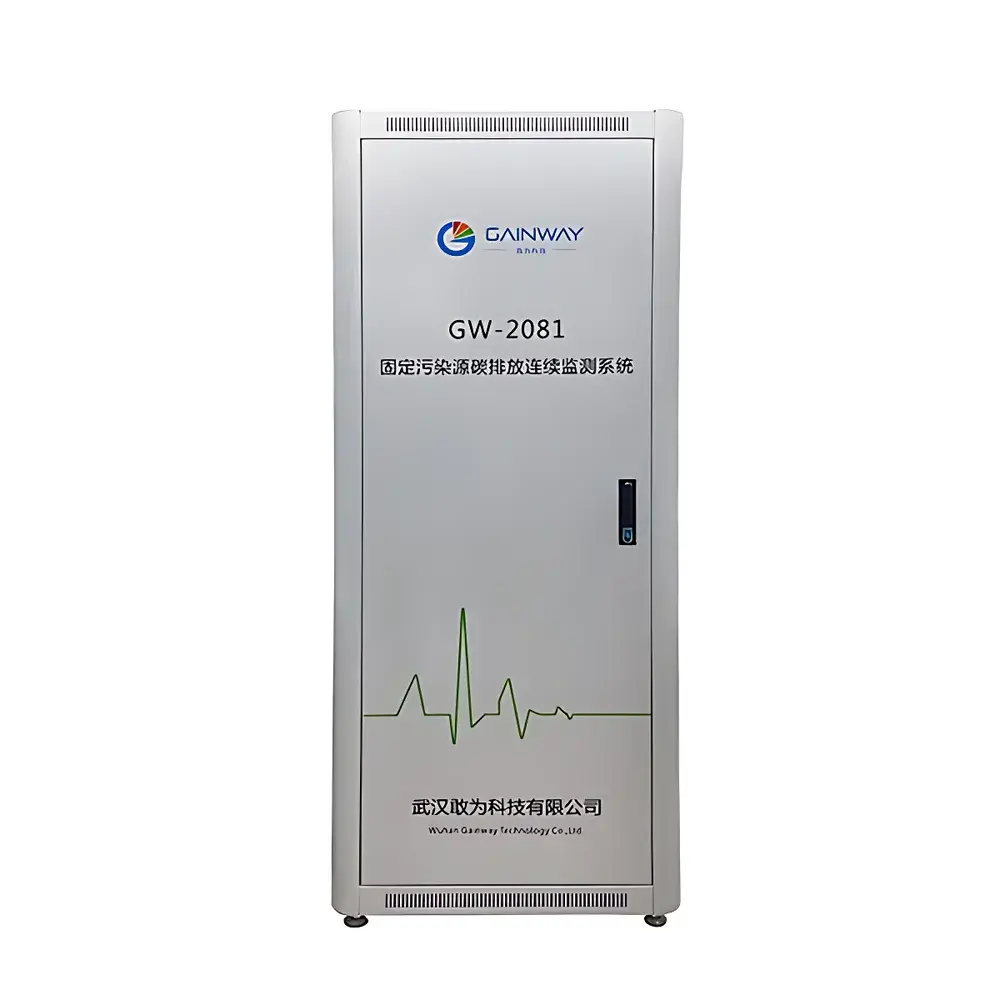
GAINWAY GW-2081 Continuous Emissions Monitoring System (CEMS) for Carbon Emissions from Fixed Sources
| Brand | GAINWAY |
|---|---|
| Model | GW-2081 |
| Origin | Hubei, China |
| Instrument Type | Online CEMS |
| Detection Target | Multi-component gases (CO₂, CH₄, N₂O, CO, O₂) |
| Measurement Ranges | 0–50 ppm (N₂O), 0–1000 ppm (CH₄), 0–20% (CO₂) |
| Response Time | <60 s |
| Flow Rate | 800 mL/min (standard), up to 3000 mL/min (dust-free) |
| Operating Temperature | 15–35 °C |
| Dimensions | 800 mm × 850 mm × 2000 mm (L×W×H) |
| Weight | 125 kg |
| Max Power Consumption | 1200 W |
| Zero Drift (24 h) | ≤0.10% FS (CO₂), ≤1 ppm (CH₄), ≤0.2 ppm (N₂O) |
| Span Drift (24 h) | ±1% FS |
| Flow Velocity Range | 0–40 m/s |
| Temperature Range | 0–300 °C |
| Humidity Range | 0–40% RH |
| Detection Principle | Gas Filter Correlation (GFC) + Long-Path Absorption Cell (L-Cell) for CH₄/N₂O |
Overview
The GAINWAY GW-2081 Continuous Emissions Monitoring System (CEMS) is an engineered solution for real-time, regulatory-grade quantification of greenhouse gas (GHG) emissions from stationary combustion and industrial process sources. Designed in alignment with ISO 14064-3, EN 15267, and China’s HJ 75–2017 and HJ 76–2017 technical specifications for fixed-source CEMS, the system integrates dual-spectrum infrared detection architectures—Non-Dispersive Infrared (NDIR) for high-concentration CO₂ and Gas Filter Correlation (GFC) coupled with a long-path absorption cell (L-Cell) for trace-level CH₄ and N₂O—to ensure metrological traceability and cross-gas interference immunity. Unlike single-beam extractive systems, the GW-2081 employs a dual-beam optical configuration: one beam passes through a reference cell containing zero gas, while the other traverses the sample stream; differential signal processing eliminates baseline drift and compensates for window fouling, enabling stable operation under high-dust, high-moisture flue gas conditions typical of cement kilns, sintering belts, and coal-fired boilers.
Key Features
- Modular architecture with independently serviceable sensor units—CO₂, CH₄, N₂O, CO, and O₂ modules can be calibrated, replaced, or upgraded without system shutdown.
- GFC+L-Cell detection achieves sub-ppb effective resolution for N₂O (0–50 ppm range) and sub-ppm precision for CH₄ (0–1000 ppm), validated per ISO 12039 for methane in flue gas.
- Integrated flue gas parameter measurement: thermal anemometry-based flow velocity (0–40 m/s, ±2.5% FS), PT100 temperature sensing (0–300 °C, ±2.5% FS), and capacitive humidity detection (0–40% RH, ±1.5% RH).
- Automated zero/span calibration with integrated purge gas management; configurable calibration frequency per regulatory schedule (e.g., daily zero, bi-weekly span per EU BREF or US EPA PS-11).
- Embedded alarm logic compliant with IEC 61508 SIL 2: simultaneous event logging for concentration exceedance, flow interruption, power loss, sensor timeout, and calibration failure—with local non-volatile memory retention (≥30 days).
- Remote connectivity via dual-mode interface: LTE/5G cellular (SIM-based) and IEEE 802.3 Ethernet (RJ45) with TLS 1.2 encryption; supports Modbus TCP, OPC UA, and MQTT protocols for SCADA integration.
Sample Compatibility & Compliance
The GW-2081 is validated for extractive sampling of hot, wet, and particulate-laden flue gases following standard conditioning protocols (e.g., heated sample line ≥180 °C, chiller-based moisture removal, Teflon-coated filters). It meets the performance requirements of China’s “Technical Specification for Continuous Monitoring of Flue Gas Emissions” (HJ 75–2017) for accuracy, drift, and response time—and is compatible with third-party verification under CNAS-accredited laboratories. For international deployment, the system supports optional CE marking (EN 61326-1 for EMC, EN 61000-6-2/6-4) and can be configured with FDA 21 CFR Part 11-compliant audit trail functionality upon software license activation. All gas modules are factory-calibrated against NIST-traceable standards (SRM 1676a for CO₂, SRM 1678 for CH₄), with calibration certificates issued per ISO/IEC 17025.
Software & Data Management
The embedded GAINWAY CEMS Manager v3.2 firmware provides full lifecycle data governance: real-time trend visualization, automatic report generation (hourly/daily/monthly emission summaries), and secure data export in CSV, PDF, or XML formats. Audit logs record every user action—including parameter modification, calibration execution, and alarm acknowledgment—with immutable timestamps and operator ID binding. Data integrity is enforced via SHA-256 hashing and write-once storage architecture. Optional cloud synchronization enables centralized fleet monitoring across multiple sites, with role-based access control (RBAC) and TLS-encrypted data transmission. The system exports standardized data packets compliant with China’s National Emission Trading System (ETS) reporting schema and supports direct upload to provincial environmental monitoring platforms via HTTPS POST.
Applications
- Coal- and gas-fired power plants: continuous CO₂ mass emission rate calculation using Q = C × V × ρ (concentration × volumetric flow × molecular weight), aligned with IPCC Tier 3 methodology.
- Cement clinker production: simultaneous monitoring of CO₂ (from calcination and fuel combustion) and NOₓ co-emissions for process optimization and decarbonization pathway modeling.
- Iron and steel sintering & blast furnace operations: CH₄ and N₂O quantification during coke oven gas combustion and sinter cooler exhaust—supporting GHG inventories under ISO 14064-1.
- Chemical manufacturing (e.g., ammonia synthesis, ethylene crackers): stack-level verification of abatement efficiency for catalytic oxidation units targeting CO and unburnt hydrocarbons.
- Waste-to-energy facilities: dynamic correction of CO₂ readings for biogenic vs. fossil carbon fractions using concurrent CH₄ and CO measurements per EN 13432 guidance.
FAQ
Does the GW-2081 comply with China’s mandatory CEMS certification requirements (HJ 75/HJ 76)?
Yes—the system has passed type approval testing at national CEMS testing centers accredited by the Ministry of Ecology and Environment (MEE), including accuracy validation, interference testing, and 168-hour continuous operation assessment.
Can the system measure both CO₂ and CH₄ simultaneously without cross-sensitivity?
Yes—via spectral isolation: CO₂ uses broad-band NDIR at 4.26 µm, while CH₄ and N₂O employ GFC modulation at 3.31 µm and 4.53 µm respectively, minimizing interferences from H₂O, CO, and SO₂ as verified per HJ 76–2017 Annex D.
Is remote firmware update supported over cellular networks?
Yes—signed OTA (Over-the-Air) updates are delivered via encrypted HTTPS channels; update integrity is verified using digital signatures prior to installation.
What maintenance intervals are recommended for field operation?
Sensor module zero calibration: daily (automated); span calibration: weekly for CO₂, bi-weekly for CH₄/N₂O; particulate filter replacement: every 3 months; optical window cleaning: quarterly—per maintenance logbook requirements in HJ 75–2017 Section 7.3.
Can the GW-2081 integrate with existing DCS or PLC systems?
Yes—native support for Modbus RTU/TCP, Profibus DP, and OPC UA (compliant with IEC 62541); custom protocol mapping available via configuration utility.
Related Products







