
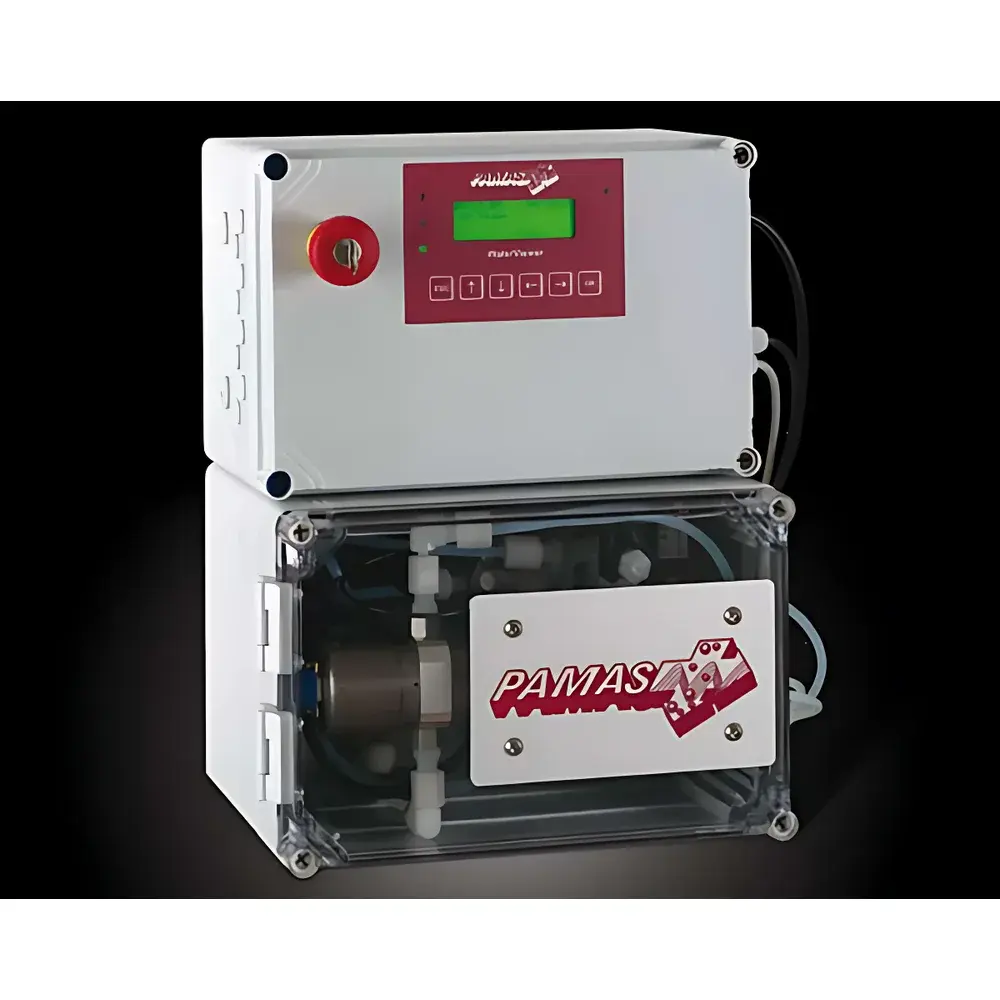
PAMAS WaterViewer Online Waterborne Particle Counter
| Brand | PAMAS |
|---|---|
| Origin | Germany |
| Model | WaterViewer |
| Instrument Type | Optical Particle Counter |
| Measuring Range | 1–100 µm (extendable to 800 µm) |
| Particle Concentration Capacity | 0–200,000 particles/mL |
| Connectivity | Multi-channel digital interface, network-enabled (Ethernet/Modbus TCP), supports up to 32 parallel water lines via multiplexer |
| Automation | Fully automated operation with scheduled sensor cleaning, remote monitoring & control capability |
Overview
The PAMAS WaterViewer Online Waterborne Particle Counter is an industrial-grade optical particle counter engineered for continuous, real-time monitoring of suspended particulate contamination in critical water systems. Based on light extinction (obscuration) principle—compliant with ISO 11171 and ISO 4406:2017—it delivers traceable, repeatable quantification of particle size distribution and concentration directly within process streams. Designed for integration into power plant condensate polishing loops, pharmaceutical purified water (PW) and water-for-injection (WFI) distribution networks, semiconductor ultrapure water (UPW) recirculation lines, and marine engine lubrication cooling circuits, the WaterViewer operates unattended for extended periods while maintaining metrological integrity under variable flow conditions (0.1–1.5 L/min typical). Its German-engineered optical detection module features a high-stability LED light source, precision-aligned flow cell geometry, and temperature-compensated signal processing to minimize drift and ensure long-term calibration stability.
Key Features
- Optical detection system calibrated per ISO 11171 reference standards, supporting dual-range sizing (1–100 µm standard; optional extension to 800 µm with recalibrated aperture and firmware)
- Programmable measurement cycles—including time-triggered, flow-triggered, and event-driven sampling modes—enabling adaptive monitoring strategies aligned with process criticality
- Integrated automatic sensor cleaning mechanism using pressurized purge fluid (deionized water or compatible solvent), activated on schedule or based on signal attenuation thresholds
- Scalable architecture: single unit controls up to 32 independent water channels via external PAMAS Multiplexer Module (Mux-32), eliminating need for redundant analyzers in multi-point distribution systems
- Industrial communication protocols: native support for Modbus TCP, Ethernet/IP, and OPC UA; configurable analog outputs (4–20 mA) for PLC integration and alarm relay contacts for fail-safe shutdown signaling
- Ruggedized IP65-rated enclosure with stainless-steel wetted parts (316L SS flow cell, sapphire windows), rated for ambient temperatures from 5 °C to 45 °C and operating pressures up to 10 bar
Sample Compatibility & Compliance
The WaterViewer is validated for use with low-conductivity, non-viscous aqueous media including demineralized water, reverse osmosis permeate, steam condensate, and pharmaceutical-grade water. It is not intended for highly turbid, viscous, or chemically aggressive fluids without prior validation. The instrument complies with electromagnetic compatibility (EMC) requirements per EN 61326-1:2013 and safety standards per EN 61010-1:2010. For regulated environments, its data acquisition and reporting functions support audit-trail generation and user-access logging—fully compatible with FDA 21 CFR Part 11-compliant software platforms when deployed with PAMAS LabView-based or third-party SCADA/HMI systems meeting ALCOA+ data integrity principles.
Software & Data Management
The WaterViewer operates autonomously but interfaces seamlessly with PAMAS ParticleTrack™ desktop software (Windows-based) for configuration, trend analysis, and report generation (PDF/CSV export). All measurement data—including timestamped particle counts per size bin, cumulative distributions, ISO cleanliness codes (per ISO 4406), and system health diagnostics—are stored locally on internal flash memory (≥1 year at 1-min intervals) and simultaneously streamed via Ethernet to centralized historian databases (e.g., OSIsoft PI, Ignition, or custom SQL repositories). Remote firmware updates, parameter reconfiguration, and diagnostic troubleshooting are supported over secure TLS-enabled connections, ensuring operational continuity during GMP/GLP audits.
Applications
- Real-time monitoring of turbine condensate quality in thermal and nuclear power plants to prevent erosion-corrosion damage
- Continuous verification of filter integrity and microbial challenge response in pharmaceutical WFI/PW loop validation studies
- In-line particle load assessment upstream of point-of-use ultrafiltration in semiconductor UPW systems
- Early-warning detection of wear debris ingress in closed-loop seawater-cooled lubrication systems aboard marine vessels
- Compliance tracking against USP , EP 2.9.19, and JP 6.07 for parenteral manufacturing water quality control
FAQ
Does the WaterViewer require periodic recalibration?
Yes—annual traceable calibration using NIST-traceable latex sphere suspensions (PSL standards) is recommended per ISO/IEC 17025 guidelines; field verification checks can be performed quarterly using certified check particles.
Can it detect non-spherical or transparent particles?
It detects particles based on light extinction cross-section; morphology and refractive index influence effective sizing—calibration assumes spherical, non-absorbing particles (e.g., silica, polystyrene); users must validate recovery efficiency for irregular or low-contrast contaminants.
Is explosion-proof certification available?
Standard units are not ATEX/IECEx-certified; however, hazardous-area variants (WaterViewer Ex-d) with flameproof enclosures are available upon request for Zone 1/21 applications.
What maintenance intervals are specified?
Sensor cleaning cycle defaults to every 24 hours; flow cell inspection and O-ring replacement are recommended every 6 months; optical window cleaning with lint-free wipes and IPA is advised after exposure to high-particulate samples.
How is data security ensured during network transmission?
All Ethernet communications support TLS 1.2 encryption; role-based access control (RBAC) and password complexity enforcement are configurable via ParticleTrack™; local data storage uses encrypted file systems compliant with IEC 62443-3-3 SL2 requirements.



