
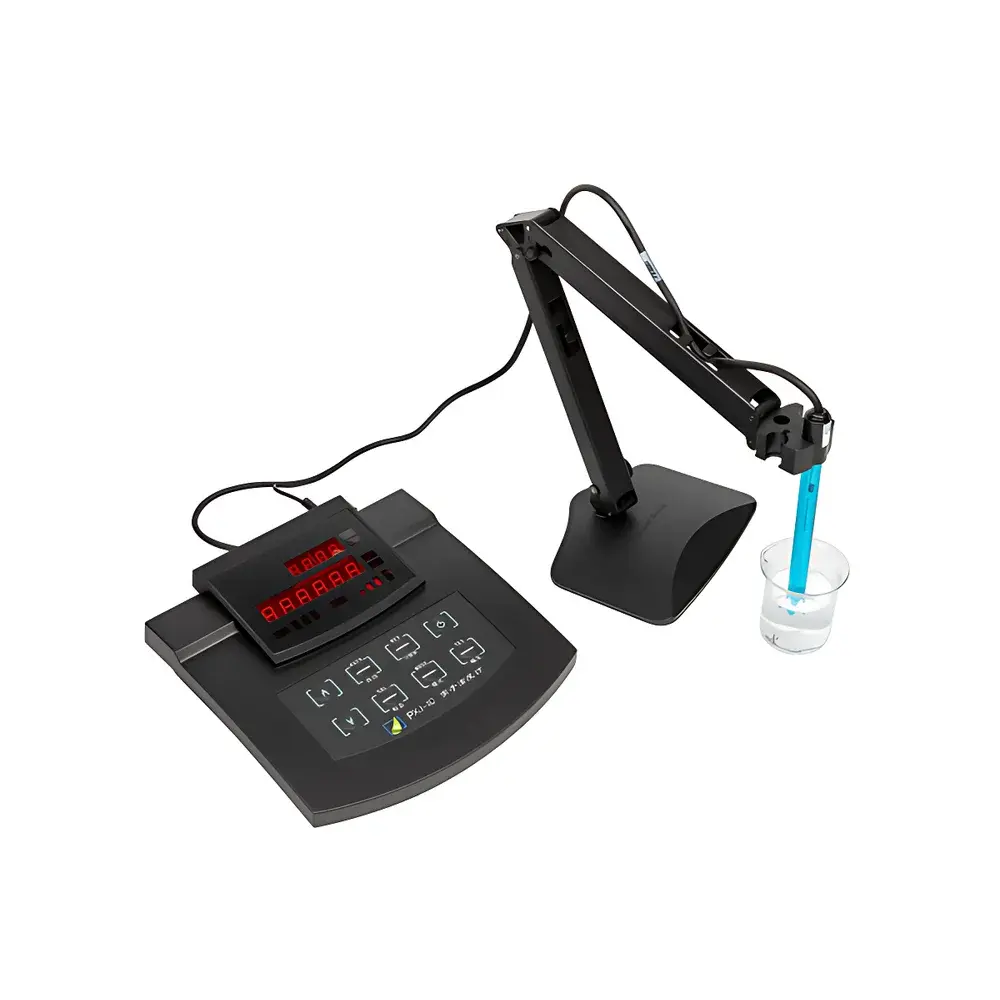
FangZhou PXJ-1C Benchtop Multi-Ion Analyzer
| Brand | FangZhou |
|---|---|
| Origin | Sichuan, China |
| Manufacturer Type | Authorized Distributor |
| Product Category | Domestic |
| Model | PXJ-1C |
| Instrument Type | Benchtop |
| Ion Measurement Range | 0–19.999 pX |
| Resolution | 0.001/0.01/0.1 pX (adjustable) |
| mV Range | −1999.9 to +1999.9 mV |
| mV Resolution | 0.1/1 mV (adjustable) |
| Temperature Range | −5.0 to +105.0 °C |
| Temp. Resolution | 0.1 °C |
| Temp. Accuracy | ±0.3 °C ±1 digit |
| pX Accuracy | ±0.005 pX ±1 digit |
| mV Accuracy | ±0.03% FS ±1 digit |
| Input Impedance | ≥3 × 10¹² Ω |
| Calibration Points | Up to 2-point auto-identification |
| Response Time | ≤3 s |
| Temperature Compensation | Automatic or Manual (−5.0 to +105.0 °C) |
| Data Output | RS232 serial interface |
| Electrode Interface | Universal BNC + temperature sensor port |
Overview
The FangZhou PXJ-1C Benchtop Multi-Ion Analyzer is a precision potentiometric instrument engineered for quantitative determination of specific ion activities in aqueous solutions using ion-selective electrodes (ISEs). Based on the Nernst equation principle, it measures the potential difference between a working ISE and a reference electrode to calculate ion concentration expressed as pX (where X denotes the target ion, e.g., F⁻, Cl⁻, NO₃⁻, NH₄⁺). Designed for routine laboratory and field-deployable water quality analysis, the PXJ-1C supports regulatory-compliant testing in environmental monitoring, municipal wastewater treatment, drinking water safety verification, and industrial effluent assessment. Its microprocessor-controlled architecture ensures stable signal acquisition, high reproducibility, and minimal drift—critical for compliance with ISO 10523 (water quality — determination of pH), ASTM D1293 (standard test method for pH of water), and EPA Method 300.0 (determination of anions by ion chromatography—supporting ISE validation protocols).
Key Features
- Triple-mode operation: simultaneous pX, mV, and temperature (T) display with real-time synchronization
- Adjustable resolution: user-selectable pX resolution (0.001 / 0.01 / 0.1 pX) and mV resolution (0.1 / 1 mV) to match analytical requirements
- Intelligent calibration system: automatic standard solution recognition during 2-point calibration; built-in memory stores calibration parameters including slope, offset, and date/time stamp
- Dynamic endpoint detection: algorithm-driven stabilization assessment eliminates subjective endpoint judgment and improves inter-operator consistency
- Robust input stage: ≥3 × 10¹² Ω input impedance minimizes loading effects when paired with high-impedance solid-state or liquid-membrane ISEs
- Flexible temperature management: dual-mode compensation (automatic or manual) across −5.0 to +105.0 °C, supporting both aqueous and elevated-temperature sample analysis
- Non-volatile data retention: power-loss protection preserves calibration history, measurement logs, and system settings without external backup
Sample Compatibility & Compliance
The PXJ-1C is compatible with all commercially available single-junction and double-junction ISEs featuring standard BNC connectors, including fluoride, chloride, bromide, nitrate, ammonium, calcium, and potassium electrodes. It accepts integrated temperature sensors (e.g., Pt1000 or thermistor-based probes) via dedicated analog input. The instrument meets essential electromagnetic compatibility (EMC) requirements per GB/T 18268.1–2010 (equivalent to IEC 61326-1) and conforms to electrical safety standards GB 4793.1–2007 (IEC 61010-1). While not certified for GMP or GLP environments out-of-the-box, its audit-ready calibration logging, timestamped records, and RS232 traceability support integration into validated workflows under ISO/IEC 17025-accredited laboratories when paired with documented SOPs.
Software & Data Management
Equipped with an RS232 serial interface compliant with EIA/TIA-232-F specifications, the PXJ-1C enables bidirectional communication with host PCs running custom or third-party data acquisition software. Raw pX/mV/T values, calibration metadata (including electrode ID, standard concentrations, measured potentials, Nernstian slope %), and timestamps are exportable in ASCII-delimited format (CSV-compatible). No proprietary driver installation is required—standard COM port configuration suffices. Internal non-volatile memory retains up to 200 measurement records and full calibration histories, facilitating internal QA reviews and trend analysis without immediate PC dependency.
Applications
- Environmental monitoring: quantification of fluoride in groundwater (per WHO guideline values), nitrate in agricultural runoff, and chloride intrusion in coastal aquifers
- Drinking water compliance: verification of residual disinfectant ions (e.g., free chlorine via amperometric titration-supported ISE correlation)
- Wastewater treatment: real-time monitoring of ammonium nitrogen (NH₄⁺) in nitrification/denitrification basins
- Industrial process control: electroplating bath monitoring (e.g., Cu²⁺, Ni²⁺), boiler feedwater purity (Cl⁻, SO₄²⁻), and semiconductor rinse water purity assurance
- Educational laboratories: hands-on instruction in potentiometry, Nernst equation derivation, and ISE selectivity coefficient evaluation
FAQ
What ion-selective electrodes are compatible with the PXJ-1C?
The instrument supports any ISE with standard BNC output and optional integrated temperature sensing (analog voltage or resistance-based). Common OEM electrodes from Thermo Scientific, Metrohm, and Horiba are fully interoperable.
Does the PXJ-1C support GLP-compliant data integrity?
While the device itself does not include 21 CFR Part 11 electronic signature functionality, its timestamped calibration logs, immutable parameter storage, and RS232 audit trail meet foundational ALCOA+ principles (Attributable, Legible, Contemporaneous, Original, Accurate) when implemented within a controlled IT environment.
Can the PXJ-1C perform direct concentration measurements without calibration?
No. All quantitative pX determinations require at minimum a 2-point calibration using certified standard solutions traceable to NIST or equivalent national metrology institutes.
Is temperature compensation mandatory for accurate pX readings?
Yes—Nernst slope varies with temperature. The PXJ-1C mandates either automatic (via connected probe) or manual temperature entry prior to measurement to apply correct theoretical slope correction.
What maintenance is required for long-term stability?
Regular cleaning of electrode junctions, periodic rehydration of reference electrolytes, and annual verification against certified reference materials (CRMs) are recommended. The host unit requires no routine internal servicing beyond visual inspection and connector cleaning.
Related Products







