
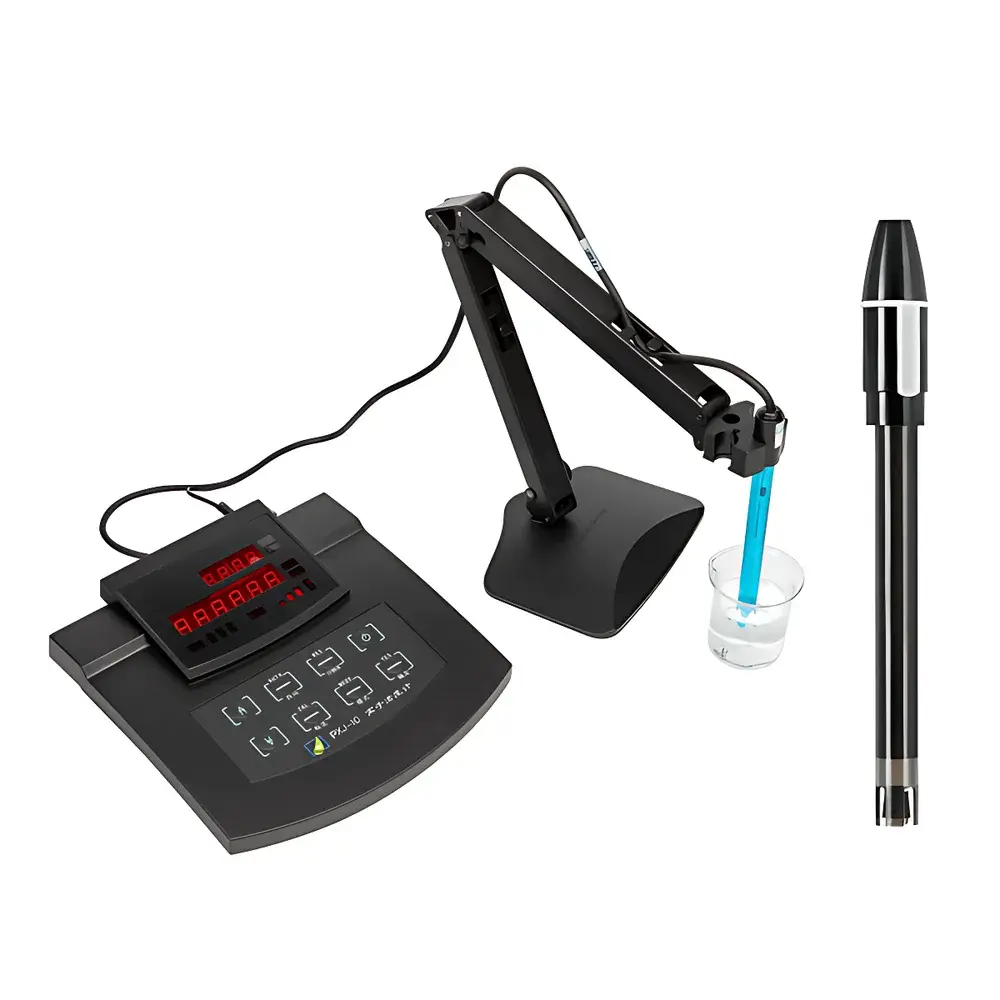
FangZhou PXJ-1C Fluoride Ion Meter
| Brand | FangZhou |
|---|---|
| Origin | Sichuan, China |
| Manufacturer Type | Authorized Distributor |
| Product Category | Domestic |
| Model | PXJ-1C Fluoride Ion Meter |
| Instrument Type | Benchtop |
| Ion Measurement Range | 0–19.999 pX |
| Resolution | 0.001/0.01/0.1 pX (adjustable) |
| Accuracy | ±0.005 pX ±1 digit |
| mV Range | −1999.9 to +1999.9 mV |
| mV Resolution | 0.1/1 mV (adjustable) |
| mV Accuracy | ±0.03% FS ±1 digit |
| Temperature Range | −5.0 to +105.0 °C |
| Temp. Resolution | 0.1 °C |
| Temp. Accuracy | ±0.3 °C ±1 digit |
| Temperature Compensation | Automatic or Manual (−5.0 to +105.0 °C) |
| Input Impedance | ≥3 × 10¹² Ω |
| Calibration Points | Up to 2-point |
| Response Time | ≤3 s |
| Electrode Interface | BNC + RTD (Pt1000 or thermistor) |
| Communication Interface | RS232 |
| Data Storage | Internal calibration history and measurement logs |
| Power Supply | AC 100–240 V, 50/60 Hz |
| Certifications | ISO 9001 certified |
Overview
The FangZhou PXJ-1C Fluoride Ion Meter is a benchtop potentiometric ion analyzer engineered for precise, trace-level fluoride (F⁻) quantification in aqueous environmental and industrial samples. It operates on the principle of selective ion electrode (ISE) potentiometry—measuring the electromotive force (EMF) generated at the interface between a fluoride-selective membrane electrode and the sample solution, relative to a stable reference electrode. The measured potential (in mV) is converted into pX (negative logarithm of ion activity) using the Nernst equation, enabling direct, non-destructive determination of fluoride concentration across a wide dynamic range. Designed for compliance-driven laboratories, the PXJ-1C supports regulatory workflows aligned with EPA Method 300.0, ISO 10304-1, and ASTM D6919 for anion analysis in drinking water, wastewater, groundwater, and process streams. Its microprocessor-controlled architecture ensures high reproducibility, low drift, and robust signal stability—critical for routine monitoring where detection fidelity below 0.1 mg/L F⁻ is required.
Key Features
- Triple-mode display: Simultaneous real-time readout of pX, mV, and temperature (T) values with user-selectable resolution (0.001 / 0.01 / 0.1 pX; 0.1 / 1 mV)
- Intelligent auto-calibration: Supports up to two-point calibration with automatic standard recognition and endpoint detection—eliminating manual endpoint judgment errors
- Adaptive temperature compensation: Dual-mode (automatic/manual) compensation using integrated Pt1000 or thermistor probes; full-range coverage from −5.0 to +105.0 °C
- High-input-impedance circuitry (≥3 × 10¹² Ω): Minimizes loading effects and ensures accurate signal acquisition from high-impedance fluoride ISEs
- RS232 serial interface: Enables direct data export to LIMS, Excel, or third-party analytical software with timestamped records
- Non-volatile memory: Retains calibration parameters, measurement history, and system settings after power loss
- Comprehensive error diagnostics: Real-time alerts for electrode drift, out-of-range signals, and temperature sensor faults
Sample Compatibility & Compliance
The PXJ-1C is validated for use with commercially available solid-state or lanthanum fluoride crystal-based fluoride ISEs (e.g., Thermo Scientific Orion 96-09, Metrohm 6.0258.100). It accommodates samples with ionic strength ranging from deionized water to 0.1 M total dissolved solids (TDS), provided appropriate ionic strength adjuster (ISA) is added per ISO 10304-1 protocol. All firmware and hardware design elements conform to ISO/IEC 17025 general requirements for testing laboratories. The instrument’s calibration traceability, data integrity controls (including audit-ready calibration logs), and configurable auto-save intervals support GLP and GMP-aligned quality systems. While not FDA 21 CFR Part 11–certified out-of-the-box, its RS232 output and deterministic calibration behavior allow integration into validated environments when paired with compliant data acquisition software.
Software & Data Management
No proprietary PC software is bundled; however, the RS232 interface complies with standard ASCII command protocols (e.g., “READ”, “CAL?”, “TEMP?”), facilitating seamless integration with LabVIEW, Python (pySerial), or custom SCADA platforms. Each measurement packet includes UTC timestamp, pX/mV/T values, electrode ID (if encoded), and calibration status flag. Internal memory stores ≥100 calibration events with date/time stamp, slope (%/decade), and offset (mV)—accessible via front-panel navigation. Data export supports CSV formatting for post-acquisition statistical analysis (e.g., control charts per ISO 7870-2) and regulatory reporting.
Applications
- Drinking water compliance testing for fluoride per WHO guidelines (1.5 mg/L max) and national standards (e.g., GB/T 5750.5–2023)
- Monitoring fluoride discharge limits in electroplating, semiconductor, and aluminum anodizing effluents
- Quality control of fluoridated dental products and pharmaceutical excipients
- Field-deployable lab verification of portable fluoride test kits (e.g., colorimetric or ion-selective paper strips)
- Educational use in analytical chemistry curricula for ISE theory, Nernstian response validation, and calibration uncertainty estimation
FAQ
What fluoride-selective electrodes are compatible with the PXJ-1C?
The meter accepts standard BNC-output fluoride ISEs and reference electrodes with separate or combination configurations. Recommended models include those with LaF₃ crystalline membranes and double-junction reference systems to minimize interference from OH⁻, Al³⁺, and Fe³⁺.
Does the PXJ-1C support automatic calibration verification?
It performs automatic endpoint detection during calibration but does not conduct post-calibration verification checks. Users must manually validate slope (typically 57–59 mV/pF at 25 °C) and asymmetry potential against known standards.
Can temperature be measured independently of ion measurement?
Yes—the integrated temperature sensor operates continuously and can be read standalone via the “T” mode, supporting external probe interchangeability for specialized applications such as high-temperature process water monitoring.
Is firmware upgrade supported?
Firmware updates are available upon request from FangZhou technical support and require RS232 connection and dedicated utility software—no over-the-air capability is implemented.
What is the expected service life of the internal backup battery?
The onboard lithium coin-cell battery retains clock and calibration memory for ≥3 years under normal operation; replacement requires authorized service due to sealed housing design.







