
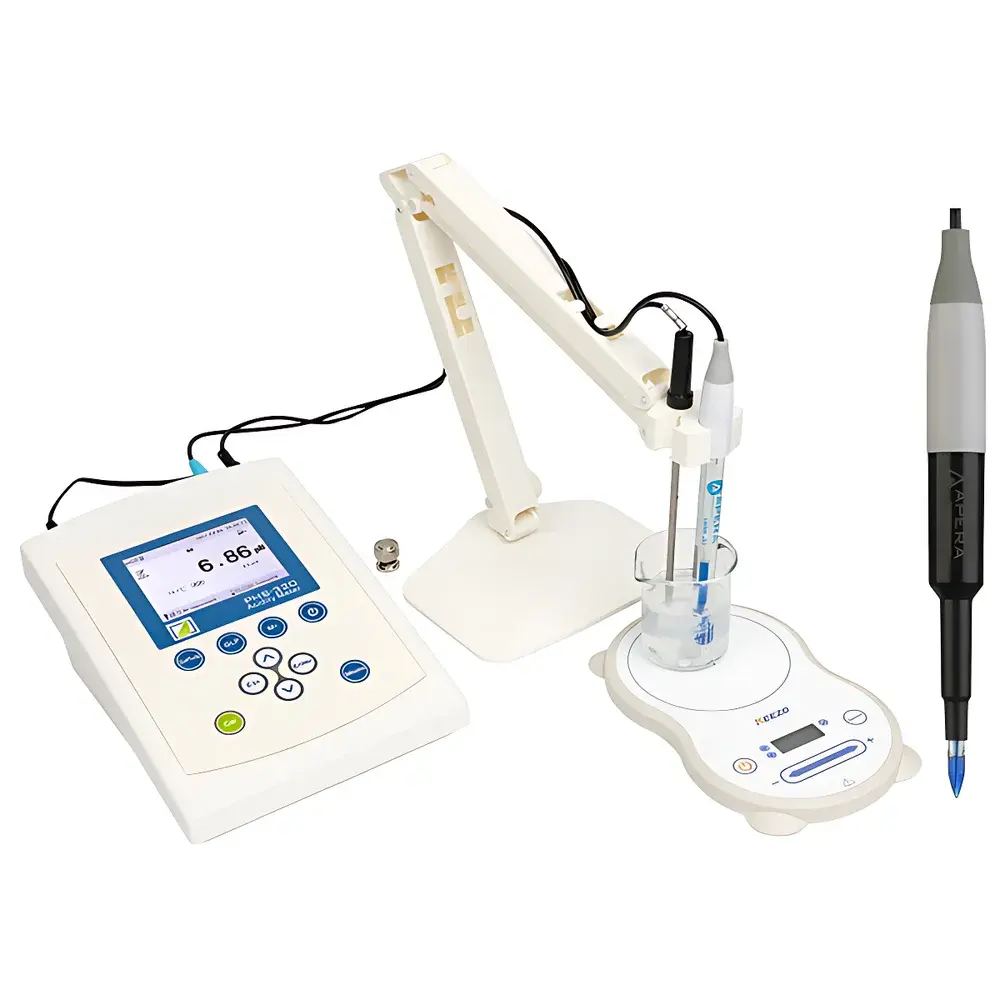
FangZhou PHS-320 Soil pH Meter
| Brand | FangZhou |
|---|---|
| Origin | Sichuan, China |
| Manufacturer Type | Authorized Distributor |
| Product Category | Domestic |
| Model | PHS-320 Soil pH Meter |
| Instrument Type | Multiparameter |
| Parameter Types | pH, mV, Rel.mV, ORP, ISE, Temperature |
| Measurement Accuracy | ±0.002 pH |
| pH Range | (−5.000 to 20.000) pH |
| Resolution | 0.001 / 0.01 / 0.1 pH (user-selectable) |
| Temperature Compensation | Automatic (ATC) or Manual (−20.0 to 135.0 °C) |
| Input Impedance | ≥3 × 10¹² Ω |
| Calibration | Up to 5-point, auto-buffer recognition, 7 buffer groups (33 NIST-traceable standards) |
| Data Storage | ≥100,000 entries with GLP-compliant metadata (sample ID, operator ID, timestamp, calibration history) |
| Interface | RS232 with printer/PC bidirectional communication |
| Power | DC 9 V, 500 mA (center-positive) |
Overview
The FangZhou PHS-320 Soil pH Meter is a microprocessor-controlled, high-precision electrochemical analyzer engineered for rigorous pH and redox potential (ORP/mV) measurements in heterogeneous and low-conductivity matrices—including soil slurries, suspensions, colloidal dispersions, and ultra-pure water. Unlike conventional benchtop pH meters optimized for aqueous electrolyte solutions, the PHS-320 integrates advanced electrode interface design, ultra-high input impedance (>3 × 10¹² Ω), and adaptive signal conditioning to mitigate junction potential drift and liquid junction errors common in non-uniform samples. Its measurement principle follows the Nernst equation under controlled thermal and ionic conditions, with automatic temperature compensation (ATC) referenced to integrated Pt1000 or external probe inputs. The instrument complies with fundamental metrological requirements defined in ISO 7027, ASTM D1293, and USP , supporting traceable, reproducible pH determination across environmental, agricultural, pharmaceutical, and industrial QA/QC workflows.
Key Features
- True-color 4.3-inch TFT LCD display with graphical real-time trend plotting and intuitive menu navigation
- User-selectable resolution: 0.001 pH / 0.01 mV (high-precision mode) or coarser steps for rapid screening
- GLP-compliant data management: 10 sample IDs, 10 operator IDs, full audit trail including calibration logs, timestamps, and electrode status diagnostics
- Five measurement modes: Real-time, Timed (0–6000 s interval), Auto-Fast, Auto-Medium, Auto-Slow—optimized for kinetic stability assessment in viscous or settling samples
- Isopotential adjustment (−20.000 to +20.000 mV) to compensate for zero-offset variations across specialized electrodes (e.g., double-junction, gel-filled, or solid-state sensors)
- Self-diagnostic system continuously monitors electrode slope, asymmetry potential, and reference junction integrity—flagging degradation before measurement error exceeds ±0.002 pH
- RS232 interface supporting three operational profiles: direct thermal printing (GLP-formatted reports), PC data export to Excel/Word via native ASCII protocol, and bidirectional command control for automated lab systems
Sample Compatibility & Compliance
The PHS-320 is validated for use with 12 dedicated electrode configurations—each selected to address matrix-specific interferences. These include FZ-600T combination electrodes for general-purpose soil slurry analysis; double-junction Ag/AgCl electrodes with ceramic frits for sulfide-rich or protein-laden suspensions; flat-surface sensors for agar plates or filter paper assays; and HF-resistant electrodes for acidic digestates. All configurations maintain compliance with ISO 11260 (soil pH determination), EPA Method 9045D (soil and sediment pH), and CLSI EP15-A3 guidelines for precision verification. Data storage adheres to FDA 21 CFR Part 11 requirements when paired with validated software and electronic signature protocols—enabling full traceability during regulatory inspections.
Software & Data Management
Internal firmware implements a deterministic file system architecture that writes timestamped records (YYYY-MM-DD HH:MM:SS) with embedded calibration metadata—including buffer IDs, measured mV values, slope (%), and offset (mV). Exported datasets contain UTF-8 encoded headers compatible with LIMS integration. The RS232 ASCII output format includes fixed-field delimiters, enabling direct ingestion into statistical packages (e.g., JMP, Minitab) without parsing scripts. Optional PC software provides batch validation reports aligned with ISO/IEC 17025 clause 7.7, including uncertainty estimation per GUM (JCGM 100:2008) using manufacturer-specified repeatability (0.001 pH) and calibration uncertainty contributions.
Applications
- Agricultural soil health monitoring: pH profiling of rhizosphere extracts, compost leachates, and fertilizer-amended substrates
- Environmental remediation: In situ pH mapping of contaminated sediments, landfill leachate, and acid mine drainage
- Pharmaceutical manufacturing: USP compliance testing of purified water, WFI, and buffer solutions
- Food safety laboratories: pH validation of dairy products, fermented foods, and meat processing brines per ISO 21527-1
- Academic research: Kinetic studies of enzymatic hydrolysis, microbial fermentation, and corrosion inhibition where pH drift must be resolved at ≤0.002 pH intervals
FAQ
Does the PHS-320 support automatic buffer recognition for all 33 NIST-traceable standards?
Yes—the instrument’s firmware contains preloaded voltage signatures for all 33 buffers across seven international groups (NIST, DIN, JIS, Merck, METTLER TOLEDO), enabling one-touch identification during calibration.
Can the built-in data logger meet GLP audit requirements for raw data integrity?
Yes—each stored record includes immutable metadata: date/time stamp, operator ID, sample ID, electrode serial number, calibration certificate ID, and checksum-verified mV readings.
What electrode types are recommended for measuring pH in clay-rich soil suspensions?
FZ-600T combination electrodes with open-junction design and KNO₃ electrolyte are validated for such applications; optional soil-specific sleeves minimize clogging while maintaining stable liquid junction potentials.
Is temperature compensation limited to Pt1000 probes, or does it accept thermistor inputs?
The PHS-320 accepts both Pt1000 (standard) and user-calibrated thermistor inputs via its analog temperature interface, with linearization coefficients configurable per sensor type.
How is measurement uncertainty quantified for regulatory submissions?
Uncertainty budgets follow EURACHEM/CITAC Guide CG4, incorporating contributions from calibration standard uncertainty (±0.001 pH), instrument repeatability (0.001 pH), temperature compensation error (±0.0005 pH/°C), and electrode drift (±0.0008 pH/day).




