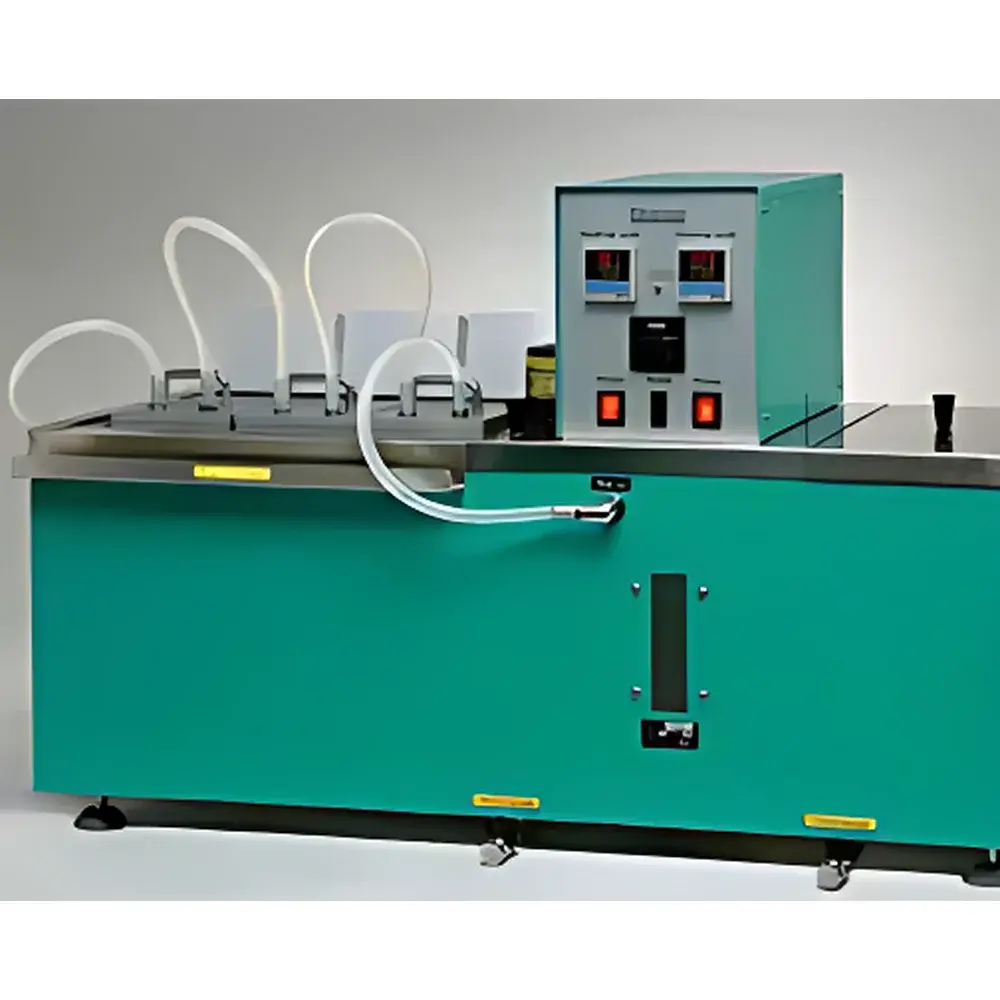
Elastocon EB 03 Fogging Tester
| Brand | Elastocon |
|---|---|
| Origin | Sweden |
| Model | EB 03 Fogging Tester |
| Heating Bath Temperature Range | 40–130 °C |
| Cooling Bath Temperature Range | 20–80 °C |
| Sample Holders | 6 x glass beakers |
| Condensation Surface | Aluminum foil-coated cooling plate |
| Compliant Standards | ISO 6452, ASTM D5393, DIN 75201, SAE J1756 |
Overview
The Elastocon EB 03 Fogging Tester is a precision-engineered instrument designed for quantitative determination of volatile condensable substances emitted from automotive interior materials under controlled thermal conditions. It operates on the principle of thermal desorption followed by cold-surface condensation—a gravimetric method standardized across global OEM and Tier-1 supply chain requirements. During testing, a conditioned specimen (e.g., polyurethane foam, PVC trim, adhesives, or carpet backing) is placed in a sealed glass beaker and heated within a thermostatically regulated oil or water bath. Volatiles released migrate upward and condense onto a cooled aluminum foil-covered plate positioned above the sample. The mass gain of the foil—measured before and after exposure—provides the fogging value in milligrams (mg), directly correlating to potential windshield or optical surface contamination risk.
Key Features
- Thermostatically controlled heating bath with precise ±0.5 °C stability across 40–130 °C, supporting both ISO 6452 (100 °C/16 h) and ASTM D5393 (100 °C/22 h) protocols.
- Dual-zone temperature management: independent regulation of heating bath and cooling bath (20–80 °C), enabling reproducible condensation kinetics and minimizing ambient drift.
- Modular 6-position sample carousel accommodates standard 50 mL borosilicate glass beakers, ensuring parallel processing without cross-contamination.
- Cooling plate assembly features high-purity aluminum substrate with certified low-background aluminum foil—pre-cut and pre-weighed to eliminate handling variability.
- Robust stainless-steel chassis with insulated bath housing, integrated safety cut-offs, and drip-resistant design compliant with laboratory-scale electrical safety standards (IEC 61010-1).
- No internal pumps or compressors: cooling achieved via external tap-water circulation or optional recirculating chiller connection (standard ½” BSP inlet/outlet).
Sample Compatibility & Compliance
The EB 03 supports diverse material forms including molded elastomers, laminated composites, textile substrates, foams, sealants, and coated plastics—provided specimens meet dimensional and mass criteria defined in ISO 6452 (e.g., 10 g ± 0.1 g, 50 mm × 50 mm surface area). All test procedures adhere strictly to the gravimetric measurement framework mandated by international automotive specifications. Full traceability is ensured through documented calibration of bath sensors (NIST-traceable Pt100 probes), foil mass verification using Class I analytical balances (0.01 mg resolution), and environmental monitoring logs. The system satisfies audit requirements for GLP-compliant laboratories and supports 21 CFR Part 11–ready data integrity workflows when paired with validated third-party weighing and reporting software.
Software & Data Management
The EB 03 is a hardware-only platform optimized for integration into existing LIMS or QA documentation ecosystems. While it does not include embedded firmware or touchscreen controls, its mechanical repeatability and analog signal stability enable seamless interfacing with external data acquisition systems. Users commonly deploy calibrated digital thermometers with RS-232/USB output for automated bath temperature logging, and integrate high-precision microbalances via serial or Ethernet interfaces to capture pre- and post-test foil masses. Test reports—including specimen ID, batch number, exposure duration, bath setpoints, ambient RH/temperature, and final fogging mass—are structured to align with ISO/IEC 17025 documentation templates and OEM-specific PPAP submission formats.
Applications
- Pre-release validation of interior components for OEMs including Volkswagen Group, BMW, Ford, and Toyota—ensuring compliance with internal fogging limits (e.g., ≤ 2.0 mg for driver-side visors).
- Root-cause analysis of haze formation in head-up display (HUD) zones, where condensed volatiles degrade optical transmission at critical wavelengths (400–700 nm).
- Raw material qualification for polymer suppliers developing low-emission TPO, thermoplastic elastomers (TPE), and bio-based plasticizers.
- Regulatory support for REACH SVHC screening, particularly for phthalates, amine catalysts, and residual monomers known to contribute disproportionately to fogging mass.
- Method transfer between R&D labs and contract testing facilities due to standardized geometry, foil specifications, and thermal profiles across EB-series instruments.
FAQ
Does the EB 03 include built-in temperature logging or data export capability?
No—the EB 03 is a dedicated benchtop test apparatus without onboard memory or connectivity. Temperature and mass data must be recorded externally using calibrated instrumentation.
Can the cooling plate be substituted with alternative substrates such as PET film or chrome-plated brass?
No—aluminum foil is specified in all referenced standards (ISO 6452 Annex A, ASTM D5393 Section 7.2) due to its consistent surface energy, low intrinsic volatility, and predictable condensation morphology.
Is the EB 03 suitable for testing non-automotive materials such as aerospace cabin interiors or medical device packaging?
Yes, provided test parameters are adapted per application-specific protocols; however, regulatory acceptance requires formal method validation against relevant industry benchmarks (e.g., AMS 3670 for aerospace, ISO 10993-12 for extractables).
What maintenance intervals are recommended for long-term accuracy?
Heating bath fluid should be replaced annually or after 2,000 operating hours; aluminum foil holders require single-use disposal; temperature sensors should undergo annual NIST-traceable recalibration.
How does the EB 03 differ from the older EB 01 and EB 02 models?
The EB 03 introduces improved thermal uniformity across the 6-beaker array, enhanced cooling plate alignment repeatability, and updated safety interlocks compliant with EN 61010-1:2010/A1:2019.