
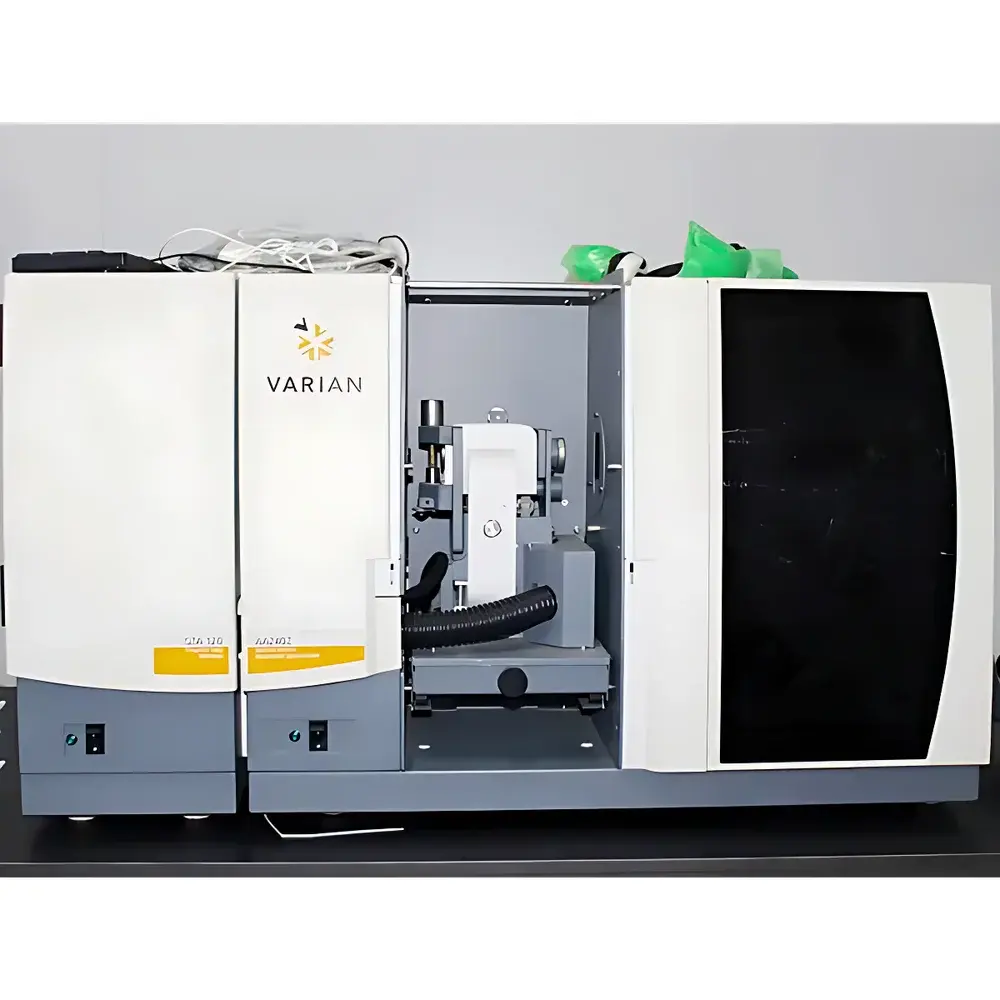
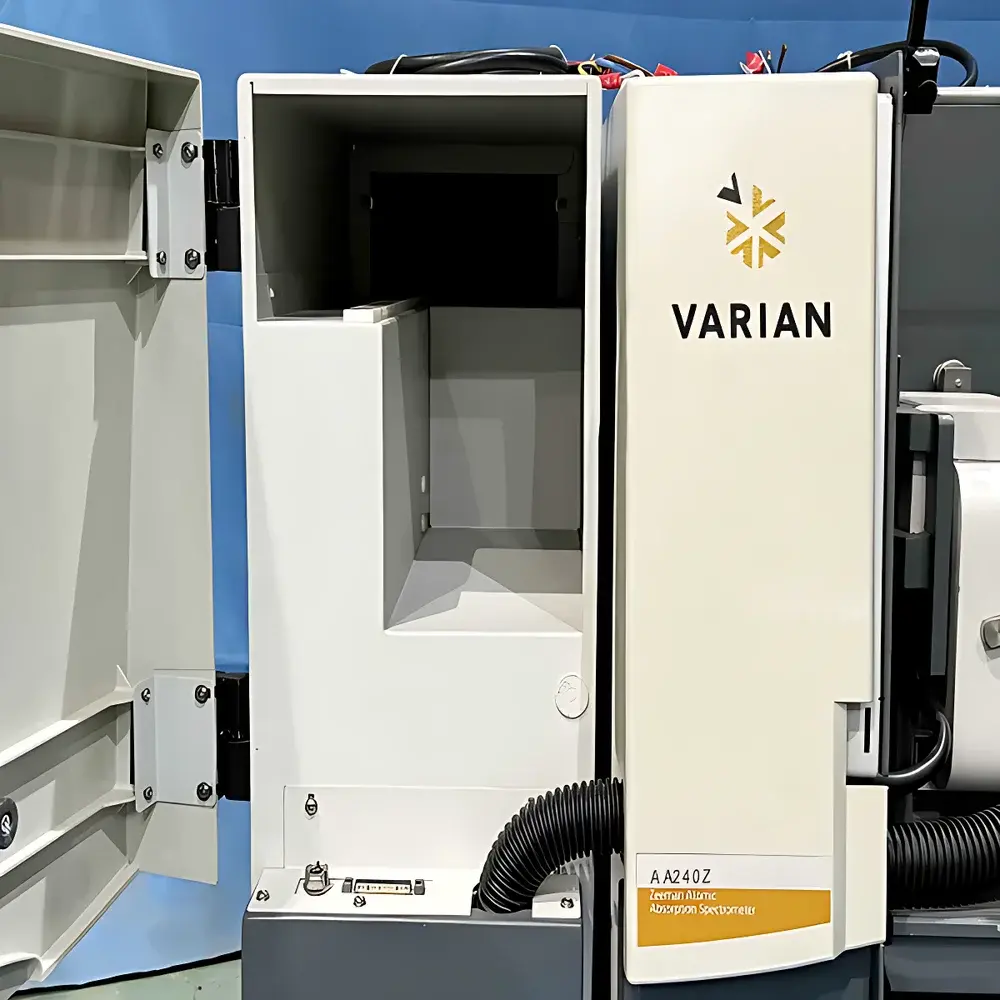
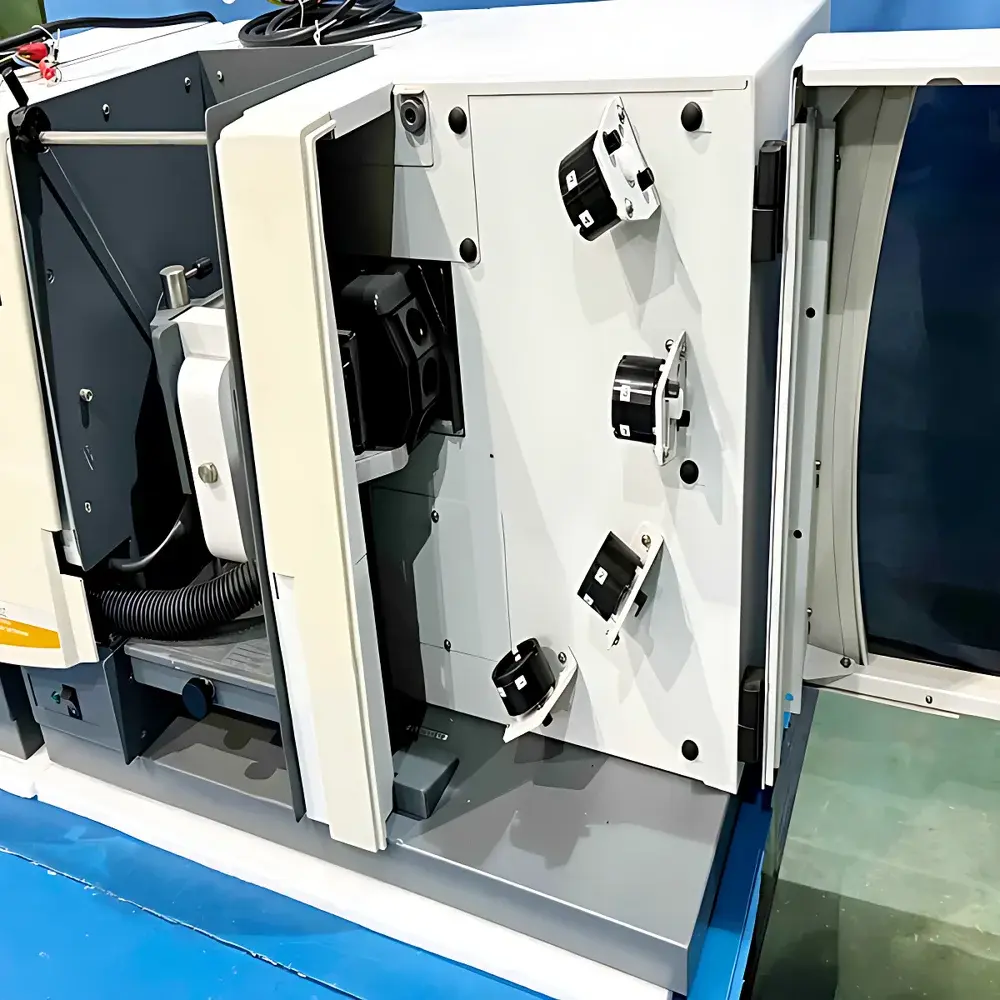
Agilent 240Z AA Graphite Furnace Atomic Absorption Spectrometer
| Brand | Agilent Technologies |
|---|---|
| Origin | Malaysia |
| Model | 240Z |
| Instrument Type | Graphite Furnace AAS |
| Monochromator | Echelle Grating |
| Optical System | Single-Beam |
| Detector | Photomultiplier Tube (PMT) |
| Background Correction | Deuterium Lamp |
| Resolution | 0.3 nm |
| Sensitivity | 0.3 ng/mL for Cd |
| RSD (Repeatability) | ≤0.3% |
| Detection Limit | 0.006 ng/mL for Cd |
| Baseline Stability | ±0.005 absorbance units/30 min |
Overview
The Agilent 240Z AA is a high-performance graphite furnace atomic absorption spectrometer engineered for trace elemental analysis in complex matrices. It operates on the fundamental principle of atomic absorption spectroscopy (AAS), where ground-state atoms in a graphite tube absorb characteristic radiation emitted by hollow cathode or UltrAA lamps. The instrument employs a single-beam optical path with an echelle grating monochromator to deliver high spectral resolution (0.3 nm), enabling precise isolation of analytical lines even in spectrally crowded regions. Unlike flame AAS, the electrothermal graphite furnace atomization provides orders-of-magnitude improved sensitivity—down to sub-ppt levels—by concentrating the entire sample into a small, temperature-controlled graphite volume. The system integrates deuterium lamp background correction for non-specific absorption compensation, ensuring robust quantitation in environmental, food safety, and pharmaceutical QC applications where matrix-induced spectral interferences are prevalent.
Key Features
- Stable Temperature Zone (STZ) graphite furnace design ensures uniform thermal distribution across the tube, minimizing analyte loss and maximizing atomization efficiency for reproducible sub-ppb detection.
- UltrAA high-intensity continuum light sources deliver enhanced radiant output, extending detection limits for refractory elements such as As, Pb, and Cd without requiring platform modification or chemical modifiers.
- Integrated PSD120 autosampler enables precise, programmable delivery of standards and samples—including matrix modifiers—into the graphite tube with microliter-level accuracy and full sequence control.
- SRM (Standard Reference Material) Method Development Wizard automates optimization of drying, pyrolysis, and atomization temperature ramps based on certified reference material performance criteria, reducing method development time by up to 70%.
- Tube-CAM high-definition real-time imaging system allows visual monitoring of sample deposition, drying homogeneity, carbon removal, and atomization events—critical for troubleshooting carryover or incomplete volatilization.
- Polynomial interpolation calibration algorithm replaces linear approximation, improving concentration accuracy by 11× compared to conventional two-point calibrations—particularly essential for wide dynamic range quantitation per USP and ASTM D5600.
Sample Compatibility & Compliance
The 240Z AA accommodates liquid samples (aqueous, acid-digested, or chelated extracts) and semi-solids (slurries up to 5% w/v) compatible with standard graphite tube geometries (e.g., pyrolytically coated L’vov platforms). It supports direct analysis of biological fluids (serum, urine) and environmental digests (EPA Method 200.9, ISO 11885) without dilution when paired with appropriate modifier chemistry. The system complies with GLP/GMP data integrity requirements through audit-trail-enabled software (Agilent AA Data Analysis v5.2), supporting 21 CFR Part 11-compliant electronic signatures, user access controls, and immutable raw-data archiving. All calibration and QC records—including drift correction logs and background absorbance traces—are timestamped and exportable in .csv or .pdf formats for regulatory submission.
Software & Data Management
Controlled via Agilent’s AA Data Analysis software, the 240Z AA provides a validated, workflow-driven interface for method setup, acquisition, quantitation, and reporting. The software includes built-in compliance tools: automatic QC failure flagging (e.g., RSD >0.3%, baseline drift >0.005 AU), auto-reinjection prompts for out-of-spec replicates, and integrated uncertainty propagation per ISO/IEC 17025:2017 Annex A. Raw spectral data (absorbance vs. time/wavelength) is stored in vendor-neutral .asc format; processed results support automated report generation aligned with ISO 17025 clause 7.8.2 requirements. Remote monitoring and method sharing across networked instruments is enabled via optional Agilent OpenLab CDS integration.
Applications
The 240Z AA is routinely deployed in accredited laboratories for regulatory testing under EPA 200.9 (metals in drinking water), FDA Elemental Impurities Guidance (ICH Q3D), and EU Pharmacopoeia 2.4.20. Its optimized geometry and STZ furnace enable reliable quantitation of Cd (<0.006 ng/mL), Pb (0.012 ng/mL), and Ni (0.025 ng/mL) in infant formula digestates (AOAC 2012.03), soil leachates (TCLP), and active pharmaceutical ingredients. When equipped with the VGA adapter, the platform extends to hydride generation-AAS for As, Se, Sb, and Bi—providing orthogonal verification of graphite furnace results per CLIA and CAP proficiency testing guidelines.
FAQ
Does the 240Z AA support Zeeman background correction?
No—the 240Z AA uses deuterium lamp background correction. Zeeman correction is available on the higher-tier Agilent 240FS and 280 series models.
Can the PSD120 autosampler handle viscous samples like honey or serum?
Yes, with optional viscous-sample syringe kits and modified rinse protocols; viscosity limits are ≤10 cP at 25°C.
Is method validation documentation included with the system?
Yes—Agilent supplies IQ/OQ protocols, performance qualification templates aligned with ASTM E2917, and a complete 21 CFR Part 11 readiness package.
What graphite tube types are supported?
Standard pyrolytic graphite-coated tubes (e.g., Agilent Part No. 5190-8351), L’vov platform tubes, and integrated platform tubes—all compliant with ISO 11171 for thermal stability certification.
How is baseline stability verified during routine operation?
Via daily auto-zero checks and 30-minute baseline drift monitoring; values exceeding ±0.005 AU trigger maintenance alerts and prevent sample analysis until recalibration.
Related Products





