
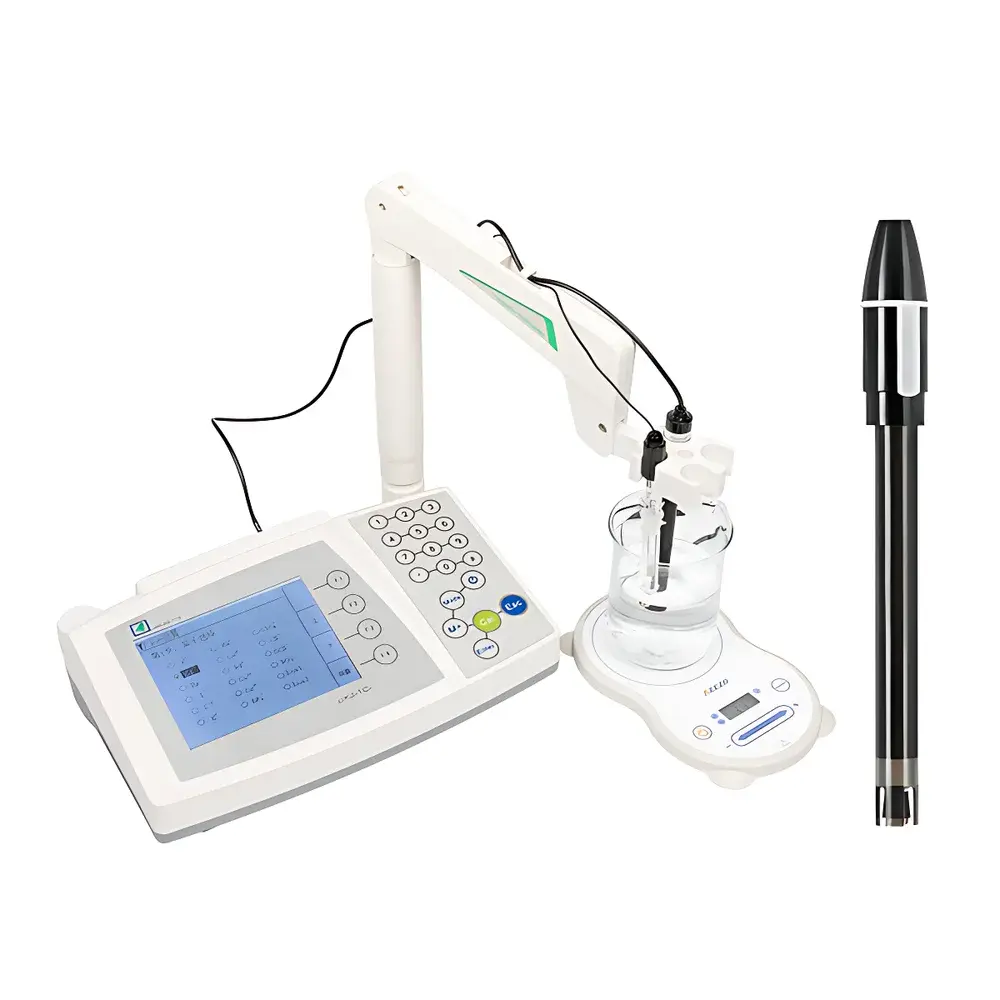
FangZhou PXJ-1C+ Cyanide Ion Analyzer
| Brand | FangZhou |
|---|---|
| Origin | Sichuan, China |
| Manufacturer Type | Authorized Distributor |
| Product Category | Domestic |
| Model | PXJ-1C+ Cyanide Ion Analyzer |
| Instrument Type | Benchtop |
| Ion Measurement Range | 0–99,999 ppm |
| Detection Limit | 9,999 ppm |
| Response Time | 3 s |
| Measurement Accuracy | ±0.5% FS ±1 digit |
| Temperature Range | −20.0 to 135.0 °C |
| Resolution | 0.001 pH / 0.01 mV / 0.1 °C |
| Data Storage | 4096 sets |
| GLP Compliance | Yes |
| Calibration Points | 2–9 points (ion), up to 5 points (pH) |
| Input Impedance | ≥3 × 10¹² Ω |
| Interfaces | BNC electrode port, Pt1000/NTC temperature input, USB, RS-232, 0–20 mV analog output |
Overview
The FangZhou PXJ-1C+ Cyanide Ion Analyzer is a benchtop potentiometric ion analyzer engineered for precise, trace-level quantification of cyanide (CN⁻) and other target anions in aqueous environmental and industrial samples. It operates on the principle of ion-selective electrode (ISE) potentiometry—measuring the potential difference between a cyanide-specific ISE and a stable reference electrode, then converting the Nernstian response into concentration via calibration curves. Designed for compliance-driven laboratories, the instrument supports full traceability per GLP requirements and integrates seamlessly into regulated water quality testing workflows, including wastewater discharge monitoring, drinking water safety verification, and electroplating effluent analysis. Its robust architecture accommodates routine use in municipal labs, environmental consulting firms, and industrial QA/QC departments where reproducibility, data integrity, and multi-parameter flexibility are critical.
Key Features
- High-resolution 0.001 pH / 0.01 mV measurement capability with user-selectable resolution modes for pH, mV, ORP, and ion concentration
- Dual-display real-time clock and date stamping—ensuring unambiguous temporal metadata for every stored measurement record
- Extended ion calibration support: 2–9 point non-linear standard curve generation using certified cyanide standards, enabling accurate quantification across wide dynamic ranges (0–99,999 ppm)
- Comprehensive ion library: pre-configured parameters for F⁻, Cl⁻, Br⁻, NH₄⁺, NO₃⁻, Na⁺, and 11 additional ions; two user-definable ion profiles with customizable Nernst slope and detection limits
- Multi-unit conversion engine: direct switching among 13 concentration units—including pX, ppm, ppb, mol/L, mmol/L, µmol/L, ng/L, mg/L, g/L, %, µg/L, ppt, and pmol/L—without manual recalculation
- Intelligent ATC (Automatic Temperature Compensation): dual-mode (auto/manual) compensation across −20.0 to 135.0 °C using Pt1000 or NTC sensors; temperature measurement accuracy ±0.2 °C ±1 digit
- GLP-compliant data management: 4096 measurement records with timestamp, electrode ID, calibration history, operator ID, and environmental conditions—all exportable via USB or RS-232
- Integrated diagnostics: real-time electrode impedance monitoring, junction status alerts, and self-test routines for sensor health verification prior to measurement
Sample Compatibility & Compliance
The PXJ-1C+ is optimized for liquid-phase analysis of filtered, clarified aqueous matrices—including surface water, groundwater, treated wastewater, leachate, and process streams. It requires compatible cyanide-selective electrodes (e.g., Ag₂S-based or polymeric membrane ISEs) and appropriate ionic strength adjusters (ISA) to minimize activity coefficient effects. The instrument meets fundamental performance criteria outlined in ISO 10304-1 (determination of anions by ion chromatography—potentiometric detection reference), ASTM D3758 (standard test method for cyanide in water), and EPA Method 335.4 (amperometric titration—used as a comparative validation benchmark). While not a standalone regulatory instrument, its design supports audit-ready documentation aligned with ISO/IEC 17025 laboratory accreditation requirements and internal GLP protocols. All firmware and calibration logs retain immutable timestamps and operator identifiers, satisfying basic FDA 21 CFR Part 11 data integrity expectations for non-critical environmental applications.
Software & Data Management
The included “FangZhou pH-Link” PC software enables bidirectional communication via USB or RS-232, supporting automated data logging, statistical summary generation (mean, SD, RSD, min/max), calibration report export (PDF/CSV), and trend visualization over time. Raw measurement files include embedded metadata: electrode serial number, calibration coefficients, temperature at time of reading, and user-defined sample IDs. The software enforces hierarchical access control (administrator/operator levels), maintains an encrypted audit trail of all configuration changes, and supports batch printing of GLP-compliant certificates of analysis. Data exports comply with LIMS-compatible formats and may be imported directly into Excel, LabWare, or Watson LIMS without format loss. No cloud connectivity or remote access functionality is implemented—ensuring full data sovereignty and alignment with institutional cybersecurity policies.
Applications
- Regulatory cyanide monitoring in municipal wastewater treatment plants (WWTPs) per national discharge permits
- Environmental site assessment (ESA) of former mining or metal-finishing facilities
- Quality control of cyanide-containing plating baths and stripping solutions in electroplating facilities
- Drinking water safety screening in rural distribution systems with historical cyanide contamination risk
- Educational laboratory instruction in analytical chemistry and environmental engineering curricula
- Multi-ion profiling in industrial effluents where co-occurring halides, nitrates, or ammonium may interfere with colorimetric methods
FAQ
Does the PXJ-1C+ measure free cyanide only, or total cyanide?
It measures free cyanide activity via selective electrode response; total cyanide requires acid distillation pretreatment per EPA 414.3 or ISO 6703-1 prior to analysis.
Can it be used with non-cyanide ISEs without recalibration?
Yes—the instrument automatically detects electrode type via BNC interface handshake and loads appropriate calibration templates and Nernst slopes.
Is the 9999 ppm detection limit typical for cyanide ISEs?
This reflects the lower practical limit of reliable detection under field conditions; optimal sensitivity is achieved between 0.1–1000 ppm with proper ISA and deoxygenation.
What power supply specifications are required for continuous operation?
DC 9 V, 500 mA, center-positive polarity; external AC/DC adapter included (CE/FCC certified).
How does the instrument handle ionic strength variations in high-salinity samples?
Users must apply matrix-matched ionic strength adjuster (ISA) solutions during calibration and sample measurement to maintain activity coefficient consistency.







