
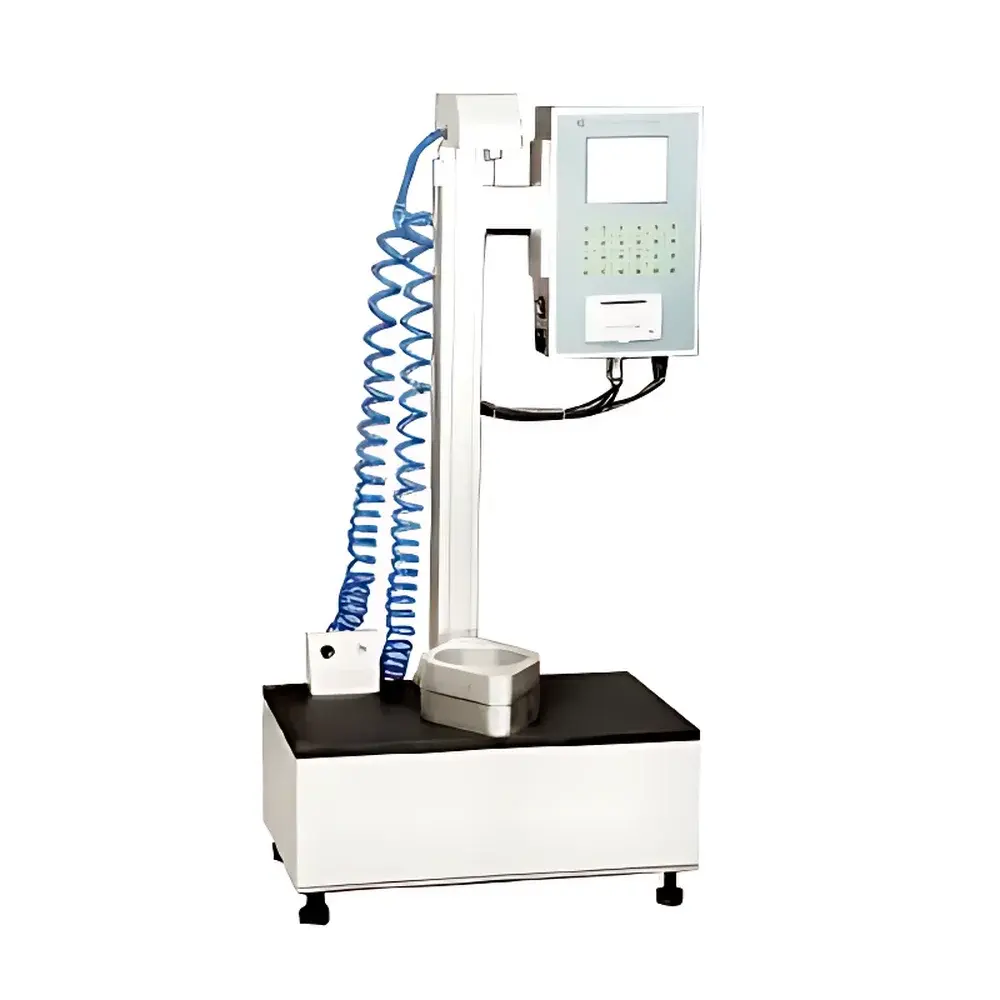
GBPI GBD-I1 Dart Impact Tester
| Brand | GBPI |
|---|---|
| Origin | Guangdong, China |
| Manufacturer | GBPI Packaging Equipment Co., Ltd. |
| Model | GBD-I1 |
| Instrument Type | Dart Impact Tester |
| Impact Mass Range | 50–2000 g (5 g increments, mass tolerance ≤ ±0.5%) |
| Dart Tip Diameter | A-method: 38 ± 1 mm |
| B-method | 50 ± 1 mm |
| Clamp Dimensions | Outer Ø 150 mm, Inner Ø 125 mm |
| Maximum Drop Height | 1500 mm (standard), 660 mm (low-height configuration) |
| Force Sensor Capacity | 50 kg |
| Test Accuracy | ±1 g |
| Compliance Standards | ISO 7765-1, ASTM D1709, GB/T 9639, GB/T 15267, JIS K7124 |
| Power Supply | AC 220 V, 50 Hz |
| Dimensions (L×W×H) | 650 × 650 × (2200–2600) mm |
| Net Weight | 50 kg |
Overview
The GBPI GBD-I1 Dart Impact Tester is a precision-engineered instrument designed for quantitative evaluation of impact resistance in thin polymeric films, foils, and laminated sheets used across flexible packaging, medical device packaging, and industrial barrier material applications. It operates on the classical free-fall dart impact principle—where a standardized weighted dart is dropped from a defined height onto a horizontally clamped specimen—and measures the critical mass at which 50% of test specimens fail (i.e., puncture or rupture). This method delivers reproducible, statistically robust data essential for QC/QA laboratories validating material toughness under dynamic mechanical stress. The GBD-I1 supports both ISO 7765-1 A-method (38 mm dart) and B-method (50 mm dart), enabling compliance with global regulatory testing protocols across North America, Europe, and Asia.
Key Features
- Two standardized test configurations: A-method (50–2000 g, 38 mm dart) and B-method (300–2000 g, 50 mm dart), fully aligned with ASTM D1709 and ISO 7765-1 requirements.
- High-precision mass calibration: Stainless-steel darts with certified weights (50–2000 g in 5 g increments); mass accuracy maintained within ±0.5% per NIST-traceable verification procedures.
- Adjustable drop height mechanism: Dual-height capability—1500 mm for standard high-energy impact assessment and 660 mm for controlled low-energy evaluation—both mechanically stabilized to minimize lateral deviation (<0.5° angular tolerance).
- Integrated pneumatic clamping system: Uniform 150 mm outer / 125 mm inner diameter specimen holder ensures consistent radial tension and eliminates edge slippage during impact.
- Onboard LCD interface with embedded microprocessor: Real-time display of test parameters, automatic pass/fail classification, statistical summary (mean, SD, CV%), and direct thermal printing of test reports.
- Robust structural architecture: Heavy-duty steel frame with vibration-dampening base; total unit weight of 50 kg ensures operational stability during repeated high-momentum impacts.
Sample Compatibility & Compliance
The GBD-I1 accommodates flat, non-porous specimens up to 150 mm in diameter and thicknesses ranging from 12 µm to 500 µm—including biaxially oriented polypropylene (BOPP), polyester (PET), polyethylene (PE), metallized films, and co-extruded barrier structures. All test procedures adhere strictly to the sample conditioning, mounting, and failure criteria defined in ISO 7765-1, ASTM D1709 (Method A & B), GB/T 9639-2008, GB/T 15267-1994, and JIS K7124. The instrument’s mechanical design and sensor calibration are validated against national metrological standards, supporting audit readiness for GLP-compliant laboratories and ISO/IEC 17025-accredited testing facilities.
Software & Data Management
While the GBD-I1 operates as a standalone hardware platform with embedded firmware, its thermal printer outputs include full traceability metadata: date/time stamp, operator ID (manually entered), test method selected (A/B), dart mass, drop height, number of specimens tested, number of failures, and calculated 50% failure mass (Em). For labs requiring digital archiving, GBPI provides optional RS-232 serial output (with TTL-level compatibility) to interface with LIMS or custom data acquisition software. All printed reports meet minimum documentation requirements for FDA 21 CFR Part 11–aligned environments when paired with procedural SOPs governing manual entry and signature verification.
Applications
- Quality control of roll-to-roll extruded films prior to lamination or metallization.
- Comparative impact performance screening during polymer formulation development (e.g., LDPE vs. mLLDPE blends).
- Validation of seal integrity in thermoformed trays subjected to vertical drop hazards in distribution simulation.
- Regulatory submission support for medical packaging per ISO 11607-1 Annex C impact criteria.
- Benchmarking of recycled-content films against virgin resin baselines under identical test conditions.
- In-process monitoring of corona treatment efficacy via correlation between surface energy and post-treatment impact resilience.
FAQ
What standards does the GBD-I1 fully support?
ISO 7765-1, ASTM D1709 (Methods A and B), GB/T 9639, GB/T 15267, and JIS K7124.
Is compressed air required for operation?
Yes—the pneumatic clamping system requires an external clean, dry air supply (recommended pressure: 0.5–0.7 MPa). Air source is user-supplied.
Can the instrument be calibrated in-house?
Mass calibration requires certified reference weights traceable to national standards; height measurement should be verified using a calibrated tape measure or laser distance meter per ISO/IEC 17025 guidelines.
What is the recommended maintenance schedule?
Daily visual inspection of dart tip wear and guide rod lubrication; quarterly verification of clamp actuation force and annual load cell recalibration by authorized service provider.
Does the GBD-I1 comply with FDA 21 CFR Part 11 requirements?
The base unit does not include electronic signature or audit trail functionality; however, it supports compliant documentation when integrated into a validated LIMS environment with procedural controls.



