
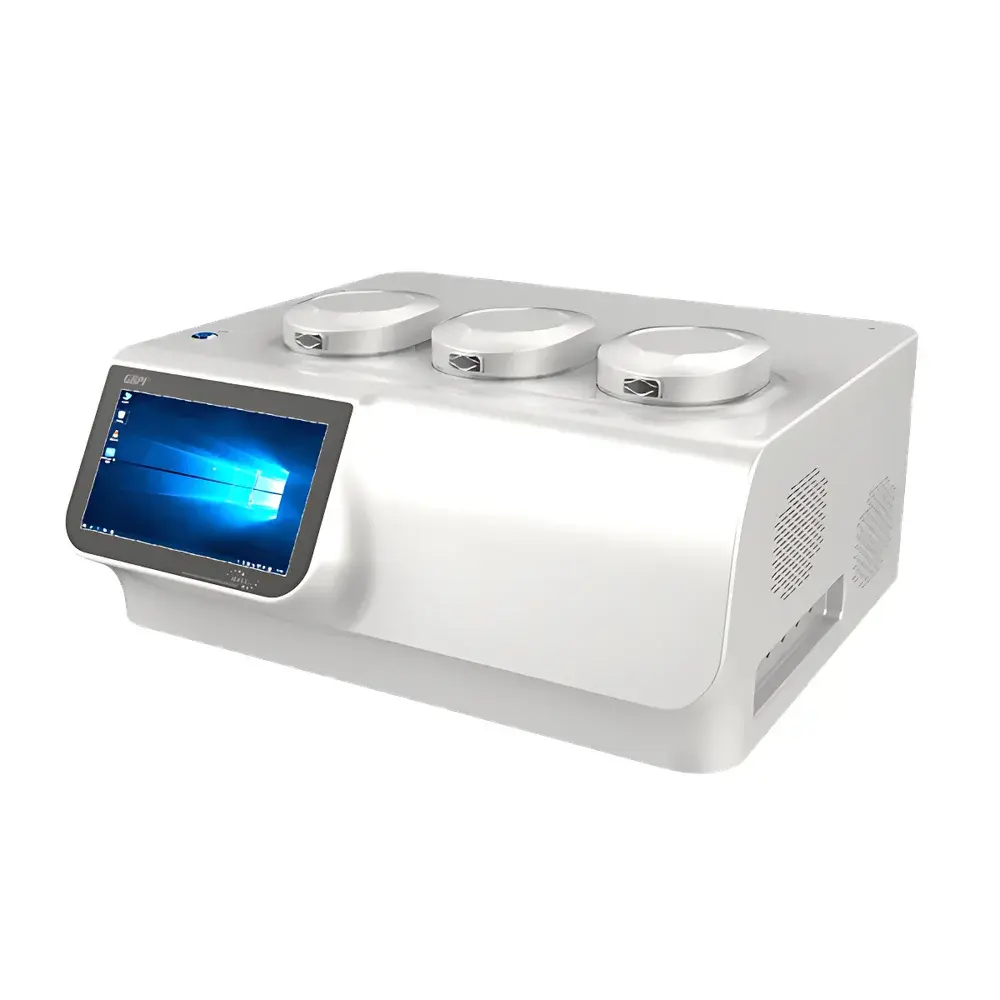
GBPI W413 2.0 Infrared-Based Water Vapor Transmission Rate (WVTR) Tester
| Brand | GBPI |
|---|---|
| Origin | Guangdong, China |
| Manufacturer Type | Direct Manufacturer |
| Origin Category | Domestic (China) |
| Model | GBPI W413 2.0 |
| Quotation | Upon Request |
| Test Principle | Infrared Moisture Detection |
| Standards Compliance | GB/T 26253-2010, ASTM F1249-2013, ISO 15106-2:2005, JIS K7129-2008, YBB 00092003-2015 |
| Measurement Range | 0.002–500 g/(m²·24h) |
| Resolution | 0.001 g/(m²·24h) |
| Temperature Control Range | 15–45 °C |
| Temperature Accuracy | ±0.1 °C |
| Humidity Control Range | 0% RH (dry gas), 30–90% RH, and 100% RH |
| Humidity Accuracy | ±1% RH |
| Test Area | 50.24 cm² |
| Specimen Diameter | Φ100 mm |
| Max Specimen Thickness | ≤3 mm |
| Sample Capacity | 3 specimens per test cycle |
| Carrier Gas | Ultra-high-purity nitrogen (99.999%), ≥0.1 MPa supply pressure, 5–100 mL/min flow rate |
| Pneumatic Clamping Pressure | ≥0.3 MPa |
| Power | 750 W, AC 220 V, 50 Hz |
Overview
The GBPI W413 2.0 is a high-precision, infrared-based Water Vapor Transmission Rate (WVTR) tester engineered for quantitative determination of moisture permeation through packaging materials and functional barriers. It operates on the principle of non-dispersive infrared (NDIR) detection—where water vapor molecules traversing a conditioned test specimen are carried by a dry nitrogen purge stream into an IR absorption cell. The instrument measures the absolute concentration of H2O in real time via characteristic 2.7 µm wavelength absorption, enabling direct, traceable, and interference-free quantification of transmission flux. Designed in strict accordance with GB/T 26253-2010 and internationally harmonized standards—including ASTM F1249-2013, ISO 15106-2:2005, and JIS K7129-2008—the W413 2.0 delivers metrologically robust data essential for regulatory submissions, shelf-life modeling, and barrier material qualification in regulated industries.
Key Features
- Infrared sensor traceability: Calibrated using NIM-certified national reference standards (GBW(E)130543/4), ensuring measurement accuracy, inter-laboratory comparability, and compliance with ISO/IEC 17025 requirements for certified reference materials.
- Integrated dual-climate control: Electromagnetic programmable temperature regulation (15–45 °C, ±0.1 °C) and dual-stream humidity generation (0%, 30–90%, or 100% RH, ±1% RH) eliminate external environmental chambers—reducing footprint, thermal lag, and calibration drift.
- Automated pneumatic clamping: Consistent 0.3 MPa clamping force ensures uniform sealing across Φ100 mm specimens up to 3 mm thick, minimizing edge leakage and operator-induced variability.
- Self-contained operation: 7-inch color touchscreen interface enables full test initiation, real-time monitoring (temperature, RH, WVTR, carrier gas flow, voltage), and report generation without external PC dependency.
- GMP-aligned software architecture: Compliant with Annex 11 (EU GMP) and FDA 21 CFR Part 11, featuring role-based user permissions, electronic signatures, automated audit trails for all data entries/modifications, and immutable test logs.
Sample Compatibility & Compliance
The W413 2.0 accommodates rigid and flexible planar specimens—including polymer films (LDPE, PET, BOPP), metallized substrates (aluminum foil, vacuum-deposited AlOx), multilayer laminates, pharmaceutical blister foils, medical device pouches, solar backsheet films, and OLED encapsulation barriers. Its 50.24 cm² test area and three-position sample holder support comparative batch testing under identical climatic conditions. For non-planar packaging (e.g., bottles, trays, sachets), optional custom fixtures enable perimeter-sealed testing per ASTM F1249 Annex A2 methodology. All hardware and firmware comply with electromagnetic compatibility (EMC) and electrical safety standards IEC 61326-1 and IEC 61010-1. Instrument validation documentation—including IQ/OQ protocols, uncertainty budgets per GUM (JCGM 100:2008), and standard operating procedures—is provided to support GLP/GMP audits.
Software & Data Management
GBPI’s proprietary WinWVTR v3.2 software provides ISO 15106-compliant calculation algorithms (per gravimetric and sensor-based methods), automatic baseline correction, and dynamic range optimization. Raw sensor output, climate parameters, and calculated WVTR values are stored in an embedded SQL database with timestamped metadata (operator ID, calibration status, environmental deviation flags). Reports conform to 21 CFR Part 11 requirements: digitally signed PDF exports include full audit trail overlays, revision history, and instrument identification. Data export supports CSV, XML, and LIMS-compatible ASTM E1384 formats. Remote diagnostics and firmware updates are supported via secure TLS-encrypted Ethernet connection—no cloud storage or third-party data routing.
Applications
- Quantitative barrier validation of food packaging films for shelf-life prediction (e.g., snack bags, coffee pouches, dairy lids)
- Accelerated stability testing of pharmaceutical blister packs and cold-chain transport containers per ICH Q1A(R2)
- Quality control of medical packaging per ISO 11607-1:2019 and AAMI ST77:2022
- R&D evaluation of novel barrier coatings (SiOx, AlOx, graphene oxide composites) and biodegradable substrates
- Compliance verification for electronics encapsulation films (flexible PCBs, OLED displays) per JEDEC J-STD-033
- Regulatory dossier preparation for FDA 510(k), CE Marking (MDR Annex II), and NMPA registration
FAQ
What national metrological certifications does the W413 2.0 hold?
The instrument is manufactured under GBPI’s National Standard Substance Production License (GBW(E)130543/4) issued by the State Administration for Market Regulation (SAMR), and all factory calibrations are performed using NIM-traceable moisture permeation standards.
Is nitrogen purity critical for accurate measurements?
Yes—carrier gas must be ≥99.999% pure nitrogen to prevent interference from CO2, hydrocarbons, or residual moisture in lower-grade gases; impurities compromise IR absorption linearity and increase baseline noise.
Can the system validate test method transfer between laboratories?
Absolutely—the built-in inter-lab comparison mode generates standardized uncertainty reports aligned with ISO 5725-2:2019, supporting multi-site method equivalence studies required for contract manufacturing organizations (CMOs).
Does the software support 21 CFR Part 11-compliant electronic records?
Yes—WinWVTR v3.2 implements full ALCOA+ principles: attributable, legible, contemporaneous, original, accurate, complete, consistent, enduring, and available—with electronic signature workflows, permission-tiered access control, and tamper-evident audit logs archived for ≥25 years.
How is sensor longevity ensured during high-humidity or low-WVTR testing?
The infrared detector features active over-range protection: if signal saturation exceeds 120% of full scale, the system automatically isolates the sensor and triggers alarm—notifying operators before thermal or optical degradation occurs.





