
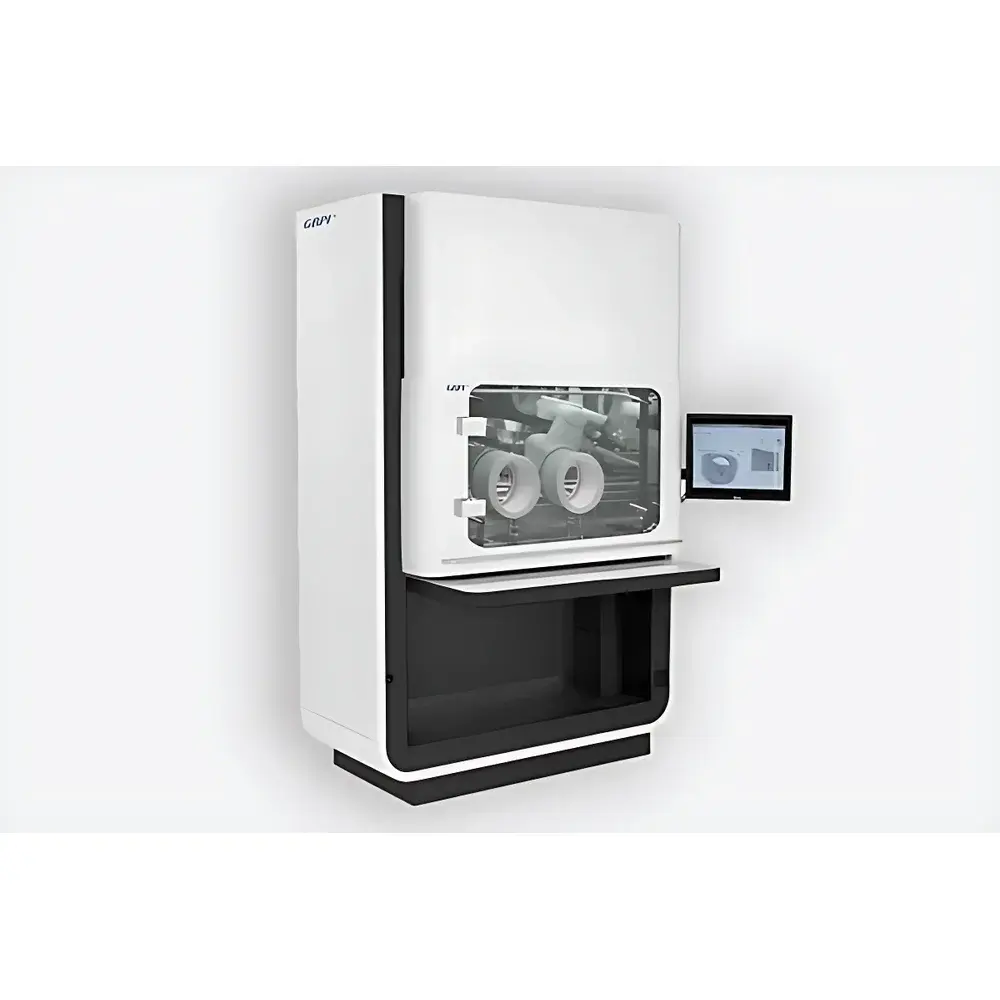
GBPI XF-1000 Bacterial Filtration Efficiency (BFE) Tester for Medical Masks
| Brand | GBPI |
|---|---|
| Origin | Guangdong, China |
| Manufacturer Type | Direct Manufacturer |
| Country of Origin | China |
| Model | XF-10010Q |
| Instrument Category | Aerosol Detector |
| Sampling Flow Rate (A/B) | 28.3 L/min ±2.5% |
| Nebulizer Flow Rate | (8–10) L/min ±2.5% |
| Peristaltic Pump Flow Range | (0.006–3.0) mL/min ±2.5% |
| Pressure Measurement Accuracy | ±2.5% (except aerosol chamber: ±2.0%) |
| Aerosol MMAD | 3.0 ± 0.3 µm, GSD ≤1.5 |
| Andersen Cascade Impactor Stages | 6-stage (I–VI), cutpoints: >7, 4.7–7, 3.3–4.7, 2.1–3.3, 1.1–2.1, 0.6–1.1 µm |
| Aerosol Chamber Dimensions | 600 × 85 × 30 mm (L×Ø×T) |
| Cabinet Negative Pressure | –50 to –200 Pa |
| Aerosol Chamber Negative Pressure | –90 to –120 Pa |
| Temperature Range | –40 to 99 °C ±2.5% |
| Data Storage Capacity | >100,000 test records |
| HEPA Filter Efficiency | ≥99.99% @ ≥0.3 µm |
| Noise Level | <65 dB(A) |
| Power Supply | AC 220 V ±10%, 50 Hz |
| Power Consumption | <1500 W |
| Net Weight | ~150 kg |
Overview
The GBPI XF-1000 Bacterial Filtration Efficiency (BFE) Tester is a fully integrated, regulatory-compliant aerosol testing platform engineered for precise quantification of microbial particle retention performance in medical face masks and filter media. It operates on the principle of controlled aerosol generation, dual-path parallel sampling, and quantitative microbiological enumeration—aligning with the core methodology defined in YY 0469–2004, YY/T 0969–2013, ASTM F2101, ASTM F2100, and EN 14683. The system generates a stable, monodisperse bioaerosol using a calibrated nebulizer delivering Staphylococcus aureus (ATCC 6538) suspension at a mass median aerodynamic diameter (MMAD) of 3.0 ± 0.3 µm and geometric standard deviation (GSD) ≤1.5—ensuring reproducible challenge conditions traceable to international reference protocols. Dual independent 6-stage Andersen cascade impactors (stages I–VI) enable simultaneous upstream (challenge) and downstream (filtered) sampling across six discrete aerodynamic size fractions—from >7 µm down to 0.6–1.1 µm—providing granular insight into size-resolved filtration behavior beyond bulk BFE calculation.
Key Features
- Negative-pressure biosafety cabinet with structural integrity verified per ISO 15193 and WHO Laboratory Biosafety Manual guidelines; cabinet negative pressure maintained between –50 and –200 Pa during operation
- Dual-channel high-precision mass flow control: A- and B-path sampling at 28.3 L/min ±2.5%, independently monitored and stabilized via digital feedback loops
- Integrated peristaltic pump with programmable flow range (0.006–3.0 mL/min, resolution 0.001 mL/min) for consistent agar plate impaction volume delivery
- Microbial aerosol generator optimized for uniform droplet formation and minimal re-aerosolization; nebulizer flow adjustable from 8–10 L/min (±2.5%) with real-time pressure monitoring (0–300 kPa)
- Embedded industrial-grade microcomputer with 10.4-inch high-brightness TFT-LCD touch interface; supports multi-language UI and parameter logging with time-stamped audit trail
- Comprehensive environmental monitoring: real-time measurement of chamber pressure (–90 to –120 Pa), ambient temperature (–40 to 99 °C), and differential pressures across all critical flow paths
- Modular mechanical architecture: height-adjustable support frame (±10 cm), detachable stainless-steel sample holder, and dual-mode casters (lockable for stability / swivel for mobility)
- Integrated safety systems including residual-current circuit breaker (RCCB), insulated thermal barrier between inner/outer cabinet layers, front-access laminated glass viewing window, and internal LED illumination compliant with IEC 61000-4-8 immunity standards
Sample Compatibility & Compliance
The XF-1000 accommodates flat mask materials (including surgical, procedure, and N95-equivalent nonwovens), layered composites, and melt-blown polypropylene filter substrates up to 150 mm × 150 mm. Sample clamping utilizes pneumatic sealing to eliminate edge leakage—critical for ISO/IEC 17025-accredited laboratories performing proficiency testing. All fluidic pathways are constructed from medical-grade 316L stainless steel and borosilicate glass to prevent biofilm adhesion and ensure chemical compatibility with ethanol, isopropanol, and aqueous saline solutions used in viability recovery. The instrument satisfies functional requirements for GLP-compliant validation per OECD Series on Principles of Good Laboratory Practice and supports full 21 CFR Part 11 compliance when paired with GBPI’s optional secure data management module (audit trail, electronic signatures, role-based access control).
Software & Data Management
Control firmware implements deterministic real-time scheduling (RTOS kernel) to guarantee sub-second synchronization across all sensors, actuators, and data acquisition channels. Raw sensor outputs—including flow, pressure, temperature, and timing events—are timestamped at 100 Hz and stored locally in binary-encoded .bin files with embedded CRC-32 checksums. Export functionality supports CSV and PDF report generation (per ASTM E29–23 formatting rules), including calculated BFE (%) = [1 − (CFUdownstream/CFUupstream)] × 100, with automatic uncertainty propagation based on ISO/IEC Guide 98-3 (GUM). Data archives exceed 100,000 complete test records and retain full metadata: operator ID, calibration certificate IDs, environmental logs, and raw impactor stage colony counts. USB 2.0 host port enables encrypted U-disk transfer; network interface (optional) supports TLS 1.2-secured remote diagnostics and firmware updates.
Applications
- Regulatory conformance testing of surgical masks per YY 0469–2004 and EN 14683 Class I/II/Type IIR
- Quality control release testing for disposable medical respirators in ISO 13485-certified manufacturing facilities
- Comparative evaluation of novel electret-charged filtration media under standardized bioaerosol challenge
- Method validation and inter-laboratory comparison studies coordinated by national metrology institutes (e.g., CNAS ILAC-MRA signatories)
- Research into humidity-dependent filtration decay mechanisms using controlled environmental chambers interfaced via analog I/O
- Development of ASTM WK78429 revision inputs related to aerosol deposition efficiency modeling in fibrous networks
FAQ
Does the XF-1000 comply with FDA requirements for BFE testing of Class II medical devices?
Yes—the system meets the technical specifications outlined in FDA Guidance for Industry: “Testing and Labeling of Surgical Masks” (2022), including mandatory use of S. aureus ATCC 6538, 3.0 µm MMAD aerosol, and dual-path Andersen impactor sampling.
Can the instrument be validated for ISO/IEC 17025 accreditation?
Absolutely. GBPI provides full validation documentation packages—including IQ/OQ/PQ protocols, traceable calibration certificates for all flow and pressure transducers (NIST-traceable), and uncertainty budgets aligned with EURACHEM/CITAC Guide CG4.
Is the aerosol chamber compatible with alternative challenge organisms such as Pseudomonas aeruginosa?
Yes, provided the organism suspension meets ISO 8573-1 purity class 1 requirements and viscosity remains within the nebulizer’s operational envelope (1–5 cP); users must perform in-house viability verification per CLSI M22-A3.
What maintenance intervals are recommended for the HEPA filter and impactor stages?
HEPA filters require replacement every 500 operational hours or after 50 bioaerosol tests—whichever occurs first; Andersen stages should be cleaned ultrasonically in 70% IPA after each test series and inspected for orifice deformation per ASTM D1498.
Does GBPI offer on-site installation qualification (IQ) support?
Yes—qualified field service engineers conduct mechanical verification, airflow mapping, pressure decay testing, and software configuration verification per ISO 14644-3 Annex B, with final IQ report issued on company letterhead.







