
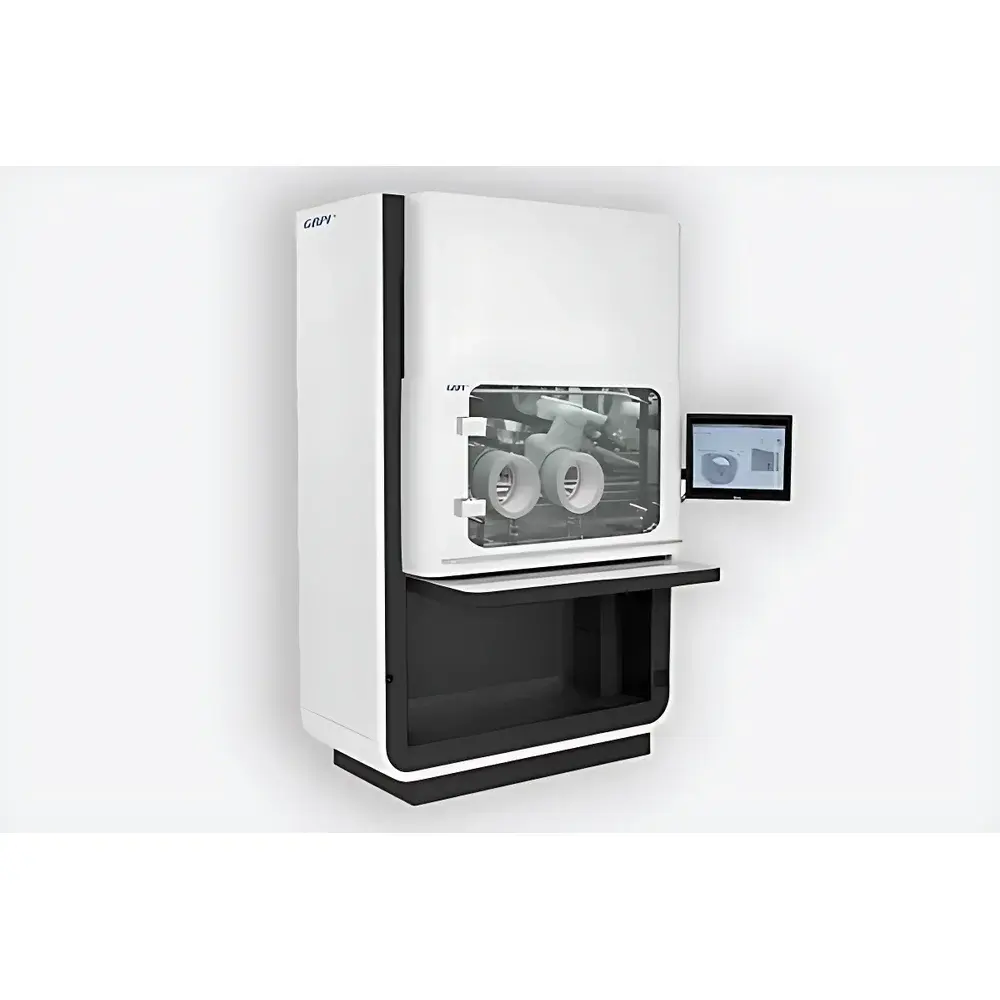
GBPI XF-10010 Bacterial Filtration Efficiency (BFE) Tester for Medical Masks
| Brand | GBPI |
|---|---|
| Origin | Guangdong, China |
| Manufacturer Type | Manufacturer |
| Country of Origin | China |
| Model | XF-10010 |
| Instrument Type | Aerosol Detector |
| A-Path Sampling Flow | 28.3 L/min ±2.5% (0.1 L/min resolution) |
| B-Path Sampling Flow | 28.3 L/min ±2.5% (0.1 L/min resolution) |
| Nebulizer Flow | (8–10) L/min ±2.5% (0.1 L/min resolution) |
| Peristaltic Pump Flow | (0.006–3.0) mL/min ±2.5% (0.001 mL/min resolution) |
| Pressure Before A/B Flowmeters | (−20–0) kPa ±2.5% (0.01 kPa resolution) |
| Pressure Before Nebulizer | (0–300) kPa ±2.5% (0.1 kPa resolution) |
| Ambient Temperature Range | (−40–99) °C ±2.5% (0.1 °C resolution) |
| Aerosol Chamber Negative Pressure | (−90–−120) Pa ±2.0% (0.1 Pa resolution) |
| Cabinet Negative Pressure | −50 to −200 Pa |
| Data Storage Capacity | >100,000 test records |
| Vortex Mixer | 8 × Φ16×150 mm tubes |
| HEPA Filter Efficiency | ≥99.99% for particles ≥0.3 µm |
| Aerosol Generator MMAD | 3.0 ± 0.3 µm, GSD ≤1.5 |
| Andersen Six-Stage Impactor Cut Points | Stage I >7 µm, II: 4.7–7 µm, III: 3.3–4.7 µm, IV: 2.1–3.3 µm, V: 1.1–2.1 µm, VI: 0.6–1.1 µm |
| Aerosol Chamber Dimensions | 60 cm (L) × 8.5 cm (Ø) × 3 cm (T) |
| Positive Control Target | 2200 ± 500 CFU |
| Cabinet Ventilation Flow Rate | ≥5 m³/min |
| Cabinet Door Size | W1000 × D730 mm |
| Main Unit Dimensions | W1180 × D650 × H1300 mm |
| Adjustable Stand Dimensions | W1180 × D650 × H600 mm (±10 cm height adjustment) |
| Noise Level | <65 dB(A) |
| Weight | ~150 kg |
| Power Supply | AC 220 V ±10%, 50 Hz |
| Power Consumption | <1500 W |
Overview
The GBPI XF-10010 Bacterial Filtration Efficiency (BFE) Tester is a fully integrated, dual-path aerosol challenge system engineered for standardized quantitative assessment of bacterial particle retention performance in medical face masks and surgical mask materials. It operates on the principle of controlled microbial aerosol generation, simultaneous comparative sampling across two parallel Anderson six-stage impactors, and colony-forming unit (CFU) enumeration — in strict accordance with YY 0469–2004, YY/T 0969–2013, ASTM F2100, ASTM F2101, and EN 14683. The instrument generates a polydisperse Staphylococcus aureus (or equivalent) bioaerosol with a mass median aerodynamic diameter (MMAD) of 3.0 ± 0.3 µm and geometric standard deviation (GSD) ≤1.5, simulating realistic respiratory droplet nuclei. Dual independent 28.3 L/min sampling streams ensure high reproducibility and statistical confidence in filtration efficiency calculation: BFE (%) = [1 − (CFUdownstream/CFUupstream)] × 100. All critical airflow paths are maintained under precisely regulated negative pressure to prevent operator exposure and cross-contamination.
Key Features
- Negative-pressure biosafety cabinet design compliant with ISO 14644-1 Class 5 (ISO Class 5) ambient containment; integrated leakage detection and audible/visual alarm for pressure deviation
- Dual-channel Andersen six-stage cascade impactor system with individually calibrated flow control for upstream (challenge) and downstream (filtrate) sampling
- High-fidelity microbial nebulizer delivering stable, repeatable aerosol output (8–10 L/min) with adjustable droplet size distribution and minimal wall loss
- Embedded industrial-grade microcomputer controller with real-time PID regulation of all pneumatic parameters and full audit trail logging
- 10.4-inch high-brightness capacitive touchscreen interface supporting multilingual operation, parameter presetting, and live trend visualization
- Integrated peristaltic pump (0.006–3.0 mL/min, 0.001 mL/min resolution) for precise collection fluid delivery to agar plates or liquid impingers
- HEPA filtration (≥99.99% @ 0.3 µm) on exhaust line and recirculation path, validated per ISO 14644-3
- Thermally insulated, flame-retardant double-wall construction with front-access laminated safety glass door (W1000 × D730 mm)
- Modular, height-adjustable support stand (±10 cm range) with dual-mode casters (lockable for stability, swiveling for mobility)
- Comprehensive electrical safety: built-in RCD (residual current device), overcurrent protection, and grounded chassis per IEC 61010-1
Sample Compatibility & Compliance
The XF-10010 accommodates flat mask material specimens (typically 100 mm × 100 mm or circular 90 mm diameter) mounted in standardized holders conforming to ASTM F2101 Annex A. It supports both solid-phase (agar plate) and liquid-phase (buffered peptone water) collection methods. All operational parameters—including aerosol chamber pressure (−90 to −120 Pa), cabinet static pressure (−50 to −200 Pa), and environmental temperature (−40 to 99 °C)—are continuously monitored and logged to satisfy GLP (Good Laboratory Practice) and ISO/IEC 17025 documentation requirements. The system meets electromagnetic compatibility (EMC) standards per CISPR 11 and safety certification per IEC 61010-1. Data integrity complies with FDA 21 CFR Part 11 principles through secure user authentication, electronic signatures, and immutable audit trails stored in non-volatile memory.
Software & Data Management
The embedded control software provides full lifecycle test management: method setup (flow rate, duration, nebulization interval), real-time sensor monitoring (pressure, temperature, flow), automated pass/fail evaluation against user-defined BFE thresholds (e.g., ≥95% per YY 0469), and export-ready reporting. Raw data—including timestamped flow values, pressure differentials, and CFU counts per impactor stage—are stored in CSV and PDF formats. USB 2.0 interface enables encrypted data transfer to external drives without network connectivity, preserving air-gapped security in regulated QC environments. Firmware updates are performed via signed firmware packages to maintain configuration traceability and prevent unauthorized modification.
Applications
- Regulatory conformance testing of surgical masks, procedure masks, and respirator filter media per YY/T 0969–2013 and ASTM F2101
- Quality assurance in medical PPE manufacturing facilities during batch release and process validation
- Research and development of novel filtration materials, electrospun nanofibers, and antimicrobial-coated textiles
- Reference laboratory calibration and inter-laboratory comparison studies coordinated by NIM (National Institute of Metrology) or CNAS-accredited bodies
- Evaluation of mask degradation under humidity, mechanical stress, or repeated washing cycles
- Supporting ISO 13485-certified quality management systems through documented measurement uncertainty analysis
FAQ
What microbial strain is recommended for BFE testing?
Staphylococcus aureus ATCC 6538 is the reference organism specified in ASTM F2101 and YY 0469–2004; alternative strains must be justified and validated per ISO 17025.
Can the XF-10010 perform viral filtration efficiency (VFE) testing?
No — the system is configured and validated exclusively for bacterial aerosols. VFE requires separate biosafety level (BSL-2/3) containment, different challenge agents (e.g., bacteriophage Φ6), and modified impaction protocols not supported by this platform.
Is third-party calibration certification included with purchase?
Yes — each unit ships with a factory-issued calibration certificate traceable to NIM (China National Institute of Metrology) for all primary sensors (mass flow meters, pressure transducers, temperature probes).
How often should the HEPA filter be replaced?
Under normal operation (≤4 hrs/day), replacement is recommended every 12 months or after 1,000 test cycles, verified by in-situ dioctyl phthalate (DOP) leak testing per ISO 14644-3.
Does the system support automated CFU counting integration?
The XF-10010 outputs standardized agar plate images and raw CFU inputs; integration with commercial colony counters (e.g., Synbiosis ProtoCOL, iQ-Scan) is possible via CSV import but requires external hardware and validation per user’s SOP.







