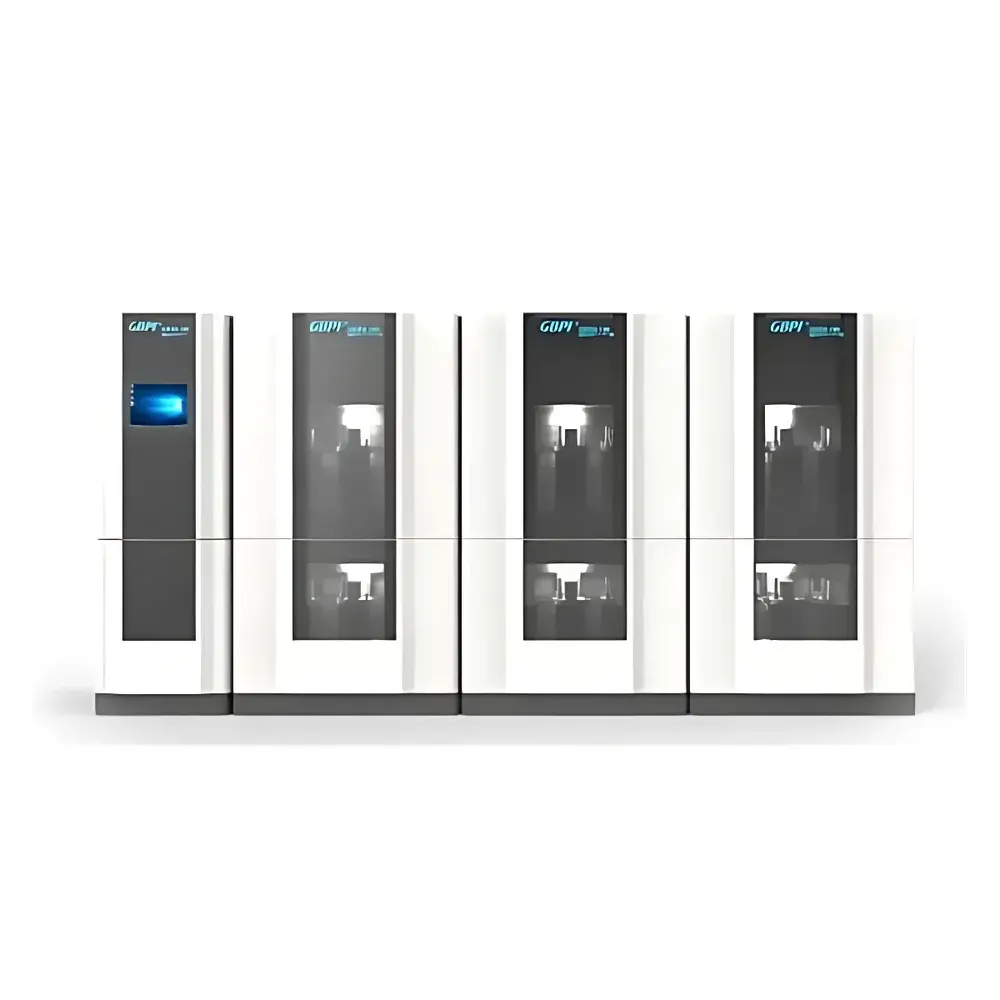
GBPI GBDA-180K Automated Composting Biodegradation Testing System
| Brand | GBPI |
|---|---|
| Origin | Guangdong, China |
| Manufacturer Type | OEM Manufacturer |
| Country of Origin | China |
| Model | GBDA-180K |
| Price Range | USD 112,000 – 252,000 (based on EUR/USD exchange rate and typical export pricing) |
| Mass Measurement Resolution | ±0.01 g |
| Gas Flow Rate Range | 0.01–10 L/min |
| Reactor Volume | 500 mL |
| Maximum Number of Simultaneous Reactors | 18 |
| Temperature Control Range | Ambient to 80 °C |
| Temperature Control Accuracy | ±0.5 °C |
| CO₂ Detection Range | 0–10,000 ppm |
| CO₂ Detection Accuracy | ±40 ppm (0–3,000 ppm), ±2% FS (3,000–10,000 ppm) |
| O₂ Detection Range | 0–25% vol |
| O₂ Detection Accuracy | ±1% FS |
| Pressure Detection Range | 0–200 kPa |
| Pressure Detection Accuracy | ±1% FS |
| Gas Supply Pressure | 0.2–0.8 MPa |
| Power Supply | AC 220 V, 50 Hz |
| Total Power Consumption | 3,000 W |
| Dimensions (W×D×H) | 3600 × 810 × 1930 mm |
| Weight | 1,100 kg |
Overview
The GBPI GBDA-180K Automated Composting Biodegradation Testing System is a high-precision, multi-channel respirometric instrument engineered for standardized determination of ultimate aerobic biodegradability of organic materials under controlled composting conditions. It operates on the principle of dynamic respirometry: test specimens—typically polymers, additives, or packaging materials—are mixed with mature compost inoculum and incubated in sealed, temperature-regulated reactors under continuous aeration. Microbial metabolism converts organic carbon into CO₂, H₂O, mineral salts, and new biomass. The system quantifies cumulative CO₂ evolution via infrared (NDIR) gas analysis, enabling calculation of biodegradation percentage relative to theoretical CO₂ yield (ThCO₂) as defined in ISO 14855-1 and ASTM D5338. Designed for compliance-driven laboratories, the GBDA-180K supports fully automated, parallel testing across up to 18 independent reaction vessels—each equipped with dedicated mass flow control, real-time CO₂/O₂ monitoring, and programmable agitation—ensuring statistical robustness and inter-laboratory reproducibility.
Key Features
- Eighteen independently controlled reaction channels, each with individual gas flow regulation (0.01–10 L/min), CO₂ sensing, and temperature management.
- PID-based fuzzy logic temperature control (ambient to 80 °C, ±0.5 °C accuracy) across all chambers, with integrated thermal uniformity verification.
- High-stability NDIR CO₂ sensors (0–10,000 ppm range; ±40 ppm @ low end, ±2% FS at full scale) and electrochemical O₂ sensors (0–25% vol, ±1% FS).
- Automated gas-tightness validation routine prior to each test cycle, ensuring integrity of closed-loop respirometry.
- Programmable mechanical stirring per reactor, configurable for frequency, duration, and rest intervals to simulate natural compost turnover.
- Modular hardware architecture with field-replaceable sensor modules, calibrated flow controllers, and user-accessible metrological verification protocols.
- Role-based access control (administrator, operator, observer) with password authentication and granular permission assignment for method, data, and system configuration.
Sample Compatibility & Compliance
The GBDA-180K accommodates solid and particulate test materials—including films, foams, fibers, and granules—with particle size compatibility down to <20 µm (e.g., TLC-grade cellulose reference material). Each 500 mL reactor accepts standardized inoculum-to-specimen ratios per ISO 14855-1 and GB/T 19277.1. The system is validated for use with common inocula such as activated vermiculite-compost blends and meets functional requirements for ASTM D6400 (compostable plastics), JIS K 6953, and OECD 301B respirometric endpoints. All electronic records comply with ALCOA+ principles and support 21 CFR Part 11–aligned audit trails—including system-level, method-level, and run-level event logging—with immutable timestamps and user attribution.
Software & Data Management
The embedded GBPI BioDecayStudio™ software provides a validated, Windows-based platform for test method definition, real-time parameter visualization (CO₂ evolution curves, O₂ depletion, pressure drift), and automated biodegradation kinetics modeling. Users define test parameters—including incubation duration (up to 180 days), sampling interval (1–60 min), temperature ramp profiles, and blank/reference allocation—via intuitive wizards. Raw sensor data are stored in encrypted SQLite databases with checksum integrity checks. Reporting modules generate GLP-compliant PDF and Office-compatible outputs containing calibration certificates, raw time-series data, ThCO₂ calculations, and pass/fail determinations against regulatory thresholds (e.g., ≥90% biodegradation within 180 days). Audit trail exports include all user actions, parameter changes, and data modifications with digital signatures.
Applications
This system serves quality assurance and R&D laboratories in polymer manufacturing, packaging development, regulatory testing bodies (e.g., CNAS-accredited labs), and academic research centers focused on sustainable materials science. Typical use cases include: verification of conformity to EN 13432 and ISO 17088; comparative degradation profiling of PHA, PLA, PBAT, and starch-blend formulations; kinetic modeling of microbial colonization and carbon mineralization rates; validation of industrial composting facility feedstock compatibility; and generation of data for environmental product declarations (EPDs) and life cycle assessment (LCA) inputs. Its 18-channel capacity enables statistically powered experimental designs—such as triplicate samples + controls across multiple timepoints—within a single instrument run.
FAQ
What international standards does the GBDA-180K support out-of-the-box?
The system natively supports test protocols aligned with ISO 14855-1, ASTM D5338, ASTM D6400, GB/T 19277.1, and JIS K 6953—including automatic calculation of % biodegradation vs. ThCO₂ and reporting templates formatted to each standard’s annex requirements.
Can the system operate unattended for extended durations (e.g., 180-day tests)?
Yes. With redundant power supply monitoring, automated daily self-diagnostics, and local data buffering (72 h minimum), the GBDA-180K maintains uninterrupted operation over multi-month cycles without manual intervention.
Is sensor recalibration performed in situ or requires external equipment?
All critical sensors (CO₂, O₂, pressure, mass flow) support on-board zero/span calibration using certified gas standards and internal reference masses—no disassembly or third-party tools required.
How is data integrity ensured during regulatory audits?
Full 21 CFR Part 11 compliance is achieved via electronic signatures, immutable audit logs, role-based access restrictions, and cryptographic hashing of all raw datasets—validated per ICH GCP and ISO/IEC 17025 documentation requirements.
What maintenance intervals are recommended for long-term operational reliability?
Preventive maintenance is scheduled every 6 months, including flow controller verification, NDIR optical path cleaning, and seal integrity inspection—documented in the included maintenance logbook and supported by GBPI’s global service network.
Related Products