
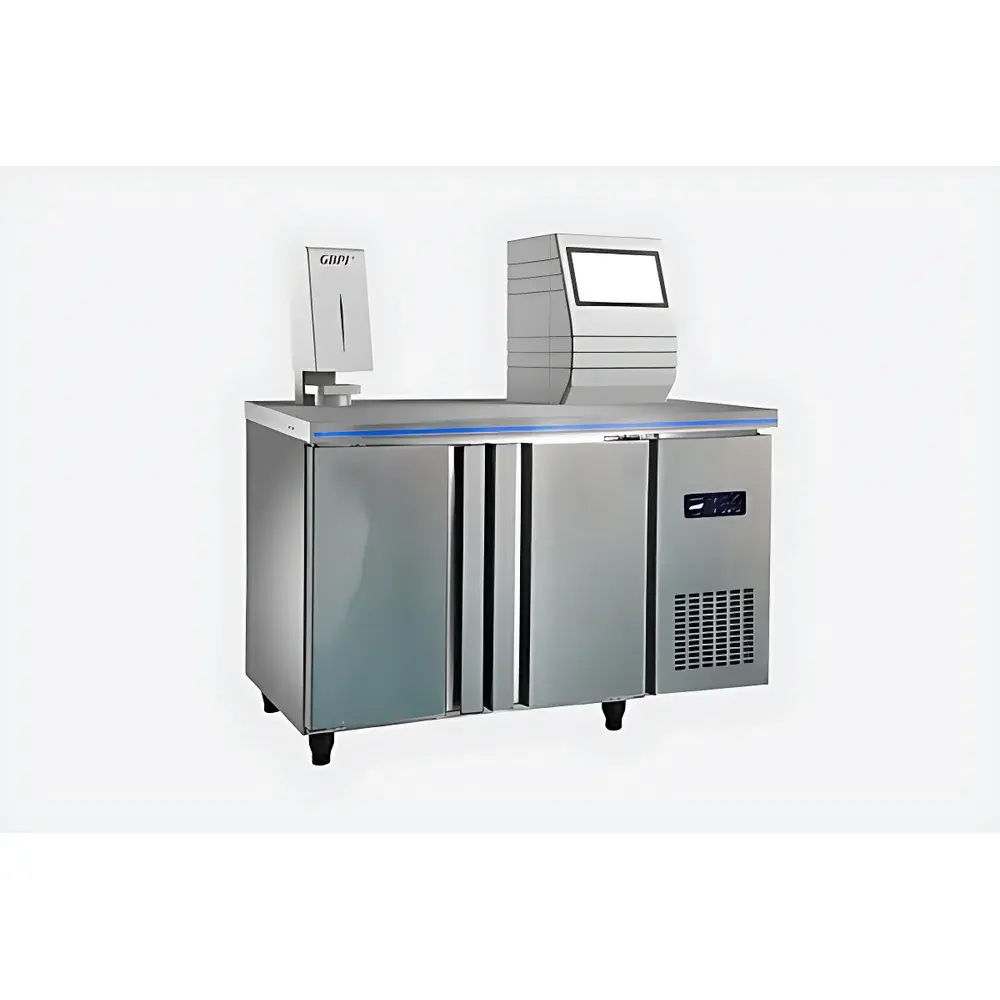
GBPI GB-KF30010E Aerosol Filtration Efficiency Tester
| Brand | GBPI |
|---|---|
| Origin | Guangdong, China |
| Manufacturer Type | Direct Manufacturer |
| Country of Origin | China |
| Model | GB-KF30010E |
| Instrument Type | Aerosol Filtration Efficiency Tester |
| Filtration Efficiency Range | 0–99.999% |
| Aerosol Flow Rate | 10–100 L/min (Accuracy Class 2.5) |
| Sampling Frequency | 1–9999 times/min (adjustable) |
| Test Aerosol Concentration | 20–30 mg/m³ |
| Count Median Diameter (CMD) | NaCl aerosol (0.075 ± 0.02) µm |
| Geometric Standard Deviation (GSD) | NaCl ≤ 1.86 |
| Dynamic Detection Range | 0.001–100 mg/m³ (Accuracy: ±1%) |
| Differential Pressure Sensor Range | 0–500 Pa |
| Dimensions | 460 mm × 525 mm × 1430 mm |
| Power Supply | AC 220 V, 50 Hz |
| Environmental Requirements | 25 °C ± 5 °C, 30 %RH ± 10 %RH |
Overview
The GBPI GB-KF30010E Aerosol Filtration Efficiency Tester is a precision-engineered instrument designed for quantitative evaluation of particulate filtration efficiency (PFE) in respiratory protective devices and filtration media. It operates on the principle of controlled aerosol challenge and real-time differential concentration measurement—using calibrated salt (NaCl) and oil-based aerosols to simulate airborne particulates across relevant aerodynamic diameters. The system complies with internationally recognized test methodologies under Chinese national standards including GB/T 32610–2016 (Daily Protective Masks), GB 2626–2006 (Respiratory Protective Devices), GB 19082–2009 (Medical Protective Gowns), GB 19083–2010 (Medical Surgical Masks), GB 24539–2009 (Chemical Protective Clothing), and YY 0469–2011 (Surgical Masks). Its architecture integrates aerosol generation, conditioning, sampling, and data acquisition into a single, ISO/IEC 17025-aligned platform suitable for GLP-compliant laboratories and regulatory testing environments.
Key Features
- Cold-generation dual-aerosol system: Independent NaCl and oil aerosol generators produce stable, monodisperse or polydisperse challenges per ISO 16890 and ASTM F2299 protocols—enabling compliance with both hydrophilic and hydrophobic particle resistance assessments.
- High-fidelity aerosol metrology: Equipped with traceable PM2.5 sensors and laser particle counters for real-time upstream/downstream concentration monitoring, supporting dynamic range from 0.001 to 100 mg/m³ at ±1% full-scale accuracy.
- Electrostatic neutralization module: Integrated bipolar ionizer ensures charge equilibration of test aerosols prior to filter challenge—critical for eliminating electrostatic enhancement effects and achieving true mechanical filtration assessment per EN 149 and NIOSH 42 CFR Part 84 requirements.
- Leak-tight fluidic path: Entire aerosol pathway—including sample holder, flow ducts, and sensor chambers—is sealed to ISO 10648-2 Class 2 integrity standards, minimizing operator exposure and ensuring containment of hazardous aerosols.
- Automated differential pressure monitoring: Precision 0–500 Pa transducer enables simultaneous measurement of filter resistance at constant airflow (10–100 L/min), supporting pressure drop vs. filtration efficiency correlation analysis required by GB 2626 and ASTM F2100.
- Environmental control integration: Built-in temperature and humidity sensors (±0.5 °C, ±3 %RH) continuously log ambient conditions during test execution, enabling automated flagging of non-conforming environmental windows per standard-defined tolerances (25 °C ± 5 °C, 30 %RH ± 10 %RH).
Sample Compatibility & Compliance
The GB-KF30010E accommodates flat-sheet filtration media (e.g., meltblown nonwovens, electrospun membranes) and finished respirators—including surgical masks, KN95/N95-equivalent facepieces, and medical gowns—via pneumatically actuated clamping fixtures with mechanical overtravel protection. All test configurations adhere to standardized test area (100 cm²), seal integrity, and challenge duration stipulated in GB/T 32610, GB 2626, and YY 0469. The system supports full audit trails compliant with FDA 21 CFR Part 11 when operated with validated software—enabling electronic signatures, user access controls, and immutable data archiving for regulatory submissions.
Software & Data Management
Control and analysis are executed via GBPI’s proprietary Windows-based application, which implements automated sequence programming, real-time curve plotting (efficiency vs. time, ΔP vs. flow), and statistical reporting per ISO/IEC 17025 clause 7.7. Raw sensor outputs, calibration logs, environmental metadata, and operator annotations are stored in encrypted SQLite databases with SHA-256 hashing. Export formats include CSV, PDF test reports (with embedded digital signatures), and XML for LIMS integration. Software validation documentation (IQ/OQ/PQ protocols) is available upon request for GMP and GLP laboratory deployment.
Applications
- Regulatory conformance testing for PPE manufacturers seeking GB, CE, or FDA clearance.
- R&D screening of novel filtration materials (e.g., nanofiber composites, antimicrobial coatings) under controlled aerosol spectra.
- Quality assurance in high-volume mask production lines—supporting SPC charting of batch-wise efficiency drift.
- Third-party certification at national inspection centers (e.g., CNAS-accredited labs) performing type testing per GB 2626–2019 transition requirements.
- Academic research on aerosol–fiber interaction mechanics, including loading behavior, cake formation, and electrostatic decay kinetics.
FAQ
What aerosol types does the GB-KF30010E support for filtration testing?
It supports both sodium chloride (NaCl) and paraffin oil aerosols, generated independently via cold vaporization—meeting the dual-challenge requirement of GB 2626–2019 and EN 149:2001+A1:2009.
Is the system compatible with international standards beyond Chinese national standards?
Yes—the aerosol generation parameters, flow control accuracy, and particle sizing traceability align with ASTM F2299, ISO 16890, and ISO 13374-2, enabling cross-jurisdictional data acceptance.
Can the instrument perform cyclic loading tests to evaluate filter degradation over time?
Yes—programmable sampling frequency (1–9999 cycles/min) and continuous logging allow time-resolved efficiency tracking under sustained aerosol challenge, supporting ISO 16890 dust-holding capacity analysis.
Does the system include validation documentation for regulated environments?
GBPI provides comprehensive IQ/OQ documentation packages, including sensor calibration certificates (NIST-traceable), flowmeter verification records, and software validation summaries aligned with Annex 11 and ALCOA+ principles.
What maintenance intervals are recommended for long-term operational reliability?
Aerosol generator nozzles require ultrasonic cleaning every 50 hours of operation; differential pressure sensors are factory-calibrated annually; and laser particle counters undergo optical alignment verification per ISO 21501-4 every six months.
Related Products







