
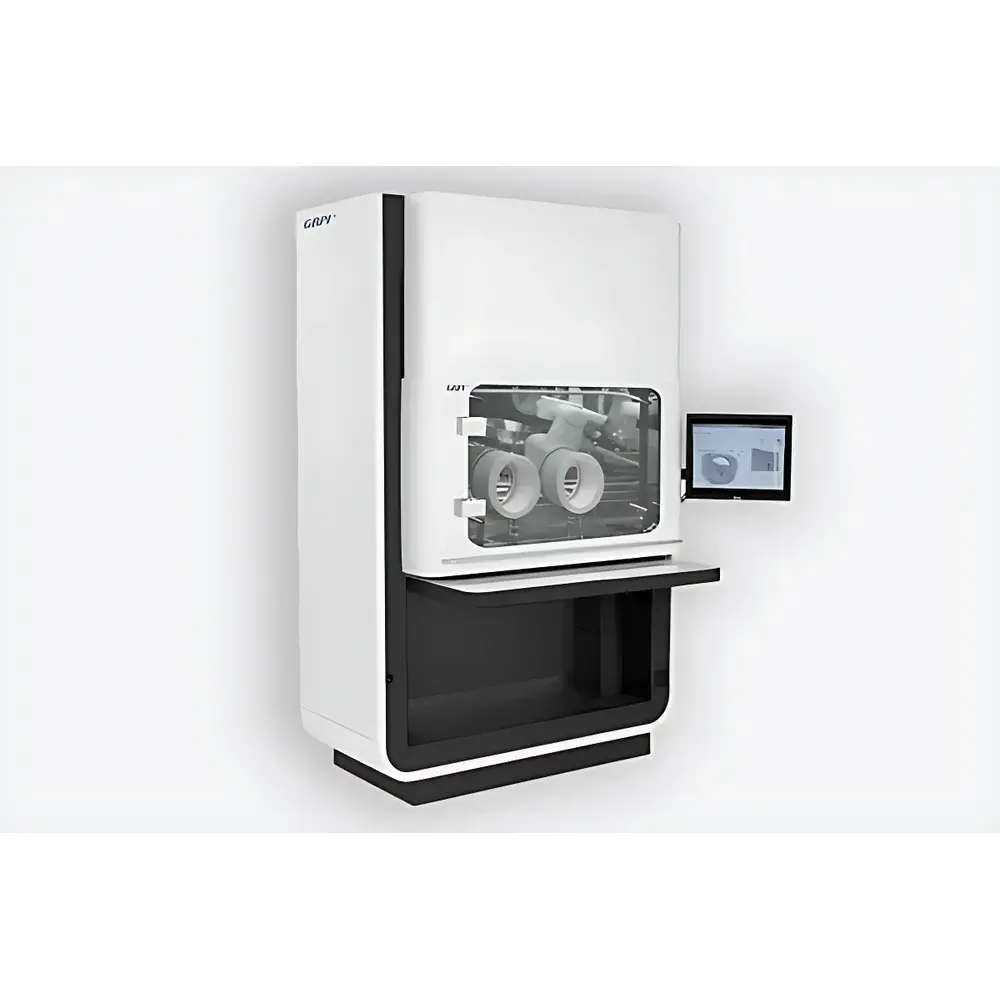
GBPI GB-XF1000D Bacterial Filtration Efficiency (BFE) Tester for Surgical Masks
| Brand | GBPI |
|---|---|
| Model | GB-XF1000D |
| Instrument Type | Aerosol-Based Bacterial Filtration Efficiency Tester |
| Origin | Guangdong, China |
| Manufacturer | Guangzhou GBPI Packaging Testing Instruments Co., Ltd. |
| Compliance | YY 0469–2004, YY/T 0969–2013, ASTM F2100, ASTM F2101, EN 14683 |
| Sampling Method | Dual-Channel Parallel Andersen Cascade Impactor (6-Stage) |
| Aerosol Generation | Monodisperse *Staphylococcus aureus* Bioaerosol (MMAD: 3.0 ± 0.3 µm, GSD ≤ 1.5) |
| Flow Rate (A/B) | 28.3 L/min ±2.5% |
| Spray Flow | 8–10 L/min ±2.5% |
| Peristaltic Pump Flow | 0.006–3.0 mL/min ±2.5% |
| Pressure Control Range | –20 to 300 kPa ±2.5% |
| Aerosol Chamber Negative Pressure | –90 to –120 Pa ±2.0% |
| Cabinet Negative Pressure | –50 to –200 Pa |
| Temperature Measurement Range | –40 to 99 °C ±2.5% |
| Data Storage Capacity | >100,000 test records |
| Display | 10.4″ Industrial Touchscreen |
| Power Supply | AC 220 V ±10%, 50 Hz |
| Max Power Consumption | <1500 W |
| Noise Level | <65 dB(A) |
| Net Weight | ~150 kg |
| Dimensions (Main Unit) | 1180 × 650 × 1300 mm (W×D×H) |
Overview
The GBPI GB-XF1000D Bacterial Filtration Efficiency (BFE) Tester is a fully integrated, negative-pressure-controlled aerosol challenge system engineered for standardized quantitative assessment of bacterial filtration performance in surgical masks and other medical face coverings. It operates on the principle of controlled bioaerosol generation, dual-path parallel sampling, and cascade impaction-based microbial collection—aligned with internationally recognized test protocols including YY 0469–2004, YY/T 0969–2013, ASTM F2101, ASTM F2100, and EN 14683. The instrument generates a stable, monodisperse aerosol of *Staphylococcus aureus* (ATCC 6538P) with a mass median aerodynamic diameter (MMAD) of 3.0 ± 0.3 µm and geometric standard deviation (GSD) ≤ 1.5, ensuring reproducible particle size distribution critical for regulatory-grade BFE evaluation. Two independent 6-stage Andersen cascade impactors operate simultaneously—one upstream (control) and one downstream (test sample)—enabling direct comparative quantification of viable colony-forming units (CFU) before and after filtration. This dual-channel architecture eliminates inter-test variability associated with sequential sampling and supports high statistical confidence in reported filtration efficiency (%) values.
Key Features
- Negative-pressure biosafety cabinet with adjustable airflow (>5 m³/min) and certified cabinet pressure control (–50 to –200 Pa), ensuring operator protection during aerosol handling.
- Dual 6-stage Andersen impactor configuration (A & B paths), each calibrated for precise aerodynamic cut-points: Stage I (>7 µm), II (4.7–7 µm), III (3.3–4.7 µm), IV (2.1–3.3 µm), V (1.1–2.1 µm), VI (0.6–1.1 µm).
- Integrated microbial aerosol generator with programmable spray flow (8–10 L/min) and high-efficiency nebulization, delivering consistent *S. aureus* suspension at defined concentration (2200 ± 500 CFU per sample for positive controls).
- High-precision peristaltic pump (0.006–3.0 mL/min, resolution 0.001 mL/min) for accurate liquid delivery to the nebulizer and sampling media.
- Embedded industrial-grade microcomputer with 10.4″ high-brightness capacitive touchscreen interface, supporting real-time parameter monitoring, method setup, and automated test sequencing.
- Comprehensive environmental sensing: temperature (–40 to 99 °C), chamber pressure (–90 to –120 Pa), and differential pressures across flow paths—all traceably calibrated to ±2.5% full scale.
- Robust mechanical design: insulated double-wall cabinet with flame-retardant materials, height-adjustable stainless-steel support frame (±10 cm), and lockable casters for mobility and stability.
- Compliance-ready data management: onboard storage (>100,000 test records), USB export capability, and audit-trail-capable timestamped logging aligned with GLP/GMP documentation requirements.
Sample Compatibility & Compliance
The GB-XF1000D accommodates standard flat-panel surgical mask specimens (up to 150 mm × 150 mm) mounted in a dedicated holder within the aerosol exposure chamber (600 × 85 × 30 mm). Sample thickness up to 10 mm is supported without flow disturbance. The system meets all physical and procedural requirements specified in YY 0469–2004 (Chinese standard for surgical masks), YY/T 0969–2013 (for disposable medical masks), ASTM F2101 (standard test method for BFE of medical face mask materials), ASTM F2100 (performance specification for medical face masks), and EN 14683 (European standard for medical masks). Its dual-path sampling architecture satisfies ISO/IEC 17025–compliant uncertainty budgeting for microbiological aerosol testing, and its pressure, flow, and temperature subsystems are validated per ISO/IEC 17025 Annex A.2 for measurement traceability.
Software & Data Management
The embedded control software provides intuitive workflow navigation through preconfigured test templates for BFE evaluation under each referenced standard. All operational parameters—including aerosol generation duration, sampling time per stage, pump speed, and environmental setpoints—are programmable and stored with user-defined method IDs. Raw data (flow rates, pressures, temperatures, timestamps) and calculated results (CFU counts, log reduction, % BFE) are logged automatically with digital signatures and immutable timestamps. Export formats include CSV and PDF reports compliant with FDA 21 CFR Part 11 requirements when used in regulated environments. Data integrity is reinforced via internal checksum validation, write-protection options, and optional external network backup via Ethernet (not included).
Applications
- Quality control and batch release testing of surgical masks, procedure masks, and respirator filter media in manufacturing facilities.
- Regulatory submission support for CE marking, NMPA registration, and FDA 510(k) clearance of medical face coverings.
- Method development and validation studies for novel antimicrobial or electrostatically enhanced filtration materials.
- Research on aerosol penetration mechanisms, particle deposition behavior, and filter aging effects under humidified or cyclic loading conditions.
- Proficiency testing and inter-laboratory comparison programs administered by national metrology institutes and accreditation bodies (e.g., CNAS, UKAS).
FAQ
What biological agent is used for BFE testing on the GB-XF1000D?
The system is validated for use with *Staphylococcus aureus* ATCC 6538P suspended in tryptic soy broth, aerosolized to achieve a target concentration of 2200 ± 500 CFU per sample for positive controls.
Does the instrument support testing per ASTM F2101 exclusively, or multiple standards?
It natively supports test configurations for YY 0469–2004, YY/T 0969–2013, ASTM F2101, ASTM F2100, and EN 14683—including automatic calculation of pass/fail criteria per standard-specific thresholds.
How is data integrity ensured during long-term operation?
All measurements are timestamped and stored with firmware-level write protection; USB export generates cryptographically hashed archives; optional audit logs record user login, parameter changes, and test initiation events.
Is routine calibration required, and what traceability does it provide?
Yes—annual calibration of flow meters, pressure transducers, and temperature sensors is recommended using NIST-traceable standards; calibration certificates include uncertainty budgets per ISO/IEC 17025.
Can the system be integrated into a laboratory information management system (LIMS)?
Raw data export via USB or optional RS-232/Ethernet enables integration with third-party LIMS platforms using configurable delimiter-separated files and metadata headers.







