
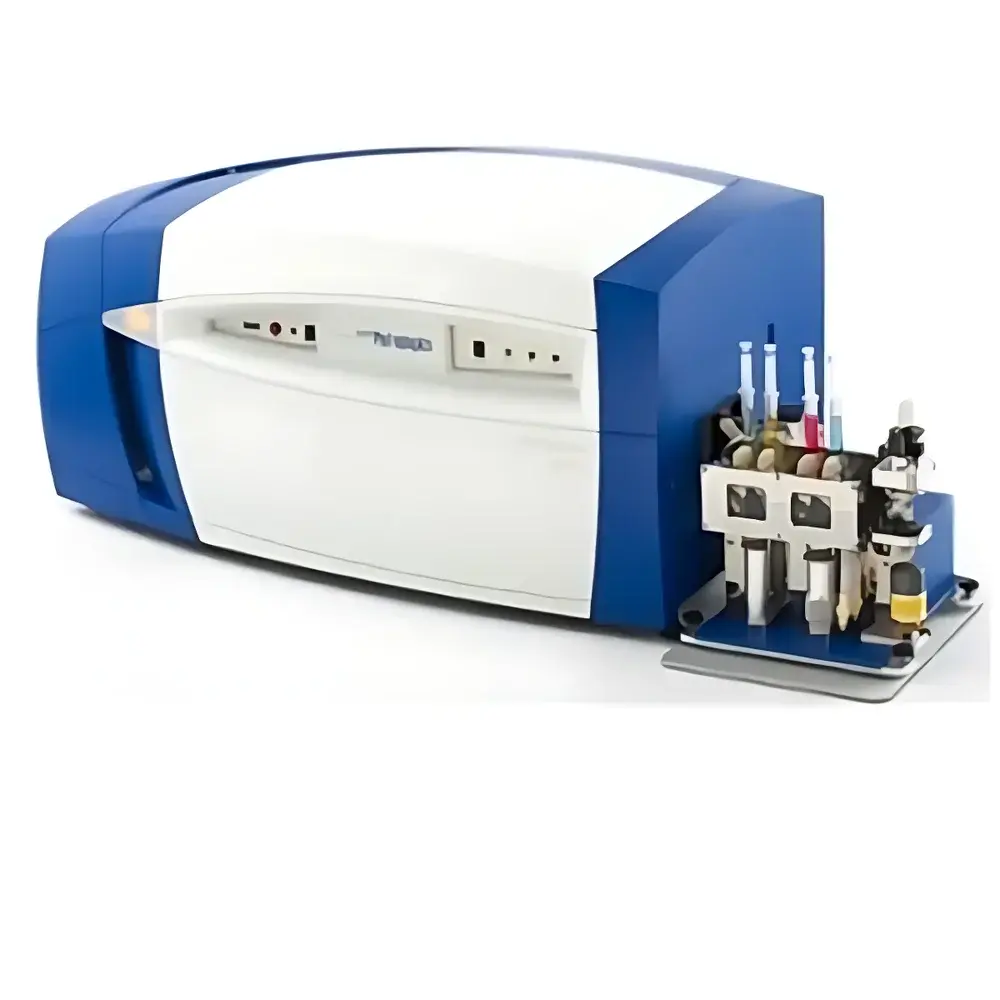
Applied Photophysics Chirascan Stopped-Flow Accessory for Circular Dichroism Spectroscopy
| Brand | Applied Photophysics |
|---|---|
| Origin | United Kingdom |
| Model | Stopped-Flow Accessory for Chirascan CD Spectrometer |
| Instrument Type | Circular Dichroism (CD) |
| Dead Time | ≤1.5 ms |
| Cuvette Volume | 20 µL (switchable 2 mm / 10 mm pathlength) |
| Compatibility | Fully integrated with Chirascan series CD spectrometers |
| Detection Modes | Stopped-flow CD, absorption, fluorescence, fluorescence polarization, diode array, quench-flow |
| Optional Modules | Multi-channel rapid mixing system, dual fluorescence detection, time-resolved absorption |
Overview
The Applied Photophysics Chirascan Stopped-Flow Accessory is a precision-engineered rapid kinetic module designed exclusively for integration with the Chirascan series of high-sensitivity circular dichroism (CD) spectrometers. It enables real-time monitoring of conformational changes and structural transitions in biomolecules—such as proteins, peptides, nucleic acids, and chiral supramolecular assemblies—on millisecond timescales. Based on the proven hydrodynamic stopped-flow principle, the accessory delivers reproducible, low-dead-time mixing (<1.5 ms) to capture transient intermediates and early kinetic phases of fast reactions occurring between 1 ms and 10 ms. Unlike conventional cuvette-based CD measurements, this accessory couples rapid solution mixing with time-resolved CD detection, allowing direct correlation of secondary/tertiary structural evolution with reaction progress—critical for mechanistic enzymology, folding/unfolding kinetics, ligand-binding thermodynamics, and metalloprotein redox equilibria.
Key Features
- Ultra-low dead time of ≤1.5 ms, achieved through optimized syringe geometry, minimal internal volume tubing, and high-precision stepper-motor-driven actuation.
- Integrated 20 µL quartz flow cell with mechanically switchable 2 mm and 10 mm optical pathlengths—enabling flexibility across concentration ranges without hardware reconfiguration.
- Full compatibility with all Chirascan CD spectrometer models (including Chirascan Plus and Chirascan V100), sharing the same detector electronics, signal processing architecture, and optical alignment reference frame.
- Modular expansion capability: supports optional add-ons including dual-channel fluorescence detection, time-resolved UV-Vis absorption (via diode array or photodiode), fluorescence anisotropy, quench-flow configuration, and multi-injection sequential mixing (up to 4 independent reagents).
- Temperature-controlled operation from 4 °C to 80 °C via external recirculating chiller interface—ensuring kinetic data integrity under physiologically or industrially relevant thermal conditions.
Sample Compatibility & Compliance
The accessory accommodates aqueous and organic-aqueous solvent systems commonly used in biophysical characterization, including buffered saline, glycerol/water mixtures, and low-conductivity solvents compatible with CD optics. Sample volumes per experiment range from 50 µL to 200 µL depending on mixing ratio and dead volume optimization. All wetted components are chemically inert (quartz, PEEK, and sapphire), minimizing adsorption artifacts and enabling studies of aggregation-prone or surface-sensitive analytes. The system complies with ISO/IEC 17025 requirements for test equipment validation and supports GLP-compliant workflows when operated with Chirascan’s audit-trail-enabled software (v6.5+). Data acquisition meets FDA 21 CFR Part 11 criteria for electronic records and signatures when deployed in regulated QC/QA environments.
Software & Data Management
Controlled via the industry-standard CD Control software suite (v6.5 or later), the accessory is fully synchronized with spectrometer hardware for simultaneous acquisition of CD, absorbance, and fluorescence signals at user-defined time points. Kinetic traces are recorded with 10 µs temporal resolution and stored in vendor-neutral ASCII or HDF5 formats. Built-in analysis modules support global fitting to multi-exponential models (e.g., A → B → C), singular value decomposition (SVD), and time-dependent secondary structure deconvolution using reference databases (e.g., CONTIN/LL, SELCON3). Raw data files include embedded metadata: timestamp, temperature, mixing ratio, lamp intensity, and detector gain—ensuring full traceability and reproducibility across laboratories.
Applications
- Kinetic analysis of protein folding/unfolding pathways under denaturant or thermal jump conditions.
- Real-time monitoring of ligand-induced conformational switching in GPCRs, kinases, and transcription factors.
- Characterization of RNA aptamer folding and riboswitch activation dynamics.
- Time-resolved CD studies of photoactive proteins (e.g., rhodopsins, cryptochromes) following laser flash excitation (when coupled with optional Q-switched laser trigger interface).
- Quantitative assessment of chiral catalyst formation and enantioselective intermediate accumulation in asymmetric synthesis screening.
FAQ
What is the minimum measurable dead time, and how is it verified?
The nominal dead time is ≤1.5 ms, validated using the standard acetone–iodide chemical reaction (k ≈ 1.2 × 10⁴ s⁻¹ at 25 °C) and confirmed by instrument response function (IRF) measurement using scattered light detection.
Can the accessory be used for non-CD modalities without modifying the Chirascan base unit?
Yes—the accessory shares the same optical train and detector interface; switching between CD, absorption, and fluorescence modes requires only software reconfiguration and appropriate emission filters or grating settings.
Is remote operation supported for unattended kinetic experiments?
Yes, the system supports Ethernet-based command-line control via TCP/IP protocol, enabling integration into automated lab platforms and scheduled overnight acquisition protocols.
Are calibration standards and verification procedures included?
A NIST-traceable quartz polarimeter cell and a set of kinetic validation dyes (e.g., cobalt(II) chloride, cytochrome c) are supplied with full SOP documentation for routine performance qualification.
Does the accessory meet electromagnetic compatibility (EMC) and safety standards for EU and US markets?
Yes—it carries CE marking per Directive 2014/30/EU (EMC) and 2014/35/EU (LVD), and complies with UL 61010-1 and IEC 61010-1:2010 for laboratory electrical equipment safety.



