
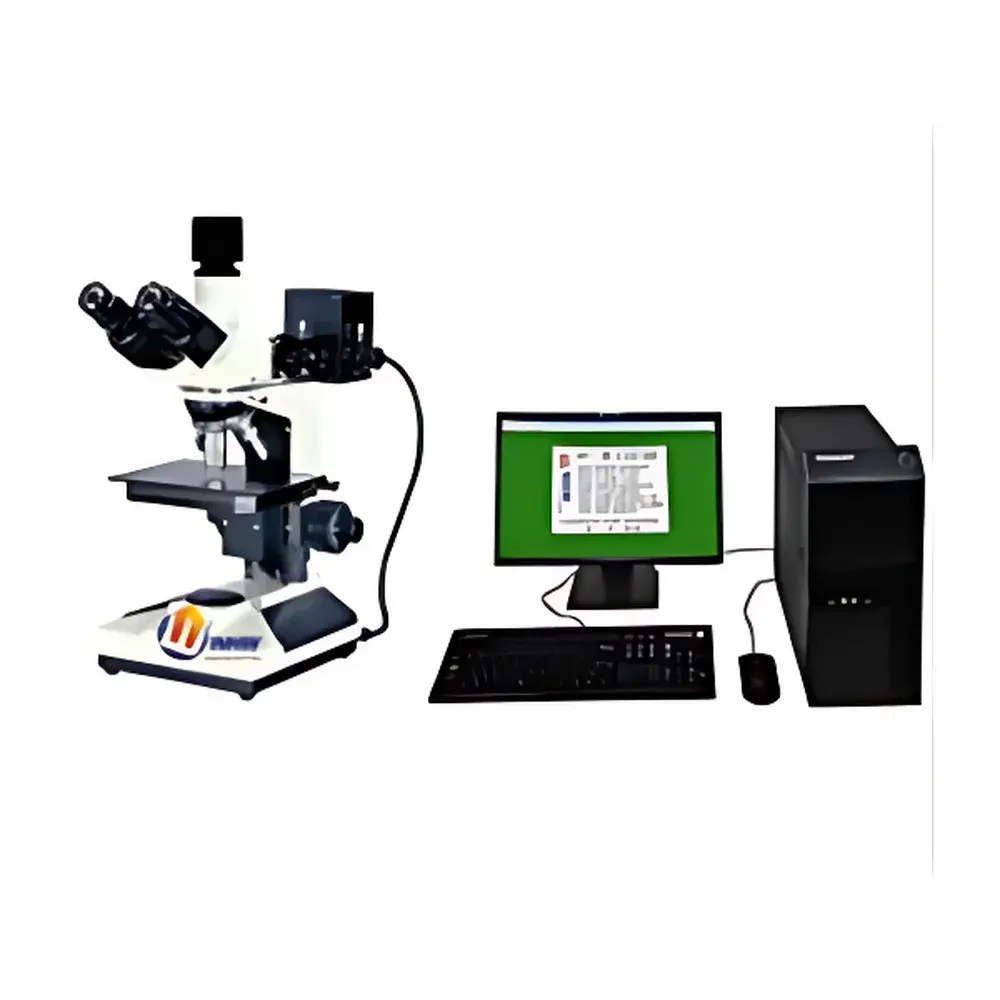
YANRUN MMAS-5 Metallurgical Microscope Measurement & Analysis System
| Brand | YANRUN |
|---|---|
| Origin | Shanghai, China |
| Manufacturer Type | Direct Manufacturer |
| Product Type | Upright |
| Image Analysis System Included | Yes |
| Total Magnification Range | 50× to 600× |
| Eyepieces | Wide-Field WF10X (Φ18 mm) |
| Objectives | PL 5X/0.12, PLL10X/0.25, PLL40X/0.60, PLL60X/0.75 (spring-loaded) |
Overview
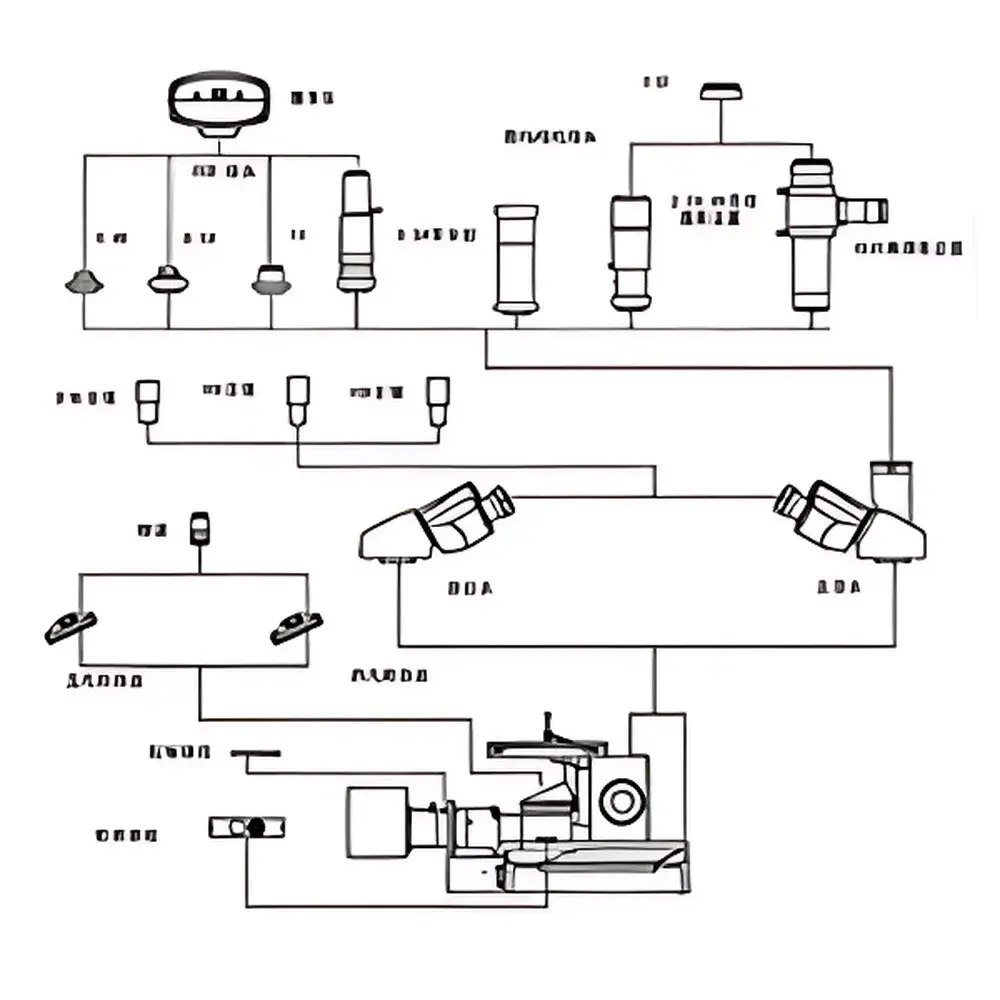
The YANRUN MMAS-5 Metallurgical Microscope Measurement & Analysis System is a precision upright optical instrument engineered for high-fidelity microstructural characterization of opaque specimens—primarily metals, alloys, ceramics, and advanced composites. Designed around Köhler illumination principles and optimized for reflected-light (epi-illumination) observation, the MMAS-5 integrates a robust mechanical platform with an advanced MOS (Modular Optical System) architecture and a fully calibrated digital imaging pipeline. Its optical train employs long-working-distance plan achromat objectives (cover-slip free), wide-field eyepieces, and built-in polarizing optics—including a push-pull polarizer and analyzer—enabling both brightfield, darkfield, and polarized contrast modalities without external accessories. The system meets foundational requirements for metallurgical quality control, failure analysis, phase identification, grain size evaluation, inclusion rating, and coating thickness assessment in compliance with ASTM E112, ASTM E3, ISO 643, ISO 13008, and GB/T 6394 standards.
Key Features
- Upright configuration with triple-port trinocular head (30° inclined), supporting simultaneous visual observation, photomicrography, and video capture at 100% beam-splitting efficiency.
- Four-position objective turret (ball-bearing internal centering); optional five-position turret available for expanded magnification flexibility.
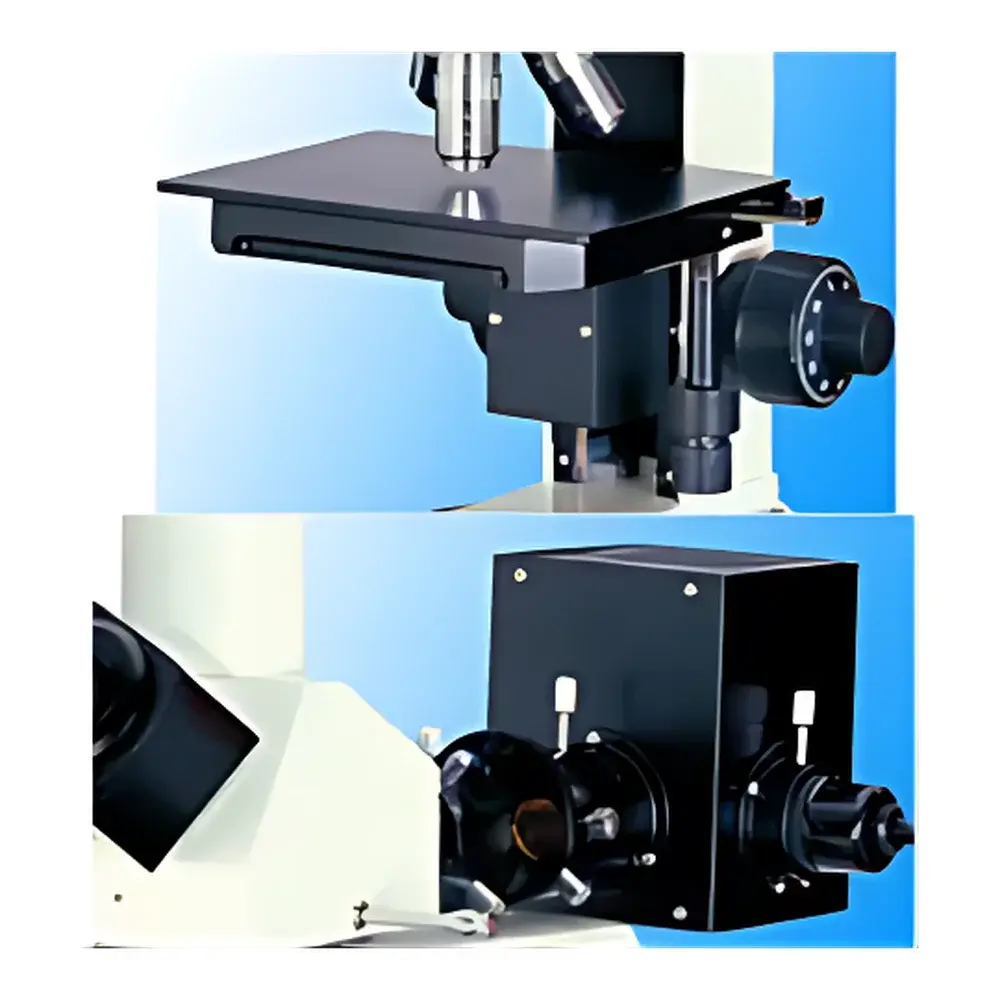
- Dual-layer mechanical stage (185 × 140 mm), offering 75 × 50 mm travel range with vernier-scale positioning and low-friction linear motion.
- Adjustable episcopic illumination system: 6 V / 20 W halogen lamp with continuous brightness control, integrated field and aperture diaphragms, and filter carousel accommodating yellow, blue, green, and ground-glass diffusers.
- Coaxial coarse/fine focusing mechanism with 0.002 mm fine-focus graduation, adjustable coarse-focus tension, dual limit stops, and mechanical lock for vibration-resistant stability during image acquisition.
- Built-in analyzer module in the trinocular tube enables rapid switching between standard and crossed-polarized observation—critical for birefringent phase detection and crystallographic orientation analysis.
Sample Compatibility & Compliance
The MMAS-5 accommodates flat, polished, or etched metallographic specimens up to 30 mm in height and 75 mm in lateral dimension. Its long-working-distance objectives (≥10.2 mm at 10×, ≥3.5 mm at 40×) permit safe observation of rough surfaces, coated samples, and specimens with protruding features—common in failure analysis and additive manufacturing QA. All optical components comply with ISO 10110 surface quality specifications; the system supports GLP-compliant documentation workflows when paired with MMAS software audit trails. While not FDA 21 CFR Part 11–certified out-of-the-box, the MMAS software architecture supports configurable electronic signatures, user access levels, and immutable log files—facilitating alignment with GMP and ISO/IEC 17025 laboratory accreditation requirements.
Software & Data Management
The bundled MMAS (Metallurgical Microscope Analysis System) v5.x software suite provides a validated, standards-based digital workflow for quantitative metallography. It includes over 400 preconfigured modules aligned with ASTM, ISO, GB, and JIS grading criteria—including ASTM E112 (grain size), ASTM E45 (inclusions), ISO 4967 (nonmetallic inclusions), and GB/T 10561 (steel cleanliness). Core capabilities include automated feature recognition (e.g., ferrite/pearlite segmentation), geometric measurement (line, polygon, circle, angle), multi-image stitching, focus stacking (Z-stack synthesis), and pseudo-3D topographic rendering via differential interference contrast (DIC) simulation. Raw image data is stored in TIFF or BMP format with embedded metadata (magnification, objective ID, exposure time, calibration scale). Reports are exportable as PDF or DOCX with customizable templates, revision history, and digital signature fields—ensuring traceability across QA/QC audits.
Applications
- Quantitative grain size analysis per ASTM E112 and ISO 643 in heat-treated steels, aluminum alloys, and titanium grades.
- Inclusion rating and classification (Type A–D, DS) in rolled, forged, or cast metallic components per ASTM E45 and ISO 4967.
- Porosity and defect mapping in powder metallurgy parts, weld zones, and thermal spray coatings.
- Phase distribution quantification (e.g., martensite vs. austenite in TRIP steels) using threshold-based segmentation algorithms.
- Coating thickness verification on electroplated, PVD, or CVD layers via edge-detection profiling.
- Educational use in university materials science labs for hands-on microstructure interpretation and standard-based reporting.
FAQ
Is the MMAS-5 compatible with third-party digital cameras?
Yes—the trinocular port accepts standard C-mount adapters (0.4×, 0.5×, 1× magnification options included), enabling integration with USB3/UVC or GigE industrial cameras meeting GenICam protocol specifications.
Does the system support automated stage scanning or motorized focus?
The base MMAS-5 configuration features manual mechanical controls; however, optional motorized XY stages and Z-axis focus drives can be retrofitted and synchronized with MMAS software via RS-232 or USB HID interfaces.
Can MMAS software generate compliant inspection reports for ISO 9001 audits?
Yes—MMAS supports user-defined report templates, timestamped audit logs, operator ID authentication, and PDF export with embedded calibration certificates—fulfilling key evidence requirements for ISO 9001 clause 8.6 and ISO/IEC 17025 section 7.8.
What calibration standards are recommended for routine verification?
A NIST-traceable stage micrometer (0.01 mm division) and resolution test target (e.g., USAF 1951) are recommended for daily optical validation; annual verification against ISO 10110–5 surface flatness and ISO 9336–2 magnification tolerance standards is advised.
Is training provided for MMAS software operation and method validation?
YANRUN offers remote and on-site application training packages covering software setup, module configuration, measurement uncertainty estimation (per ISO/IEC Guide 98-3), and SOP development for regulated environments.





