
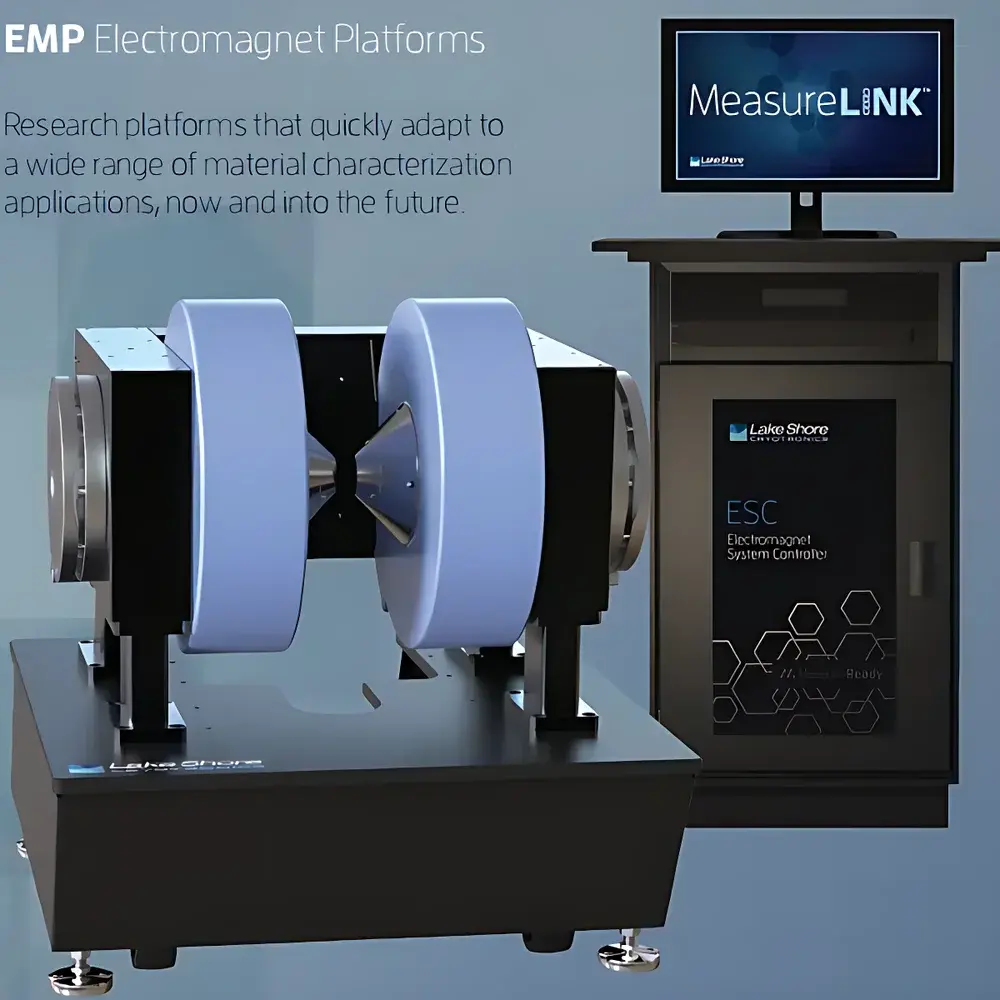
Lake Shore MCS Electromagnet-Based Variable-Temperature Hall Effect Measurement System
| Brand | Lake Shore |
|---|---|
| Origin | USA |
| Manufacturer Type | Authorized Distributor |
| Product Category | Imported Instrument |
| Model | MCS |
| Instrument Type | Variable-Temperature Hall Effect Tester |
| Constant Current Source Range | 1–20 mA |
| Mobility Range | 0.01–10⁶ cm²/V·s |
| Resistivity Range | 1×10⁻⁵ – 1×10⁵ Ω·cm |
| Carrier Concentration Range | 8×10² – 8×10²³ cm⁻³ |
| Typical Measurement Time | <10 s |
| Magnetic Field | 1 T (RT), 0.75 T (77 K) |
| Sample Dimensions (Max) | 10 mm × 10 mm × 3 mm (Solder Card) |
Overview
The Lake Shore MCS Electromagnet-Based Variable-Temperature Hall Effect Measurement System is a precision-engineered platform for quantitative characterization of charge transport properties in semiconductor, thermoelectric, and novel quantum materials. Built around a high-stability 1 T permanent magnet and integrated electromagnet control architecture, the MCS system implements the FastHall® measurement methodology — a proprietary, field-polarity-independent technique that eliminates the need for magnetic field reversal during Hall coefficient acquisition. This enables robust, drift-resistant measurements under static-field conditions, critical for low-mobility or high-resistivity samples where signal-to-noise ratio is inherently limited. The system operates across a defined thermal range, supporting ambient-temperature measurements and optional liquid nitrogen cooling (77 K), facilitating temperature-dependent carrier analysis aligned with fundamental solid-state physics models such as the Mott variable-range hopping or activated conduction regimes.
Key Features
- FastHall® methodology: Single-field, polarity-agnostic Hall coefficient extraction — no mechanical or electronic field reversal required, minimizing thermal drift and contact resistance artifacts
- Wide dynamic range: Simultaneous support for resistances from 10 mΩ to 1 GΩ and carrier mobilities spanning 0.01 to 10⁶ cm²/V·s — suitable for heavily doped semiconductors, wide-bandgap oxides, organic semiconductors, and topological insulator candidates
- Integrated 1 T permanent magnet assembly with calibrated field homogeneity (<±0.5% over 10 mm Ø sample zone) and optional 0.75 T cryogenic field configuration for LN₂-cooled operation
- Dual-probe and van der Pauw compatible sample stages: Precision-machined solder card (10 mm × 10 mm × 3 mm) and pin card (10 mm × 10 mm × 2 mm) holders with gold-plated contacts and thermal anchoring provisions
- Programmable constant-current source (1–20 mA, 0.01% stability) with auto-ranging voltage compliance and real-time current monitoring for accurate sheet resistance determination
- Modular thermal extension: Optional liquid nitrogen cryostat interface enabling single-point 77 K measurements with thermal stabilization time <5 min post-fill
Sample Compatibility & Compliance
The MCS system accommodates standard Hall bar and van der Pauw geometries without requiring lithographic patterning — enabling rapid screening of as-grown thin films, bulk crystals, and printed or solution-processed layers. Its electrical architecture complies with IEEE Std 116–2022 for resistivity and Hall effect measurements in semiconductors, and supports traceable calibration via NIST-traceable reference standards (e.g., Si doped with known arsenic concentration). All measurement sequences adhere to ASTM F76–22 guidelines for Hall effect mobility and carrier concentration determination in electronic materials. Data integrity protocols conform to GLP principles, including operator audit trails, timestamped parameter logging, and immutable raw-data export (CSV, HDF5) — fully compatible with FDA 21 CFR Part 11–compliant laboratory information management systems (LIMS) when deployed in regulated environments.
Software & Data Management
Control and analysis are performed via Lake Shore’s proprietary CryoSoft™ v5.x software suite, running on a dedicated Windows-based workstation included with the system. The GUI provides real-time visualization of Rxx, Rxy, and derived parameters (ρ, RH, μH, nH) with configurable averaging and outlier rejection. Batch measurement workflows support automated temperature sweeps (when cryogenic option is installed), multi-sample queuing, and conditional logic (e.g., pause if resistance exceeds threshold). All datasets include embedded metadata: instrument ID, calibration date, magnetic field value, current magnitude, contact configuration, and environmental temperature. Export formats include CSV (for spreadsheet analysis), MATLAB .mat, and HDF5 (for Python/NumPy integration). Software updates are delivered through secure, authenticated channels and maintain backward compatibility with legacy measurement files.
Applications
- Characterization of low-mobility organic semiconductors (e.g., pentacene, P3HT) and perovskite thin films for optoelectronic device development
- Quantitative evaluation of dopant activation efficiency and compensation effects in SiC, GaN, and AlN power electronics substrates
- Transport property mapping of 2D materials (graphene, MoS₂, Bi₂Se₃) exfoliated or CVD-grown on insulating substrates
- Thermoelectric material screening: simultaneous extraction of σ, S, and κ via integration with Seebeck measurement modules
- Quality assurance in compound semiconductor epitaxy (MBE, MOCVD), including layer uniformity assessment and defect density estimation via mobility vs. temperature trends
- Academic research in strongly correlated electron systems, where anomalous Hall signals require high-fidelity baseline subtraction and low-drift instrumentation
FAQ
Does the MCS system require liquid helium or closed-cycle refrigeration?
No — the base configuration operates at room temperature using a permanent magnet. The optional liquid nitrogen module provides 77 K capability only; no cryocooler or He infrastructure is needed.
Can the MCS perform Hall measurements on non-square van der Pauw samples?
Yes — the software applies geometric correction factors based on user-input dimensions and contact placement, ensuring accuracy for rectangular or irregularly shaped specimens meeting standard four-point probe symmetry requirements.
Is the FastHall® method compatible with AC lock-in detection?
No — FastHall® relies on precision DC current sourcing and nanovolt-level differential voltage measurement. It is optimized for stability and reproducibility rather than noise rejection via modulation; however, its inherent field-independence significantly reduces low-frequency drift compared to conventional alternating-field methods.
What calibration standards are recommended for routine verification?
Lake Shore supplies certified Si reference wafers (n-type and p-type, with certified carrier concentrations of 1×10¹⁵ cm⁻³ and 5×10¹⁶ cm⁻³) traceable to NIST SRM 2136. Annual recalibration of the current source and nanovoltmeter is recommended per ISO/IEC 17025 guidelines.






