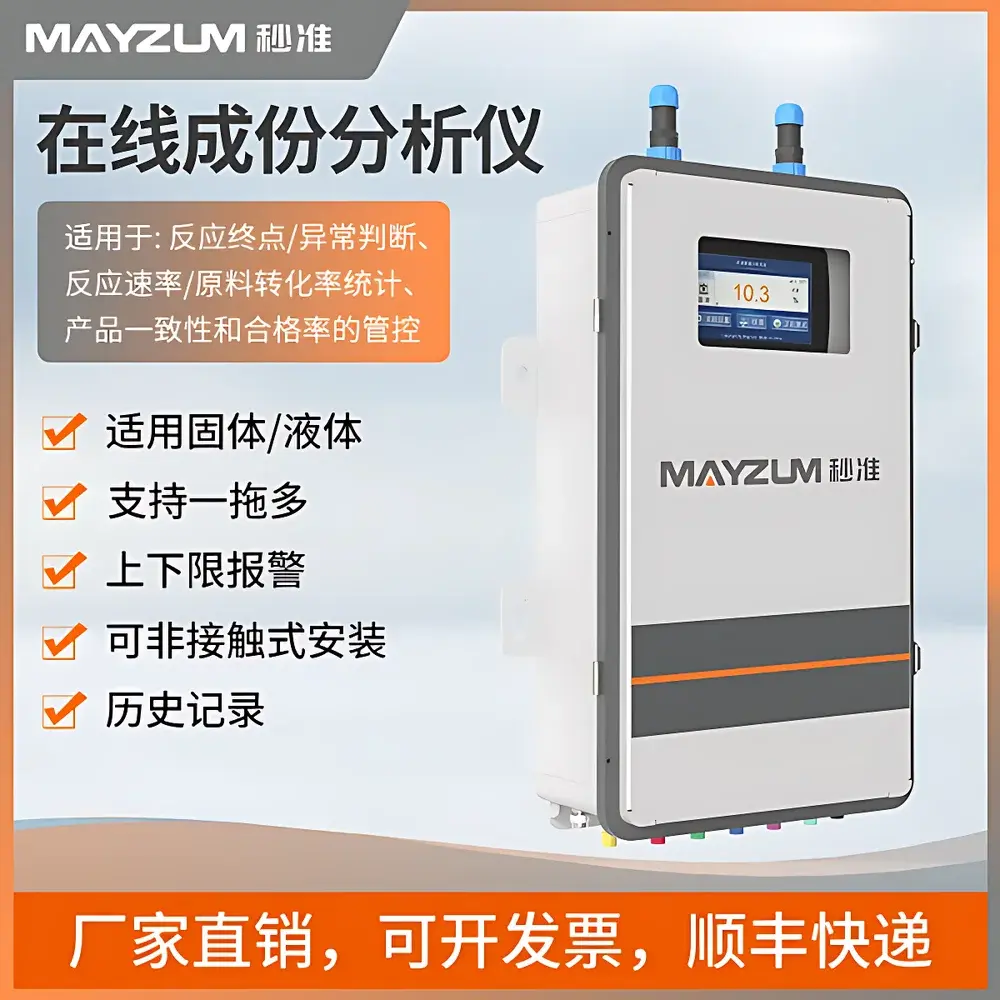
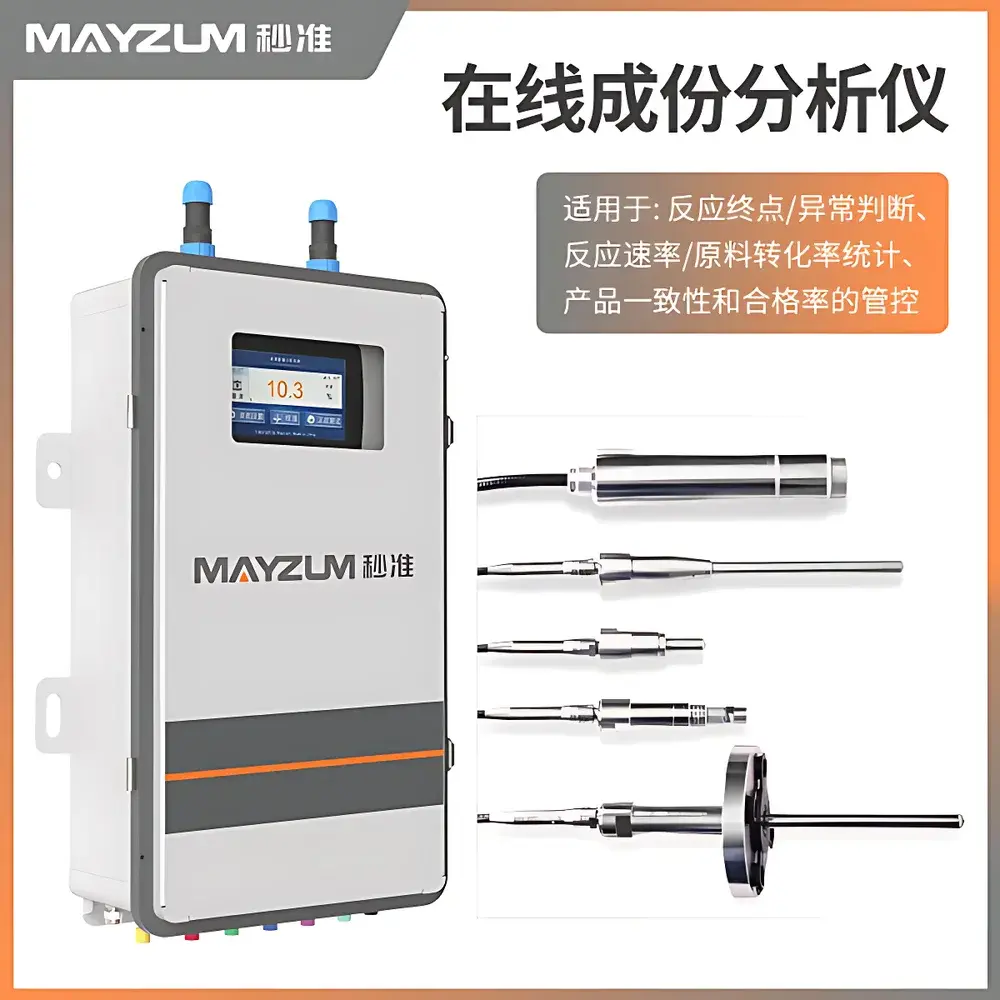
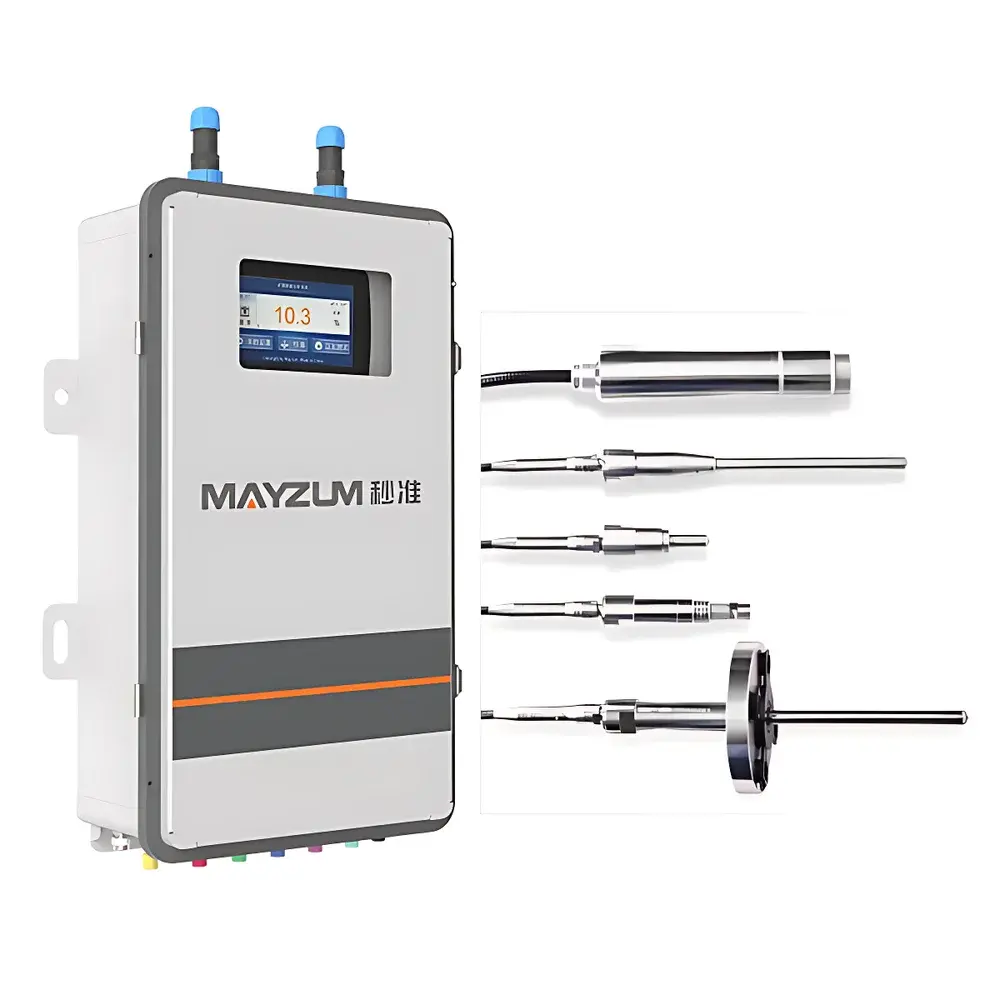
MAYZUM MAZ-Ra300-R4 Alkyl Amino Ester Fuel Additive Online Composition Analyzer
| Brand | MAYZUM |
|---|---|
| Model | MAZ-Ra300-R4 |
| Origin | Guangdong, China |
| Concentration Range | 10 ppm – 99.9% |
| Measurement Temperature | −20 °C to 135 °C |
| Concentration Accuracy | ±10 ppm to ±0.1% (dependent on matrix and calibration) |
| Resolution | 0.01% |
| Sensor Technology | Soft X-ray & Visible Spectroscopy |
| Pressure Rating | ≤1 MPa |
| Environmental Operating Temperature | −10 °C to 130 °C |
| Output Signals | TCP/IP, RS-485/232 (digital), 2-channel relay outputs (high/low limit & fault alarms) |
| Power Supply | 220 V AC, <0.2 A |
| Ingress Protection | IP67 (wetted parts) |
| Display Options | 4.3″ or 8″ embedded touchscreen controller |
| Temperature Compensation | Automatic |
| Channel Capacity | 1–6 configurable detection channels (customizable) |
Overview
The MAYZUM MAZ-Ra300-R4 Alkyl Amino Ester Fuel Additive Online Composition Analyzer is a process-integrated, non-invasive spectroscopic analyzer engineered for real-time quantitative monitoring of alkyl amino ester concentration in hydrocarbon-based fuel formulations and related reaction streams. It employs dual-mode spectral interrogation—combining soft X-ray absorption edge analysis with visible-range optical spectroscopy—to resolve molecular composition changes in complex liquid-phase mixtures without sample extraction or reagent consumption. This hybrid spectral approach enables selective quantification of nitrogen-containing functional groups (e.g., –NH–COOR) characteristic of alkyl amino esters, even in the presence of overlapping hydrocarbon backgrounds, sulfur compounds, or oxidation byproducts. Designed for continuous operation in refinery blending units, additive dosing stations, and pilot-scale synthesis reactors, the system delivers sub-second measurement cycles (<3 s per acquisition) with full temperature compensation across −20 °C to 135 °C process conditions—making it suitable for both ambient storage tanks and high-temperature hydrotreating or nitration lines.
Key Features
- Non-contact, through-container measurement capability—enables direct analysis through quartz, borosilicate glass, or fluoropolymer-lined vessels without process interruption or wetted-part exposure.
- Multi-channel architecture supporting up to six independently calibrated probes on a single controller—ideal for parallel reactor monitoring or multi-point blend verification.
- Corrosion-resistant wetted materials including Hastelloy C-276, PTFE, and M400 alloy—validated for service in acidic, chlorinated, and oxidizing fuel additive environments.
- Embedded real-time chemometric engine with auto-model selection—applies pre-validated PLS or MLR regression models based on stream identity, eliminating manual method switching.
- Integrated alarm logic with dual independent setpoints (HI/LO), flow-loss detection, and dry-probe diagnostics—configured via IEC 61508-compliant safety logic modules.
- Full data traceability: timestamped spectra, raw intensity values, and processed concentration outputs stored locally for ≥3 years; exportable in CSV, HDF5, or OPC UA formats.
Sample Compatibility & Compliance
The MAZ-Ra300-R4 demonstrates robust performance across heterogeneous matrices including homogenous liquid fuels, emulsified blends, viscous catalytic intermediates, and suspended particulate systems (e.g., TiO₂-stabilized dispersions). It is validated for use with organic solvents (methanol, ethanol, acetone), polar aprotic media (DMF, NMP), and aggressive inorganic mixtures (mixed acids, nitrating agents). Regulatory alignment includes support for 21 CFR Part 11 audit trails (electronic signature, change control, user-level access logs), GLP-compliant raw data archiving, and compatibility with ISO 8258 (Shewhart control charts) and ASTM D7462 (standard test method for fuel additive concentration by spectroscopy). All hardware meets IEC 60079-0 (Explosive Atmospheres) general requirements and carries CE marking under the EMC and Low Voltage Directives.
Software & Data Management
The embedded controller runs MAYZUM’s ProcessSpectra™ v4.2 firmware—a deterministic real-time OS with deterministic loop timing (<10 ms jitter). Configuration, calibration, and diagnostics are accessible via local touchscreen (4.3″ or 8″ resistive/capacitive options) or remotely over TLS-secured HTTP/HTTPS, Modbus TCP, or native OPC UA server (compliant with OPC Foundation UA Specification Part 4 & 5). Historical data is indexed by probe ID, timestamp, and batch tag; trend plots support overlay of up to eight parameters (e.g., concentration, temperature, flow status). Firmware updates are performed via signed package deployment with SHA-256 verification. Audit logs record all configuration changes, model uploads, and user authentication events—including failed login attempts—with retention configurable from 90 days to permanent.
Applications
- Real-time endpoint detection in alkyl amino ester synthesis (e.g., transesterification of fatty amines with alkyl chloroformates).
- In-line quality verification during fuel additive blending—ensuring compliance with ASTM D975 Annex A4 specifications for nitrogen content.
- Reaction kinetics profiling in continuous-flow nitration or sulfonation processes where ester stability is thermally sensitive.
- Batch-to-batch consistency monitoring in pharmaceutical excipient manufacturing (e.g., amino ester-based solubilizers).
- Early fault detection in catalyst deactivation scenarios—identified via deviation from expected concentration vs. residence time profiles.
- Regulatory release testing support for GMP-manufactured fuel treatment additives, satisfying ICH Q5C and USP <1058> analytical instrument qualification requirements.
FAQ
Does the MAZ-Ra300-R4 require periodic recalibration?
Yes—calibration frequency depends on process stability and regulatory requirements. Under GMP conditions, initial qualification includes IQ/OQ/PQ; routine verification uses NIST-traceable reference standards every 72 operating hours or per batch, whichever is more frequent.
Can the system interface with DCS or MES platforms?
Yes—native Modbus TCP and OPC UA servers enable bidirectional integration with Emerson DeltaV, Honeywell Experion, Siemens PCS7, and Rockwell FactoryTalk. Optional gateways support legacy DDE or PI System connectors.
Is hazardous area certification available?
Standard units carry ATEX Category 3G (Zone 2) and IECEx Zone 2 ratings. Custom variants with intrinsic safety barriers (e.g., entity-approved for Zone 1) are available upon request with lead-time extension.
What validation documentation is supplied?
Each unit ships with Factory Acceptance Test (FAT) report, spectral calibration certificate (NIST-traceable), material compliance dossier (RoHS/REACH), and electronic copy of IQ/OQ protocol templates aligned with ASTM E2500 and EU Annex 11.
How is temperature-induced spectral drift managed?
The system integrates dual-point thermal referencing: internal blackbody cavity at fixed T_ref and real-time probe-junction thermistor feedback. Spectral correction applies physics-based Beer-Lambert attenuation modeling with temperature-dependent cross-section libraries.
Related Products